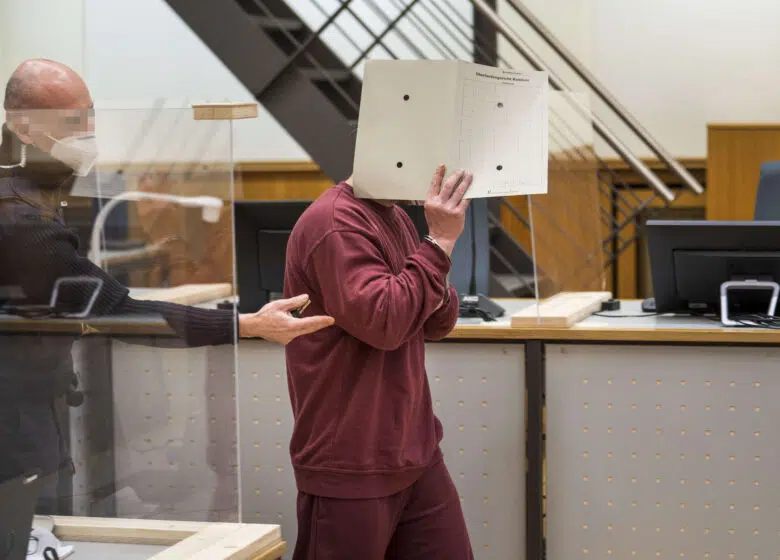
FRANKFURT — Who would have thought that the road to justice in Syria would begin in Frankfurt? And that we might watch as the executioner — who’d been convinced that coming to Germany as a refugee was his escape — was now walking into a German courtroom?
Yes, this place more than 4,000 kilometers from Damascus that’s separated by borders and continents and languages is where Syrian war criminals are pursued, while no such judicial institution or activity is on the case inside the country where the crimes occurred.
For the latest news & views from every corner of the world, Worldcrunch Today is the only truly international newsletter. Sign up here.
In a paradox that is hard to fathom, some of those involved in torture and killings inside Bashar al-Assad’s prisons found themselves — not in safe exile — but in front of German judges reading their files with great patience, listening to the testimonies of their victims in translated languages, and ultimately issuing uncompromising verdicts.
In the city of Koblenz, just west of Frankfurt, the first hearings began — later known as the Al-Khatib Branch trial — after former Syrian Army Colonel Anwar Raslan was arrested in 2019, after seeking asylum in Germany in an attempt to escape his past as the head of one of the most notorious intelligence branches in Damascus. He did not escape accountability — and in January 2022, the court sentenced him to life in prison after convicting him of crimes against humanity, including the torture of more than 4,000 detainees and the killing of 58 individuals inside the branch he headed.
Raslan was not alone — in the same case, Eyad Al-Gharib, a former officer under his command, was sentenced to four and a half years in prison after it was proven he participated in the arrest of peaceful civilians and their transfer to the torture machine of Al-Khatib.
This trial marked a global precedent — the first to examine Syrian regime crimes through independent European legal mechanisms — and opened the door to holding accountable those who thought themselves safe from the law.
Medical torture
After Koblenz, attention turned to Frankfurt — where Syrian doctor Alaa Mousa stood trial on charges of torturing and killing detainees inside regime hospitals. Having worked at the Mezzeh military hospital, Mousa did not deny his presence in Syria during those years, but the testimonies of dozens of colleagues and victims told horrific stories of killings by injection and direct burning using alcohol. After three years of trial, a life sentence was handed down last month, with the crime described as part of a systematic attack on civilians.
In February 2023, Mouaffaq Al-Dahwah — a former member of the “Free Palestine Movement” militia — was sentenced to life imprisonment after being found guilty of firing an anti-tank shell at a gathering of civilians in Yarmouk camp during humanitarian aid distribution — killing four people.
In Hamburg, in December 2024, the court sentenced local militia leader Ahmad H. to ten years in prison after convicting him of running checkpoints responsible for torture, extortion and forced labor against civilians.
There is a consistency of German legal standards in dealing with grave crimes — regardless of perpetrator or political background.
The trials were not limited to those arrested in Germany. In June 2018, authorities issued an international arrest warrant for former Air Force Intelligence director Jamil Hassan, accusing him of overseeing a systematic torture and killing system within his agency’s detention centers during the early years of the Syrian uprising.

The prosecutions also extended to prominent figures from extremist opposition factions — as in the case of Suleiman S., a former member of the “Al-Nusra Front” — who was convicted in 2017 and sentenced to more than three years in prison for his involvement in a kidnapping in Syria. Although his affiliation was not with the regime, his case stands as a key reference for understanding the consistency of German legal standards in dealing with grave crimes — regardless of perpetrator or political background.
Justice, beyond time and place
Germany based its trials on the Code of Crimes Against International Law (VStGB), enacted in 2002 — which grants courts the authority to prosecute perpetrators of war crimes, crimes against humanity and genocide — without the crimes needing to have any direct link to Germany. The principle of universal jurisdiction formed the legal foundation for the earliest Syria-related cases, from the trials of Raslan and Al-Gharib to Alaa Mousa and Mouaffaq Al-Dahwah.
The legal infrastructure would have been fruitless without an institutional backbone.
But the legal infrastructure would have been fruitless without an institutional backbone. The Federal Public Prosecutor’s Office established a special war crimes unit in Karlsruhe, methodically gathering thousands of testimonies from Syrian refugees, analyzing documents, videos and human rights reports as part of the “structural investigation.” It is a process aimed not only at individuals, but at building a comprehensive understanding of the systems behind the violations, such as regime security services and militias.
Alongside that, international and local human rights organizations played a crucial role in building the cases — notably the European Center for Constitutional and Human Rights (ECCHR), the Syrian Center for Media and Freedom of Expression, the Syrian Network for Human Rights and the Caesar Files Group. These groups did more than document — they filed civil lawsuits, translated forensic evidence and arranged meetings between victims and the German public prosecutor.
Individual testimonies — silenced for a decade by fear — became compelling evidence in court. Survivors of torture, doctors under duress and defectors from regime institutions provided detailed accounts of torture orders, killing methods, names of officials and command chains behind this institutionalized violence.
Photos and documents played a pivotal role — most notably the “Caesar” file — smuggled out of Syrian security services — containing thousands of images of detainees who died under torture. These images were not only shown to judges, they served as concrete links between survivors’ testimonies and what happened in Syrian security basements. It was a careful documentation of mass death, dates, names and records, making denial or justification of the crimes impossible.
Recycling regime symbols
While German courts were holding Syrian criminals to account, the streets of Damascus were witnessing a very different scene. Familiar faces from the era of repression were donning new masks — entering through doors of civil peace and community reconciliation — as if nothing had happened.
Syria’s new leaders have pushed a reconciliation processes with former security and military personnel that has sparked widespread controversy: some support it as a way to reduce personal retaliation, and while others insist on arrests and accountability. And some just want a general amnesty.
The storm broke when Major General Talal Makhlouf — a relative of former president Bashar Al-Assad and former commander of the 105th Brigade of the Republican Guard — appeared at the Baath Party headquarters. After handing in his weapon and settling his status with the officers and soldiers from his brigade, he spoke to the media about feeling “safe.”
Makhlouf’s name topped the list of those accused of committing widespread crimes and violations against civilians since the Syrian revolution began in 2011 — when he led the Republican Guard — the most powerful military arm of the former regime.
He is accused of direct participation in massacres, forced displacement and systematic looting in multiple regions, most notably Eastern Aleppo, Ghouta, Wadi Barada and Daraa. His name appeared in a Human Rights Watch report as one of those who gave orders to shoot protesters.

Fadi Saqr — former commander of the “National Defense Forces” militia in Damascus — also re-emerged, suspected of direct involvement in one of the most horrific documented massacres of the Syrian war in the Al-Tadamon neighborhood in 2013. Despite widespread media and human rights outrage after footage of the mass execution was published by The Guardian, no official investigation was opened against him in Syria. He later appeared as a negotiator in a detainee release deal, and as a representative of “national reconciliation.” It was a scene that victims’ families and many survivors found shocking.
In all these cases, the issue is not just the lack of accountability, but the reintegration of these figures into the structure of power and society — as if they were never part of the repression apparatus. Some even appear as voices of reason in times of chaos, as though they had not been part of the chaos when it was backed by arms, influence and loyalty.
Lesson in transnational justice
What Germany has proven is that justice does not need proximity of land as much as it needs a living conscience and a will unafraid of confrontation. There, Syrian testimonies found their way to court — not as cries in the void but as damning evidence — and the images that were once smuggled in secret from death chambers turned into official documents leading to convictions, and pain was not treated as a burden on peace — but as a truth that no future could be built without confronting.
The executioner was not tried because he lost, but because someone decided to tell the truth
In Syria, after everything that has happened, accountability remains postponed, executioners are free and victims’ voices are left suspended in the air — classified either as part of chaos — or a threat to “national consensus.”
The executioner was not tried because he lost, but because someone decided to tell the truth and insisted on it, until the judge said: Yes, what happened was a crime. And that alone — even if it does not end the suffering — was enough to give victims a measure of justice.
Justice is neither a luxury nor a threat; it is the only ground on which anything real can be built. Between a country that opens the files — even if thousands of kilometers away — and one that cannot look its victims in the eye, the question remains: Can Syria be born anew if it does not begin its next life from the truth?