
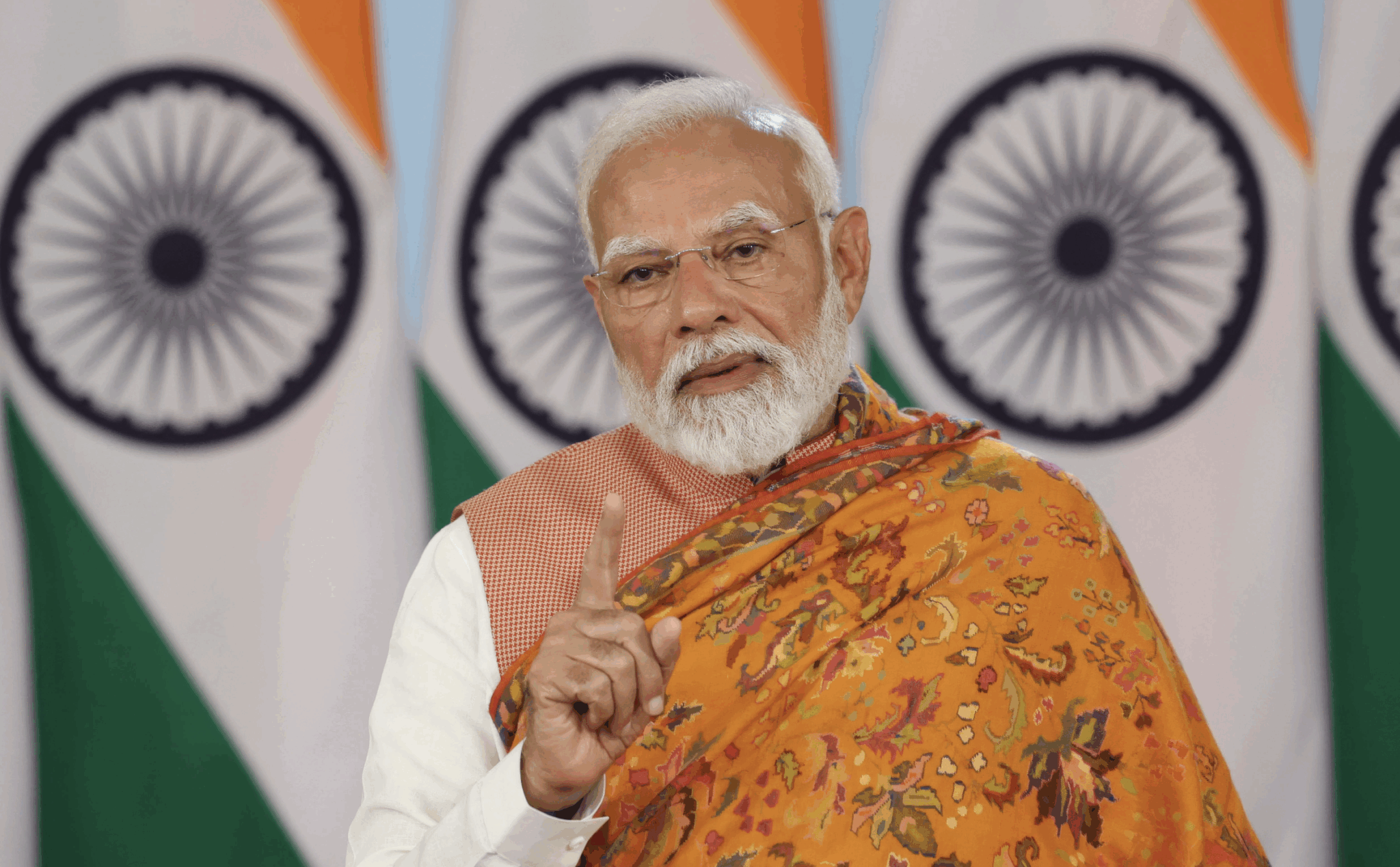
NEW DELHI — In his first post of the morning on July 25 on X, Union Minister Jitendra Singh rejoiced at the news that former Indian Prime Minister Indira Gandhi had been “overtaken” by Narendra.
A few minutes after 9 a.m., his message to the public accompanied a large picture of Modi, next to a significantly smaller Indira Gandhi. The reason behind such contrast? Modi beating Gandhi’s record of 4,077 consecutive days in office, thus making him “India’s second longest-serving Prime Minister.”
Several other “firsts” were listed near Modi’s name, none of which can be denied. There is only one such “achievement” that can be somewhat contested: Modi has not yet become the “only PM (after Nehru) to win 3 consecutive national polls.” Indeed, he did not “win” the 2024 polls, but merely cobbled together a majority with the assistance of alliance partners.
A better way to make this claim would have to write that he is the only leader after Nehru who came to power thrice in succession after Parliamentary elections. But then, Modi’s BJP partly is hardly given to nuances.
Not a committed champion of democracy
What however is clearly false is the spin another BJP leader gave to this purely statistical accomplishment. A party spokesperson claimed that while Modi had become prime minister in 2014 with public support, both Indira Gandhi and Jawaharlal Nehru “became the prime minister for the first time due to the inevitability of circumstances or political manoeuvring of the circumstances, not due to public support.”
The same can be said about Modi too. After all, he became chief minister of Gujarat in October 2001 without ever having held any public office or even being elected as member of any legislative body.
He ascended the office of the CM because a handful of BJP leaders decided to replace the then incumbent, Kesubhai Patel. All formal processes were undertaken only after Modi landed in Ahmedabad after the decision was taken, and party Member of the Legislative Assembly were presented with a fait accompli.
This government considers Parliament as a body to merely endorse its decisions.
But, what Nehru and Gandhi have been accused of is little but “New history” in the so-called New India. If the BJP remains in office for some more years, we can expect this contention too being incorporated in school history textbooks.
But, because Modi and Indira Gandhi have been juxtaposed, it is worthwhile to compare the two on various parameters. Importantly, this statistical record has been “broken” close on the heels of Modi and the rest of the BJP and others of its ilk demonizing the latter for “trampling” democracy by imposing the Emergency some 50 years ago.
On this count itself, Modi’s record is not a committed champion of free speech and democracy. On the contrary, during the past 11 years, freedom of expression has been clearly quashed and divergent viewpoints of public personalities, and even not so public individuals but who may made a post on the social media, have been harangued by the foot soldiers of the Sangh Parivar, the Hindutva organizations that crawl every crevice of society.
In the last few years, various State institutions as well, have been hollowed out. This includes the legislature and the judiciary. For instance, the constitutional post of the Deputy Speaker has been vacant since 2019.
This is a clear indication that this government considers Parliament as a body to merely endorse its decisions and not as forum for bipartisan debate and discussion from which a consensual view of a given situation can emerge.
These are little but dangles for members of the judiciary with clear message: be committed to “our cause” and we shall “take care” of you, post-retirement.
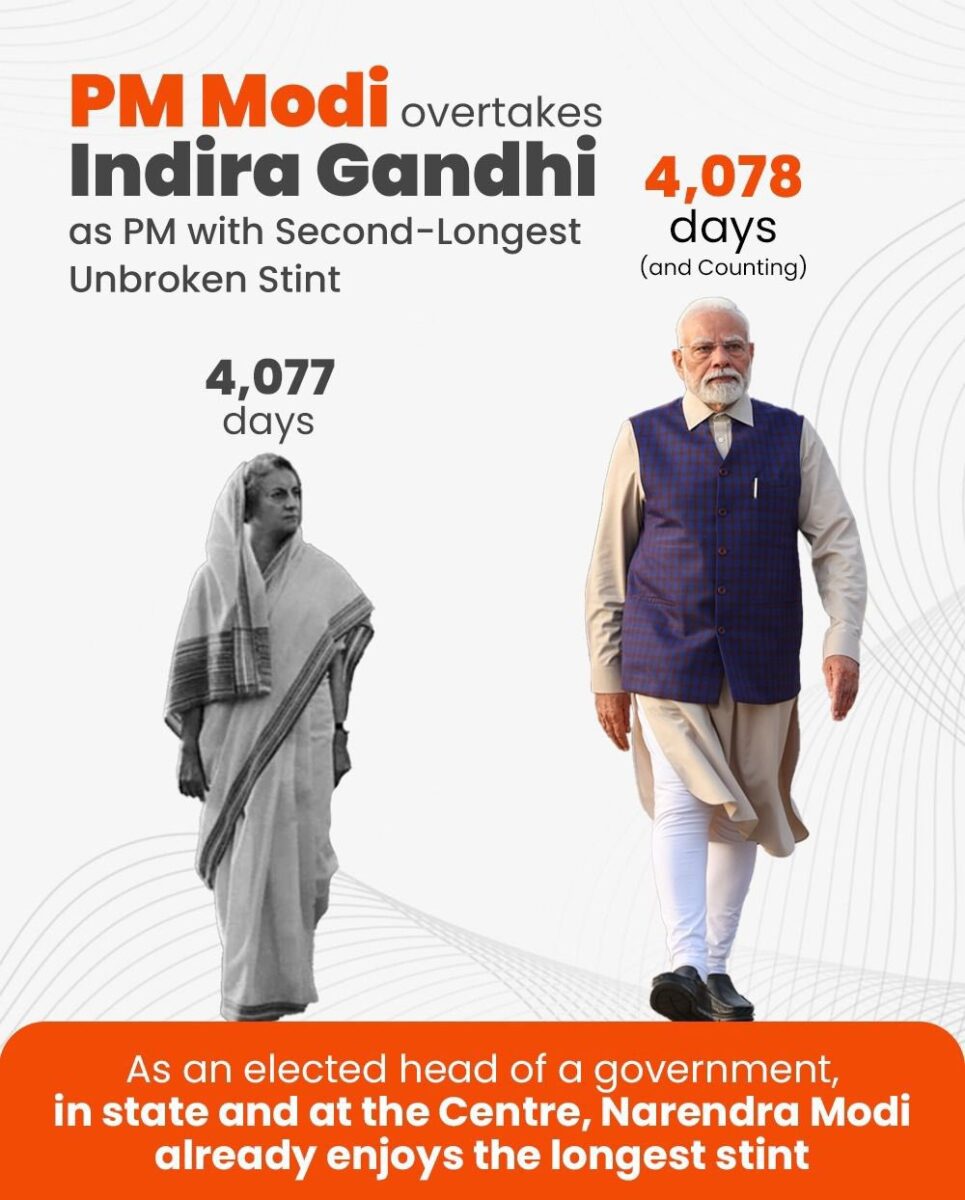
Pro-Modi visual shared by Jitendra Singh on July 25 via his X account.
More than a match?
In fact, Modi matches Indira Gandhi almost completely, and even goes beyond. Virtually every social and political ailment, barring the promotion and backing of physical targeting of adversaries and “others” of today, owe their genesis to many practices she initiated: from converting Indian polity into being purely personality-driven, besides calling for a “committed” bureaucracy, judiciary and of course the media.
Despite paying lip-service to democracy and its institutions, this government under Modi’s leadership is formulating a new definition of democracy: of the “select” people, by the “select” people and for the “select” people.
In contrast, before being tempted to slide further down the crevice of authoritarianism to tighten her stranglehold, Indira Gandhi chose to call for elections.
On the contrary, Modi does not shy away from holding elections, and he probably never will, but not before reducing the entire poll process to a partisan exercise. Now even the electoral rolls are being “selectively trimmed” in the name of eliminating “intruders” from the voters list.
Initially, Modi was often compared to Indira Gandhi. And in his initial years, Modi did not spout venom against her, reserving his ammunitions for Jawaharlal Nehru. It was evident that he had sneaking admiration for her although he did not say it in as many words.
Understandably, Jitendra Singh and the BJP ran her down even while glorifying Modi for “beating” Indira Gandhi’s record. But, it is important to note that the backdrop of the challenges the two faced at the onset of their tenures.
Very different challenges
For starters, Indira Gandhi assumed office when India had not yet been able to pull out of the uncertainties created by two wars in quick succession – 1962 and 1965.
Additionally, although Shastri had somehow steadied the ship after the colossal sense of loss at Nehru’s passing, his death had come unexpectedly.
Unlike Nehru, he had not been wracked by ill-health as a result, there was little time to prepare for the ‘eventuality’ and moreover, much had to be done by Indira Gandhi.
This was a challenging task for a person without great track record in government although she was politically savvy. Economically, India was in shambles and she had to literally go around the world with a “begging bowl.”
In contrast, although Modi took charge of a fairly stabilised economy, his policies have rendered India, into a nation of huge disparities, resulted in massive dropout rate from the nation’s middle classes and extensive impoverishment of large sections of people, especially the poor.
On the national security front, the 1971 war and the manner in which Indira Gandhi stood up against American pressure tactics, the vivisection of Pakistan and creation of Bangladesh made her a demigod in the people’s eyes.
Modi too has smashed to smithereens the BJP’s famed collegial style of functioning.
In stark contrast, Modi evoked a sense of dismay, especially in his core electoral constituency, after declaration of cessation of hostilities against Pakistan during Operation Sindoor.
It is true that Modi benefited in 2019 by airstrikes on Balakot and inverted the electoral trend, but as proven by the terrorist strike in Pahalgam, it was no deterrence on Pakistan.
This despite the fact that Modi has far greater resources and there has also been massive technological advancement for constantly playing out one publicity blitzkrieg after another.
Despite imposing Emergency, Gandhi not only came back to power in less than three years, but is also recalled with tremendous reverence across large swathes of India despite having been assassinated more than 40 years ago.
Last but not least, Indira Gandhi faced the huge challenge of resurrecting not just the nation, but also a flagging political narrative. The post-independence dream had faded completely and she faced the challenge of stabilizing the Congress ship.
In the Lok Sabha and state assembly elections in 1967, the Congress performance dipped to unprecedented levels. Yet, by a series of manoeuvres and policy decisions, she seized the initiative, split the party and became a political giant.
But just as she destroyed the Congress party and its organizational capacities, Modi too has smashed to smithereens the BJP’s famed collegial style of functioning.
Additionally, much like she locked horns with the Syndicate, Modi too has been jostling with the RSS leadership for almost 18 months. Indira Gandhi had ultimately emerged victorious but it is too early to predict the outcome this time around — and altogether a tad early to compare the two Indian leaders.