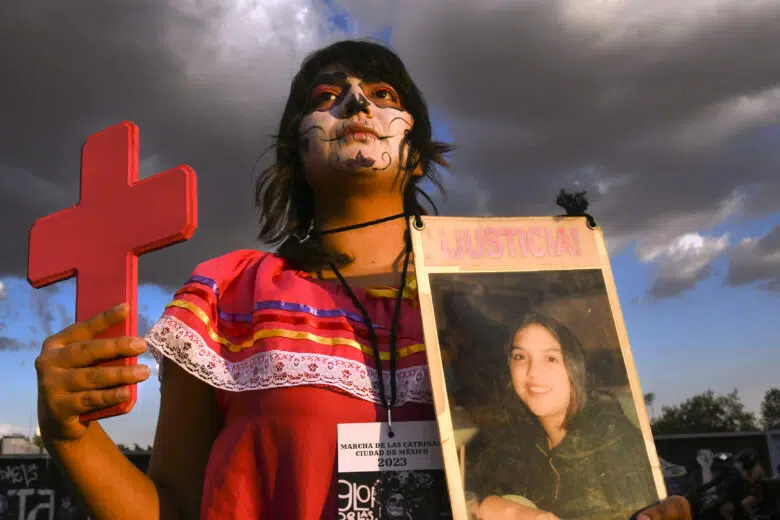
MEXICO CITY — “Wendy was also a minor, and she won’t be back in five years,” reads one of the banners displayed by the collective of mothers of femicide victims at the Zinacantepec Courts for Adolescents, in the State of Mexico. Wendy was 16 years old when her partner, Fredy, murdered her a few months before he turned 17.
For the latest news & views from every corner of the world, Worldcrunch Today is the only truly international newsletter. Sign up here.
On the afternoon of March 20, 2021, the young woman asked permission to go out in downtown Xonacatlán with her boyfriend. A few hours later, Fredy returned to Wendy’s house and told her mother that her daughter had left him because she had received a call from her aunt. From the beginning, he tried to disassociate himself from “anything that could have happened” and told a version of the story that was contradicted by evidence requested by the family.
Friends, neighbors and loved ones helped Wendy’s parents, Guadalupe Sevilla and Hector, search for their daughter for two days before an acquaintance informed them that the body of the young woman had been found in a pool of raw sewage in La Manga, near Fredy’s house. Wendy was found barefoot and with her clothes torn.
The investigation started under the femicide protocol, but the authorities committed irregularities: There was no support in the diffusion of the search bulletins, the Xonacatlán police officers ignored the missing persons report, some officials suggested that Wendy was at a party, and others said she had stumbled and drowned.
In addition to institutional revictimization and non-compliance with protocols, in the last four years Guadalupe and Héctor have faced the same uncertainty felt by the families of Fátima Varinia Quintana Gutiérrez (who died on Feb. 5, 2015, in Lerma, Edomex), Karen Alvarado Mosso (Aug. 4, 2016, Ecatepec, Edomex), “Magui” Ramirez (Jan. 16, 2020, San Miguelito, Aguascalientes) and Jalix Rubio Telésforo (March 26, 2022, Temoaya, Edomex). Where is the justice when when the murderers of their daughters serve a maximum of five years?
Failed juvenile justice reform
After two years on the run, Fredy was arrested in March 2023, charged and sent to the Juvenile Detention Center in Zinacantepec. Weeks later, in May, he was found guilty of femicide and sentenced to five years in prison, the maximum term set by the National Law of the Comprehensive Criminal Justice System for Adolescents (LNSIJPA).
“The authorities can’t allow femicide perpetrators to enjoy privileges that they themselves took away from the victims. It is indignant and painful. Five years is a mockery,” Sevilla said of the sentence in Wendy’s case.
Issued in June 2016, the LNSIJPA is considered the second formal stage of the Comprehensive Criminal Justice System for Adolescents (SIJPA) and, due to its complementarity with the General Law on the Rights of Children and Adolescents (2014), it represents a milestone in the homologation of the legal regime, as highlighted by Alicia Beatriz Azzolini Bincaz, a lawyer and law professor at UNAM.
Things don’t end with the sentences. We families fear for our lives.
As Juan Martín Pérez García — coordinator of the organization Tejiendo Redes Infancia en América Latina y el Caribe (“Weaving Childhood Networks in Latin America and the Caribbean”) — explained to Volcánicas, “juveniles have a justice system that is different from that of adults because of their level of personal development and resources, as they are still psychologically and economically dependent on their immediate environment.”
Ximena Ugarte, of the Mexican Institute for Human Rights and Democracy (IMDHD), says that the 2016 reform is more than a differential approach to criminal sanctions: “It also suggests the possibility that these individuals — aged 12 to under 18— whom some people call adolescents and others call young adults, can be able to carry out their activities and be confined in their own home or with a family member.”
Ugarte says that while the LNSIJPA is “designed within the framework of international standards for the best interests of children and adolescents,” it has created obstacles for femicide victims’ families, since “it has left them more unprotected.”
Scared families
Those concerns are shared by Perla Blas, coordinator of the Aquí Estamos collective, who says that these indirect victims “are more vulnerable because many have the perpetrators or their relatives living in the neighborhood. They often have to watch out for threats and live in uncertainty. They have no security anywhere. They have to wander around in the middle of a seemingly endless battle,” she says, adding that the Mexican State is failing on this issue.

Sevilla told Volcánicas that “We’ve had to face ridicule from the parents of my daughter’s murderer, even at hearings. Institutions — like the Executive Commission for Victim Assistance (CEAV) — should provide us with security because [Fredy] will be released in a couple of years. The authorities don’t even think about that, that my family and I are in danger because the murderers get angry. Things don’t end with the sentences. We families fear for our lives.”
In addition to the short duration of the custodial measures, Blas say that the LNSIJPA does not take into account the particularities of femicide, which has also led to the perpetrators being judged as murderers and, therefore, to the underreporting of hate crimes against women.
Ugarte points out that the approach to criminal proceedings tends to be limited. “In the juvenile justice system, the entire investigation is handled by a specialized Public Prosecutor’s Office, but everything is very focused on the perpetrator, the adolescent or young adult… They don’t have a victim-centered approach.”
Parents like Fátima Quintana, Karen and Erik Mosso, Lorena Gutiérrez and Sacrisanta Mosso have also emphasized that LNSIJPA loopholes translate into “benefits for the murderers” and constitute a deeply permissive and complicit message with patriarchal violence.
A complicit message
“A constant motif we see is that men commit femicide because they know they can and that nothing is going to happen to them,” Blas adds, noting that in Mexico, impunity for this crime is of 76%, and that out of the 299 femicides of girls and teenagers registered by Aquí Estamos, there have only been eight sentences.
Blas explains that the collective, which launched an investigation in 2018, has observed since 2022 “an increase in cases and we have detected that [perpetrators] are not restricted to boyfriends or ex-partners. There are other relationships, such as family relationships, in which they are brothers or step- brothers. We also have data that indicate that the age range of the offenders is between 15 and 17 years old,” Blas points out about the increase in femicides against minors committed by minors in the last three years.
Damage reparation
Another issue for families is that of reparation of damages, which is central to the General Victims Law (2013) and a right recognized in the first constitutional article. The LNSIJPA states that “the adolescent shall have the obligation to compensate the damage caused to the victim or offended person” through either labor, payment in money or cash payment charged to labor income.
Yet cases continue to demonstrate the flaws in this law. For example, Luis “E” only offered a used bicycle as collateral guarantee to Sacrisanta Mosso, who reported that the murderer of her daughter Karen and of her son Erik. The mothers’ collectives has demanded the modification of local Criminal Codes to impose sentences in accordance with the seriousness of the crime.
Ugarte explains that the “comprehensive reparation of damages is a generalized problem in the criminal system and is very complex” — even more so in cases of juvenile femicide because “a person under 18 years of age will most likely not have the economic resources to pay reparations.”

“It seems to me that an interesting debate on the matter is that if it is a monetary reparation, this obligation should be transferred… If we are talking about a new system of justice for adolescents or a specific system, let’s also think about how an adolescent or young adult could get closer to a non-repetition or compensation measure,” Ugarte says.
Claudia Alarcón Zaragoza, a researcher specializing in youth and crime prevention, says this topic must be at the center of any discussion on these measures. “Thinking about the damage enables us to see all that Mexico has not done regarding the affected communities, and the public policies that have not responded to their needs.”
Education and dialogue
In this regard, Tejiendo Redes Infancia coordinator García notes that Mexico “has not met its institutional commitment to provide socio-educational measures against violence against women.”
Zaragoza adds that there is a need for more robust and contextualized analyses. “If we think about teens who have committed high-impact crimes in the past five years, we are talking about exponential growth in the numbers… The crime-related phenomenon is increasingly violent… We need to look at what is happening in the national and everyday context and stop thinking that the world of adolescents is an isolated world.”
For their part, Ugarte and Blas insist that the concerns and demands of the groups of mothers and families of femicide victims should not be minimized. It is urgent to open up spaces for dialogue where it is made clear that — despite its importance in the normative frameworks — the LNSIJPA represents an obstacle to justice access.
There should be a differentiation based on the seriousness of the crime.
“I think that an analysis of criminality should be carried out when we talk about serious crimes. I am not saying that [underage perpetrators] should be tried as adults. But there should be a differentiation based on the seriousness of the crime, on its public and social impact,” IMDHD legal advisor Ugarte says.
The LNSIJPA needs reform because the social context of violence is changing, Blas says, adding that the 2007 General Law on Women’s Access to a Life Free of Violence needs to be rethought because it lacks a specific section for femicides committed by minors against minors.
“The argument of the maximum penalties of five years is that [the perpetrators] have the right to rebuild their lives, to redeem themselves in society and be good people, [but] the victims’ families’ response is that their daughters had the right to live and they took it away from them,” Blas says. “That is why the mothers are always on the lookout, to verify that [the authorities] do not come up with something. They never rest. For them, things don’t end when they put the killers in jail.”