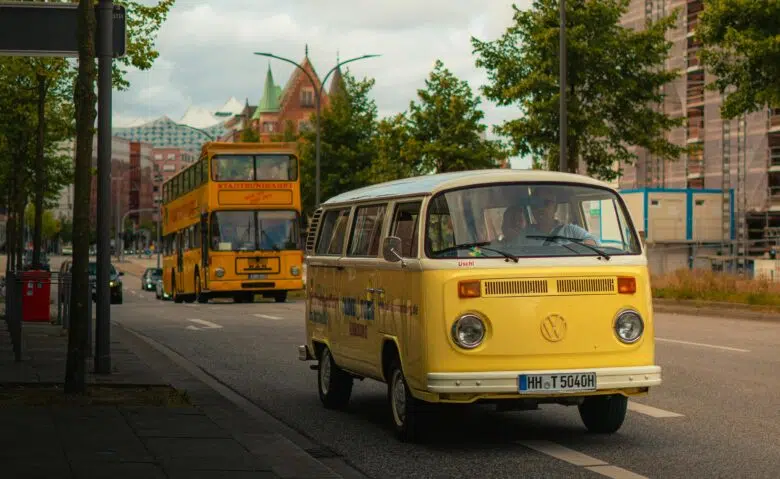
HAMBURG — Sometimes Emma is parked on Holstentwiete. Sometimes on Erdmannstrasse, right around the corner. Emma is beige, almost six meters long and a little more than two meters wide. The bulky Fiat built by the camper manufacturer Hymer is an older model. The name Emma is written above the windshield. And here in the Altona district of Hamburg, some fear that Emma is in danger.
For the latest news & views from every corner of the world, Worldcrunch Today is the only truly international newsletter. Sign up here.
A woman writes on a neighborhood platform: “I’m starting to get the impression that a camper hater is wandering around.” A post with 54 comments now debates tires that have allegedly been slashed, mostly in Altona, with at least nine reported incidents. The sole targets: the motorhomes and campervans owned by local residents.
Every autumn they return. Thousands of campervans that rumble along the roads of Europe during the summer, and then spend the winter squeezed into the narrow residential streets of the city center. They take up parking spaces and create tension. In the Ottensen quarter, it seems, the situation has now come to a head.
Since July, according to neighbors, these incidents have occurred repeatedly. The police confirmed some of the reported acts of vandalism when asked, with five cases of slashed tires alone recorded on Gaussstrasse since the summer.

Yet officers insist these are isolated incidents, as a spokesperson said on the phone. Is that really the case? Because in truth, it is hard to identify who is cutting the tires at night. A special task force focused on motorhomes is hardly likely to be sent to investigate over a handful of damaged tires.
The neighbors, however, are convinced: there is a campervan hater, possibly a woman, living in the area, someone who comes mainly at night. One thing is clear. These vehicles irritate people, much like SUVs. So, where are they supposed to go?
Pandemic effect
In 2014, the city counted about 9,000 vans. That number rose sharply during the pandemic, when long distance travel was off limits and people suddenly wanted to take their new campervan into the nearest forest to experience what was then called a micro-adventure during those strange pandemic years.
Even after the pandemic, the trend toward fuel-hungry vehicles in dense urban neighborhoods did not fade. Today, around 19,000 motorhomes drive through the city. The large VW camper models are generally not included in this figure, since they are usually listed as cars in the statistics.
The motorhomes also rob ground floor apartments of daylight and block the view of other road users
When readers of Die Zeit were asked about their experiences, 107 replies came in. Most of them sounded angry, saying that the motorhomes also robbed ground floor apartments of daylight and blocked the view of other road users, which could even put children in danger.
A woman in Winterhude has therefore begun writing notes and placing them on windshields. They say: “The size of your vehicle automatically reduces the public space available to pedestrians.”
Even though newspapers in the city raise these issues year after year, local politicians have done little. The campervans are parked legally in the city center. In Hamburg, vehicles up to 7,5 tons can stay in resident parking zones with a permit that costs 70 euros per year.
What could Hamburg do? Tübingen, in the southern Land of Baden-Württemberg, has introduced tiered prices for resident parking permits based on weight. And in Paris, the mayor, Anne Hidalgo, put a particularly drastic measure up for a vote. In 2024, a majority of the 78,000 Parisians who took part out of 1.3 million eligible voters endorsed a sharp increase in parking fees for heavy cars like SUVs, at least for visitors. Now, non-Parisians pay three times as much. Parking a car weighing more than 1.6 tons in the city center costs 18 euros per hour. The longer it stays, the more the price rises.
Farmer’s solution
In Hamburg, such measures have not even entered the debate. Yet there seems to be an urgent need for action. A parking space moratorium is now in effect. Spaces are not supposed to be removed without the approval of the Senate Chancellery. If Hamburg managed to prevent motorhomes from wintering in the city, hundreds or even thousands of parking spaces would immediately become available. The vehicles would then spend the cold months where they belong. In the countryside. Farmers already offer storage space for as little as 40 euros a month. In their barns. Perfect.

