BERLIN — I threw up for the first time after eating when I was 17. I was working at a small movie theater in my hometown and had nachos with cheese sauce during my break. Too much, I suddenly thought. Panic hit me at the idea that the calories would cling to my stomach and hips.
For the latest news & views from every corner of the world, Worldcrunch Today is the only truly international newsletter. Sign up here.
It did not stop with that one time. After a few months, I was throwing up after every regular meal and having binge-eating episodes in between, after which I also forced myself to vomit. I exercised compulsively and grew thinner and thinner.
But that was not the only consequence. My back hurt so badly from the constant vomiting that on some days I could barely walk. My hair started to fall out. I had bite marks on my hands from my teeth digging in as I pushed my fingers down my throat to bring the food back up. Medically speaking, I first developed bulimia, later anorexia, and then depression and anxiety.
Today, I am stable, and I know it will stay that way. But I worry. I worry about all the girls who are the same age today as I was when I first made myself vomit. Because I see an ideal returning that shaped my youth too: the ideal of extreme thinness.
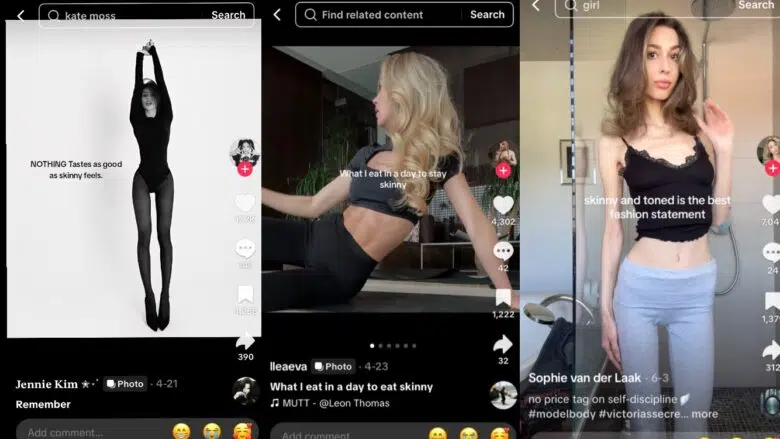
For a time, it seemed to have faded. Now it is back: on catwalks, in pop lyrics, in reports of celebrities of normal weight taking Ozempic, and especially on social media, where creators post weight-loss tips and celebrate being thin under the tag “SkinnyTok.”
Arms like matchsticks
The fact is, eating disorders have risen sharply in recent years, especially among girls and teenagers. Why exactly is not entirely clear. Eating disorders are among the most complex mental illnesses; they always involve several risk factors, from certain personality traits to personal trauma. Media, social media, or even SkinnyTok are not solely responsible. Much else has happened in recent years that weighs on the psyche: the coronavirus pandemic, wars, crises. And yet the ideal of the emaciated woman, circulating in many forms, can be a trigger or an amplifier, especially for those already lacking self-esteem or struggling with deep insecurity.
That is how it was for me. Several things had left me emotionally shaken. I felt the world was against me, but I had no control over it. That clashed with my perfectionism and my need for control. My self-esteem collapsed. So I tried somehow (though not necessarily consciously) to take control back.
Hip bones jutting, collarbones sharp, cheeks sunken, eyes huge
Inside, I was anything but stable, and all the while the world around me was hammering home an image of the ideal slim woman. At the time I began purging in order to get thinner and thinner, my environment was full of it: Kate Moss setting the tone for heroin chic, underweight with dark circles under her eyes and arms like matchsticks. Gilmore Girls and Desperate Housewives with fragile leading ladies. Bridget Jones, supposedly “fat,” though really only average weight. Gossip magazines mocking Britney Spears or Jessica Simpson for gaining a few pounds. Heidi Klum shaming slim contestants on Germany’s Next Top Model for not being thin enough, and warning them off fries at dinner.

Then the internet came: on Tumblr, I found pictures of severely underweight young women, staged almost like art, their hip bones jutting, collarbones sharp, cheeks sunken, eyes huge. Everything about them screamed fragility. Even more extreme were the Pro-Ana and Pro-Mia movements, which to this day present eating disorders as a lifestyle to aspire to (Ana for anorexia nervosa, Mia for bulimia nervosa).
Fitting in, standing out
Images like these are powerful. Seeing extremely thin bodies unsettles people and erodes self-esteem. It makes them more likely to see themselves as overweight, and to want to lose weight or exercise. If you keep seeing such content, the message that women must be thin is drilled in. And it sticks.
Certain phrases have burned themselves into my brain; even now, they feel like part of me. When I eat yogurt, for instance, a sentence I once read in a magazine automatically echoes in my head: “If you eat healthy, you can sin with a cream yogurt once in a while.” Cream yogurt, of all things? Not chips or chocolate. And why “sin”? Is food something to atone for?
Another phrase stuck in my head: “A moment on the lips, forever on the hips.” And the infamous Kate Moss line: “Nothing tastes as good as being skinny feels.” No food, apparently, could be worth more than thinness.
The celebrities, the images, the slogans, they all conveyed one message above all: women are strong when they manage to control their hunger and conform to the ideal female body. And supposedly nothing about them can be criticized.
That was exactly what my inner self longed for. On one hand, I was consumed by the negative belief that I was never good enough. Not smart enough, not hardworking enough, not special enough. So I wanted to be strong in that way too. On the other hand, I constantly felt like I was too much, drawing too much attention, being a burden. So I wanted to become unassailable, and in a sense, “less.”
This contradiction — the urge to blend in, even to the point of vanishing, while also yearning to stand out — seems to run through many eating disorders. As a journalist, I have interviewed many who shared phrases like: “Sometimes I feel like I take up too much space. I don’t want to take up so much space in the world.”
What helped me
I lived with eating disorders for about eight years. During that time, I was hospitalized four times, each stay lasting six to eight weeks. I had countless outpatient treatments and still went through repeated relapses. At 25, after yet another clinic stay, I finally managed to break free.
What helped me was medication for depression and anxiety. And behavioral therapy, where I learned to recognize warning signs. For example, if I catch myself thinking, “Maybe you should lose some weight?” I know not to let that thought take root, and certainly not to cut back on eating.
What made recovery a bit easier was that at that time, the image of the female body was becoming less rigid. A countermovement to thinness had gained strength: body positivity. Originating in the U.S. with the weight acceptance movement of the 1960s, it had spread more widely through the media since the early 2010s. Its message was clear: all bodies are beautiful, there is no single ideal. Plus-size influencers posed confidently in underwear on Instagram, and ad campaigns showcased bodies of every shape.
Such messages broaden how people see beauty, increase tolerance and help normalize non-thin bodies. But the movement has drawn criticism too. Experts on eating disorders and obesity argue the focus should be on body neutrality, which emphasizes function over appearance. This shows when, for example, a larger actress takes a lead role in a show like Euphoria without her weight becoming part of the storyline.
Bye-bye body positivity
But bitterly enough, the whole discussion around body positivity and neutrality now feels almost irrelevant. Thinness is celebrated again online, on red carpets, in advertising, and in pop culture. Goodbye body positivity: size zero is back on runways.
Last summer, the fashion brand Namilia even sent a super-thin model down the catwalk at Berlin Fashion Week in a top printed with “I love Ozempic.” Normal-weight stars, too, are injecting themselves with Ozempic to get thinner still. Rapper Shirin David sings in her hit “Bauch, Beine, Po,” which dominated the German charts for six weeks and has been streamed more than 100 million times: “Go to the gym, get skinny.”

What strikes me most, though, is how Instagram and TikTok overflow with content glorifying extreme thinness and pushing it as a life goal. The trend is called SkinnyTok.
Very thin women dance cheerfully in the street under captions like:
“How life feels when you’re not fat.”
“You can’t avoid a calorie deficit if you want to be skinny,” one video insists. Creators post rigid schedules with set exercise times and meticulously planned meals for followers to copy.
Then there are the classic “What I eat in a day” clips, especially for “skinny girls.” In others, very thin women dance cheerfully in the street under captions like: “How life feels when you’re not fat.”
Some show off jutting bones, echoes of Pro-Ana. Others pinch their already thin thighs to highlight where they still want to lose weight. Sometimes it is downright insulting: “You can’t expect to look like an elf if you eat like an ogre.” And stars of the 1990s and 2000s, my icons and tormentors alike, are nostalgically glorified.
Beyond bodies, these posts promote a lifestyle: the “skinny girl mindset.” Being thin is framed not just as an appearance, but as a character trait, a whole way of life. Thinness is portrayed as proof of self-respect. One creator says: “When you’re thin, you respect yourself.” Skinny is the outfit that shows discipline, strength, superiority.
The trend mirrors the same contradiction I described earlier, only taken further. On one side, SkinnyTok promotes fitting in, meeting a body ideal that does not attract notice for excess weight. On the other, it is about standing out for discipline and will power, being better, being admired, and proving it on social media, where more likes, views and followers mean greater success.
Vanishingly small
It brings back every warning bell I learned about in therapy. Watching SkinnyTok feels like being hurled back to the days when I saved Tumblr images to push myself to lose more weight, when I cut out photos of Kate Moss or Sienna Miller from magazines and glued them into my journal.
Even though body positivity drew criticism, what I loved was the idea of taking up space. Of women being tall, visible in every form. Of becoming stronger, larger, more nonconformist as a form of empowerment. Now women are making themselves smaller again, vanishingly small.
This is not really about me. I have been healthy for nearly 15 years. Bulimia and anorexia no longer define me. But I think about what it must be like to be a teenager today. Teenagers are fragile, open wounds. They are searching for identity and direction while their hormones swing wildly.
I think about those young people exposed to social media content every day. Those caught in SkinnyTok bubbles, fed image after image, video after video. And about the ones creating this content. And I ask myself: how would I have survived if I were a teenager today?

