HAMBURG — For everyone who wakes up in the middle of the night and can’t drift back to sleep. For everyone who doesn’t get enough rest at night, but feels too stressed to nap during the day. And for all those who feel constantly tired this late autumn. There may just be a simple solution.
For the latest news & views from every corner of the world, Worldcrunch Today is the only truly international newsletter. Sign up here.
NSDR sessions are currently the hottest alternative to the classic power nap. Put simply, they are relaxation meditations lasting between ten and thirty minutes. NSDR stands for Non-Sleep Deep Rest, which means deep relaxation without sleep. Some even call it sleep yoga. Top athletes swear by it. Oprah Winfrey and Google CEO Sundar Pichai do it, as do millions of others in studios and especially on YouTube.
Sleep yoga is said to offer ultimate recovery for the brain. And all it takes is the length of a lunch break.
Huberman’s hack
The technique was popularized by Andrew Huberman, a Stanford neuroscientist, successful podcaster, and oft-criticized health guru. NSDR is based on practices already known from Yoga Nidra, which roughly translates to yogic sleep. According to Huberman, he gave sleep yoga a new name to make it sound more neutral and scientific, and less off-putting to Western workaholics. He marketed it as a 20-minute hack that could change lives, and that, in turn, made him famous.
It’s also said to boost creativity, improve memory and enhance learning and recall
The promise is impressive: practiced during the day, sleep yoga helps you feel refreshed and alert; at night, it aids in falling asleep. But that’s not all. It’s also said to boost creativity, improve memory, and enhance learning and recall. In short, it’s presented as a powerful tool for overall mental health and well-being.
Huberman is a skilled communicator but has recently faced criticism for, among other things, making exaggerated or scientifically shaky claims. Still, other sources that are not exactly known for overstatement, such as the health insurance company AOK, also recommend sleep yoga to reduce stress, ease anxiety, and promote a more relaxed life.

How does sleep yoga work?
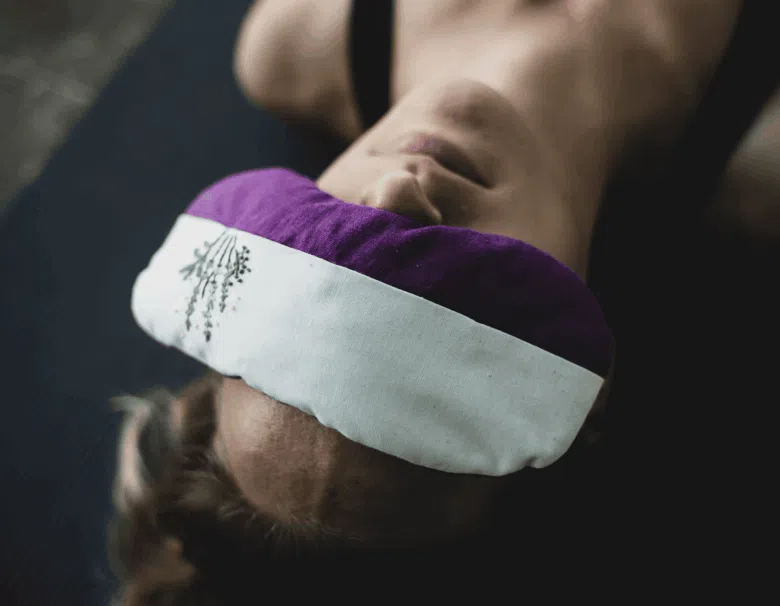
In sleep yoga, you usually lie on your back, often under a blanket, on a yoga mat, the couch, or in bed, and listen to a voice that guides you through breathing, awareness, and visualization exercises. The voice might say something like, “Focus your attention on your feet,” or “Breathe in deeply through your nose and exhale completely through your mouth.”
The voice continues: “With each exhale, imagine yourself sinking deeper into the mat or couch.” It is often mentioned at the beginning that you will feel relaxed and refreshed afterward.
The goal isn’t to fall asleep (even though that often happens, as studies have shown), but to reach a state of deep physical relaxation somewhere between wakefulness and sleep, allowing the nervous system to respond with calm.
How well documented is it?
It’s well known that slower, more mindful breathing helps calm the nervous system, reduce stress and ease anxiety. A study (Journal of Psychosomatic Research: Sharpe et al., 2023) shows that this is exactly what happens during sleep yoga, and to a greater extent than during simple rest. However, the study found no difference in other indicators such as heart rate variability, a key measure of stress that refers to the time intervals between heartbeats, between participants who practiced sleep yoga and those who simply lay down.
Another study by the University of the German Federal Armed Forces Munich and the University of Erlangen suggests that regular online sleep yoga sessions of 11 or 30 minutes could positively influence levels of the stress hormone cortisol (Stress and Health: Moszeik et al., 2025).
A 2022 review on the relevance of Yoga Nidra notes that studies over the past 20 years have reported reductions in stress, anxiety and depression, but many of these studies suffer from methodological weaknesses, meaning the effects cannot yet be considered firmly established.
Most rely on participant surveys rather than measurable physiological data and often involve only small groups. For instance, in one study with 65 participants, 24 rated a ten-minute Yoga Nidra session as beneficial for emotional balance and reported reduced stress and fatigue (Applied Psychology: Health and Well-Being: Boukhris et al., 2024). The extent to which these results can be generalized remains questionable.
Better than a nap?
Perhaps the most common claim in the sleep yoga community is that half an hour of Yoga Nidra can replace two hours of sleep. NSDR founder Huberman both questions and reinforces this claim. He says there’s no evidence that Yoga Nidra equals several hours of sleep, but admits that when he does a 30-minute session himself, he feels as if he’s slept for five or six hours, or even longer.
Dieter Riemann, a sleep researcher and clinical psychologist, also points out the lack of proof. Demonstrating such a claim would be nearly impossible because the necessary study can’t be carried out. It would require measuring the brainwaves of control groups during both activities and then interviewing participants. “But most people can’t sleep for two straight hours during the day. And if you wake people up after two hours at night, they’re usually not rested but irritated,” says Riemann, who for many years led the sleep medicine department at the psychiatric clinic of the University of Freiburg.
He therefore draws a different conclusion from Huberman: “Sleep yoga is certainly restful and relaxing, but sleep is firmly embedded in our biology for the night and cannot be replaced or compensated for by it.”
Eyes closed, less work
Nevertheless, sleep yoga and actual sleep share one key similarity, says Riemann. In both, the eyes are closed. This may sound trivial, but it has significant effects because it changes brain waves. “As soon as someone closes their eyes, alpha waves with a frequency of eight to 12 hertz dominate the brainwave pattern.” In other words, once visual input is shut off, the brain has one less job to do. The previously faster waves slow down into alpha waves, signaling a relaxed state of wakefulness.
Riemann explains that a person who meditates can reach this state just as quickly (in ten to twenty seconds) as someone who lies down for a nap and closes their eyes.
The alpha state itself is not yet considered physiological sleep. As someone drifts off, the brainwave pattern continues to change, with alpha waves giving way to theta waves. The deeper the sleep, the slower the brainwave frequency, and the more nerve cells fire in sync. Researchers often describe this as a staircase: first comes falling asleep, then light sleep with slower theta waves, and finally deep sleep with even slower delta waves.
It also lets the immune system regenerate, the metabolism slow down, and cells repair themselves.
Sleep is vital for survival: it allows the brain to process impressions, store memories, and organize thoughts. It also lets the immune system regenerate, metabolism slow down, and cells repair themselves. But these processes occur only during the deeper phases of sleep.
Riemann believes that meditators practicing sleep yoga might also take a step further down that staircase. First comes a dreamlike state, the so-called hypnagogic state, in which we see images: what Riemann calls hallucinations. During a nap, this state lasts about five to ten minutes, after which the sleeper typically moves into the theta state, which, like deeper stages, is associated with memory, learning ability, concentration, and creativity.
Falling asleep, staying asleep
Some studies suggest this might also be true for sleep yoga practitioners, although the findings are inconsistent and often not statistically significant. This is also noted in a recent meta-study, already published but still under peer review. The researchers compared and re-analyzed 12 studies from the past 20 years.
Their conclusion: further well-designed studies with larger sample sizes are needed to make reliable statements about brain waves during sleep meditation. Riemann adds, “We still don’t really know what it is about sleep that’s truly restorative. There’s no biological marker or measurable biochemical substance for it.”
However, surveys show that people feel more refreshed, relaxed, and less stressed after both a nap and meditation (Research, Society and Development: Gobbo et al., 2023).
And one thing does seem clear: sleep meditation often helps people fall asleep faster and stay asleep more easily. This is confirmed not only by studies but also by the familiar sound of snoring from the yoga mat next door. In other words, there’s no need to choose between sleep meditation and a power nap. Ideally, you could simply do both this dreary autumn.