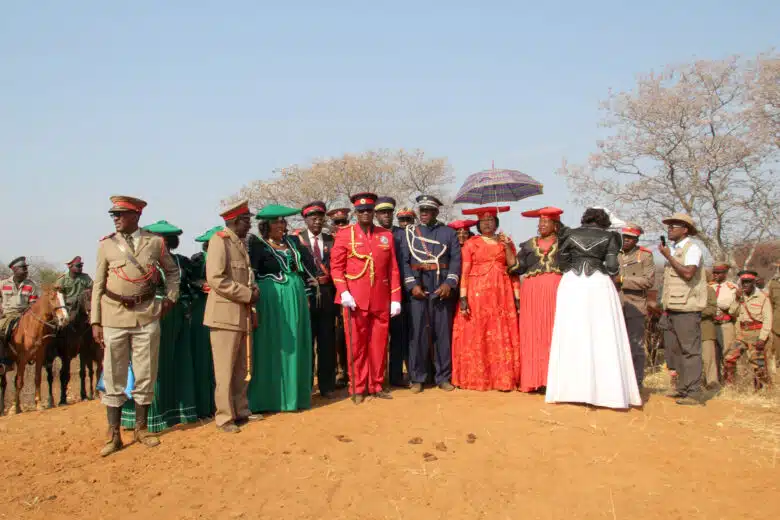
PARIS — The past always refuses to disappear. And in Namibia, a former German colony in southern Africa, it is finally coming to light Wednesday with the first-ever commemoration of a genocide that occurred 120 years ago .
History is stubborn, and this genocide — long ignored and overshadowed by other brutal events — has never entirely disappeared. It was only four years ago that Germany acknowledged its responsibility for what is considered the first genocide of the 20th century, which took place between 1904 and 1907. Negotiations over reparations are still ongoing.
For the latest news & views from every corner of the world, Worldcrunch Today is the only truly international newsletter. Sign up here.
To trace this history, we must go back to the late 19th century, during the partition of Africa among European powers. Germany received a small share of the continent, which it would eventually lose at the end of World War I. Namibia, then called South West Africa, was placed under South African mandate, and remained under its control until the end of the Cold War. Namibia gained independence in 1990, much later than most of Africa.
In 1885, the German governor of the territory was Heinrich Göring, best remembered as the father of Hermann Göring, one of the top Nazi leaders. I once saw a Göringstrasse in Windhoek, the capital — named after Heinrich — but it has long since vanished.
German retribution
Göring, the father, had very few men with him and faced fierce resistance from the local African populations. He was eventually forced to seek refuge with the British. In retaliation for this humiliation, Germany sent an expeditionary force led by General Lothar von Trotha — a name that still evokes horror.
We see how difficult it is to move forward without reconciling memories.
Von Trotha carried out a ruthless crackdown against the Herero people, who had rebelled. He surrounded them, leaving only the Kalahari Desert as an escape route — after poisoning its wells. Then he ordered his troops to shoot without mercy, killing 80% of the Herero — some 60,000 men, women, and children. He did the same to the Nama people.
These large-scale massacres were documented by the British in neighboring South Africa — indisputable facts.

Reconciling memories
Why is the memory of this genocide only resurfacing now? The 20th century was a bitter one for Namibians. South Africa imposed its unjust apartheid laws and fought a long war against the SWAPO guerrilla movement, which remains in power in Windhoek today.
Namibia is gradually reconnecting with all the tragic dimensions of its past. The current president, Netumbo Nandi-Ndaitwah, speaks of “the beginning of a national healing process” — a process that Germany has chosen to support.
This story holds universal significance
This story holds universal significance: everywhere, we see how difficult it is to move forward without reconciling memories, even if there is a risk of those memories being politicized. France, too, has its share of painful history in Africa: just last month, during a visit to Madagascar, French President Emmanuel Macron created a commission of historians to examine a massacre that took place in 1947.
This is not about a “tyranny of repentance,” as some claim — it is the only way to build a world that is more equal and just.