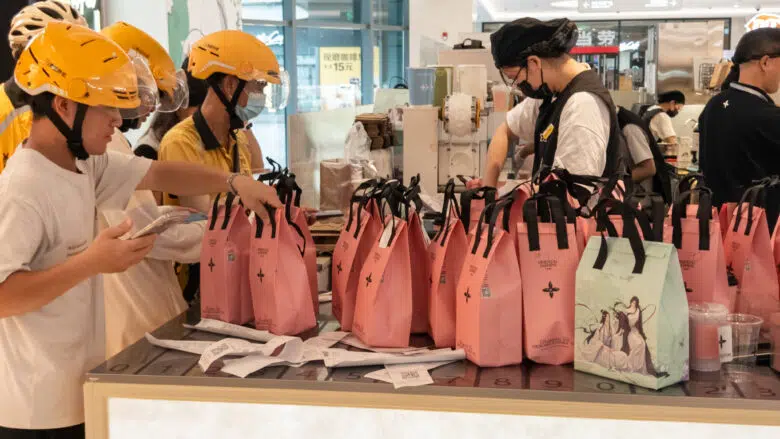
CHONGQING — For years of living on the road, I thought my most practical money-saving skill was simply never getting tired of instant noodles. But in May 2025, my diet suddenly “upgraded” — thanks to a new group-meal feature launched by China’s largest food-delivery platform, Meituan.
In that tab, users could get a full serving of 15 dumplings for 4–5 yuan (50-70 cents), or a cup of coffee or milk tea for 1–2 yuan (12-25 cents). I had just moved from a rural county in Yunnan Province — where delivery services were still limited — to a hostel in downtown Chongqing. It all felt like a special kind of “urban benefit.”
For the latest news & views from every corner of the world, Worldcrunch Today is the only truly international newsletter. Sign up here.
Soon, other platforms joined the battle. JD.com launched its own service in February and, on April 11, rolled out a 10-billion-yuan ($1.4 billion) campaign to subsidize below-market prices. Competing with Meituan, JD added another incentive: if an order arrived more than 20 minutes late, it would automatically become free.
Witnessing this commercial war unfold, I began noticing a pattern while staying with a friend in Guangzhou that June: if I placed an order 30 to 60 minutes after a heavy rain began, my food would likely be pushed to the back of the delivery queue. Delays were common, and late orders meant free meals.
Before long, I had developed an informal cheat sheet for “milking the platforms” — order when it rains and the system is overwhelmed, compare prices across apps, and target brand-new restaurants offering steep promotions.
Back then, I didn’t think much about how this race-to-save affected delivery riders. That changed the day I opened my door to find a rider in a soaked raincoat, panting after climbing to the fifth floor with no elevator in my building. Many older buildings in Guangdong are the same, yet riders are still expected to deliver to the door, even on the eighth floor.
That day, not only did I not get a free meal, I tipped the rider. Afterward, I stopped “gambling” on late deliveries. Even when I did order, I tried to run downstairs to meet riders halfway.
For months, the first thing I did every morning was open all three delivery apps to check the day’s sales and average prices, then plan my meals. I built up an entire logic of budget-friendly ordering:
- Don’t order ultra-cheap pork-rib rice — it’s almost always bone, not meat.
- Cheap chicken dishes are usually fine: chicken is inexpensive and hard to ruin.
- If eel, steak, or sushi is always cheap, beware — the quality is probably terrible.
- If an expensive dish suddenly becomes affordable for a few days, it’s likely a new restaurant trying to boost volume before raising prices again.

Guilty pleasure
While the reality is that not everyone dives into the “takeout battle” as deeply as I did. Some people still enjoy cooking or prefer maintaining control over their diet. I’ve never been a food snob. When I lived in the border city of Ruili in Yunnan, I made friends with local Burmese residents by eating my way through every Burmese snack stall I could find — and eating out was cheap. A bowl of rice noodles cost 8 yuan ($1); neighborhood canteens offered protein and vegetables by weight. It was easy to keep my daily food budget under 15 yuan ($2.10).
Big cities are different. In 2021, I lived in a Beijing alleyway. The cheapest Shan’xi noodle meal within a five-minute walk — a bowl of vegetarian noodles with no protein — cost over 20 yuan ($3). Most other options were trendy restaurants or “private kitchens” starting at 50 yuan ($7) per person.
By comparison, running the numbers on discounts and ordering from newly opened restaurants with balanced meals often became the most practical choice.
In the post-COVID economic downturn, young urbanites are often struggling just as much as delivery riders. My friend Qing works at a public institution as a non-staff contract employee. She earns less than 5,000 yuan ($700) a month, works from 7 a.m. to 5 p.m., and frequently stays until 10 p.m for extra work. With only one or two days off a month, she has no energy left for grocery shopping or cooking. For her, takeout is one of the few chances to pay for a service exchange instead of always providing it.
But low prices do not mean no cost. To keep meals cheap, food quality is often first to be sacrificed. Many people wonder whether these ultra-low-cost meals are even safe. I often reassured myself that the price war wouldn’t last forever — and even if some shops were using rotten vegetables or gutter oil, a few months’ worth probably wouldn’t give me cancer overnight.
Plastic waste
What bothered me far more was the amount of plastic waste. In many small eateries, owners provide disposable tableware even for dine-in customers because hiring a dishwasher costs more. Because of that, the blame for “white plastic pollution” often falls on consumers — the people who order takeout.
If delivery weren’t this cheap, I wouldn’t be ordering it.
One friend told me the delivery frenzy had turned her into an environmental polluter. She rarely ordered takeout before. Now, most of her meals arrive in disposable containers, along with two daily cups of discounted coffee or milk tea — and sometimes late-night barbecue orders lured by those platform discounts.
“If delivery weren’t this cheap,” she said, “I wouldn’t be ordering it.”
She’s not alone. Online, self-described “victims” of the delivery wars complain of ending up in the hospital with gout or with high blood pressure, high blood sugar, and high cholesterol — after drinking four or five heavily discounted coffees or milk teas a day, or way too much accumulated overtime.
It may look like a self-control issue, but the root remains the same: discount-driven overconsumption piling on hidden costs — financial, environmental, physical. For many young people, every tap of the “order” button carries equal parts pleasure and guilt.
Delivering to earn, ordering to save
The takeout boom coincided with another phenomenon: more and more young people were joining the ranks of delivery riders.
Hao, a 2025 high-school graduate from a county in Guangdong, signed up for three platforms — Meituan, Ele.me, and JD.com — right after finishing the national college-entrance exam “Gaokao”, just trying to be financially independent. A 2–3 kilometer order in his county paid only 2–3 yuan (20 cents).

A month later, the delivery war hit full force. Orders surged. One night, he took eight consecutive orders from a milk-tea shop staffed by only two or three workers, with order slips stacked sky-high. On another day, he was fined more than 20 yuan ($3) for a late delivery — nearly one-third of his total earnings for the day.
By mid-August, sales shrank while the number of riders soared. Not enough orders for him to earn a living, Hao eventually quit and decided to look for other jobs instead.
Jin, who worked as a part-time courier in Guangzhou, delivered meals from KFC, McDonald’s and Pizza Hut, earning up to 8 yuan ($1.10) per order. At his busiest, he started at 7 a.m. and rode for over 10 hours, making up to 400 yuan ($56) a day. During the Chinese New Year, he completed 10 consecutive days of 30-plus orders and eight-hour shifts, earning a 500 yuan ($70) bonus.
Their world narrowed to two questions: How many hours should I ride today? How much can I make?
But delivery work was far from ideal for him. Jin noticed many young riders initially saw it as a temporary gig to save money. Over time, they forgot what else they could do. Their world narrowed to two questions: How many hours should I ride today? How much can I make?
For both Hao and Jin, delivery was a last-resort option: flexible, low-barrier, and temporary. Hao said the job helped him save money but offered no connections or long-term path. Jin always thought music was his true calling, but family issues and a criminal record barred him from steady work. Delivery was simply the fastest way to fund his dream of producing his own album.
Sharing relief
I never became a delivery rider because I’m a terrible driver — even obeying every traffic rule, I still manage to crash scooters. But the highest-paying job I’ve ever had was in a bar. In that line of work, though harassment of female employees is accepted by management.
Some friends asked why, being well educated, I would accept this. But the truth is simple: those few months of high income bought me time later — time to write, to take low-paid projects I cared about, to study without panic.
Growing up, my parents gradually earned more and gave me enough allowance to eat well. I secretly saved some of it to buy the albums and magazines I loved.
As an adult, even while earning my own money, I never knew when a sudden layoff might hit. Even in stable periods, I constantly did the mental math: How much humiliation do I endure to earn this one meal? Is the trade-off worth it?
It’s the same logic that platforms use.
Many of my friends — young, creative, curious — are stuck in factories, delivery jobs, tech giants or bureaucratic systems.
YY, the friend who now orders delivery nonstop, once worked at a major tech company where productivity was measured down to the decimal point. Managers insisted the company was facing a “difficult period,” so everyone had to boost efficiency — and whenever they reached a target, the managers raised it.
It’s the same logic that platforms use when they keep shortening delivery times for riders.
YY survived three rounds of interviews and was selected from what she was told were tens of thousands of applicants. But she quit after six months because of the pressure. Today, she indulges her love of food through delivery apps’ endless discounts.
For many young people in China, this cycle never ends: delivering takeouts to make money, ordering takeouts to save money — that tiny loop of survival is the only simple relief we have.