-Analysis-
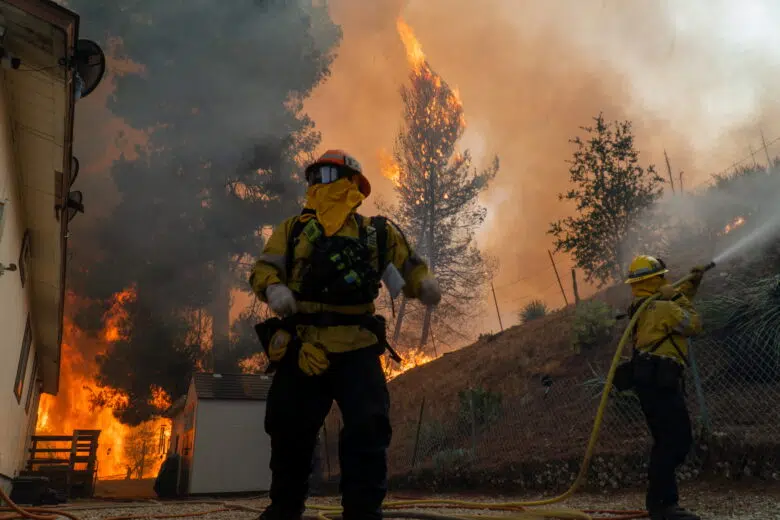
LOS ANGELES — Sunset Boulevard is one of the world’s mythical streets. It used to run from Hollywood’s dream factory all the way to the dream homes of Pacific Palisades. Today, the first thing that stands out are the charred tree trunks. Then, at the entrance to Will Rogers State Park, a sign announces: “Closed for public safety.”
For the latest news & views from every corner of the world, Worldcrunch Today is the only truly international newsletter. Sign up here.
The real devastation became clear on an August visit only once you follow the boulevard up the hill. House after house has burned down to nothing. All that remains are foundations. The outline of a pool. The warped frame of a basketball hoop. In one yard, a luxury sports car has survived, completely blanketed in dust. Block after block, street after street, the scene repeats itself. In front of the few houses that are almost intact, signs read: “Valuables removed, nothing inside.” A warning to anyone tempted to loot what is left.
Last January, the largest fire disaster in Los Angeles history killed 30 people, destroyed more than 16,000 buildings, and caused up to a quarter of a trillion dollars in damage. What remains is a vast monument to the recklessness of building in high risk areas, and to natural disasters that are becoming more intense and more frequent. Monster storms like Hurricane Helene in Florida last year. Massive floods like those in southern Spain in 2024 or the Ahr Valley in 2021. And if climate change continues pushing this pattern, a major financial crisis is on the way.
The scenario runs like this: after repeated fires, storms, and floods, insurers pull out of high risk regions. Once homes can no longer be insured, new mortgages dry up. Owners are forced to sell, prices collapse, and existing loans go unpaid. Banks that issued the mortgages get squeezed. As the climate risks keep rising, more properties end up in foreclosure. At some point, financial markets can no longer absorb the shock.
Competing scenarios
There is already plenty of talk about possible crashes: the result of excessive investment in artificial intelligence, a boom in private lending, or hedge funds gambling with government debt. Those are crises born inside the financial system. A climate driven crash would be different. Global warming would strike directly at the global economy that caused it. And no one has any real idea how such a crisis could be contained.

Few have sounded the alarm more forcefully than an Austrian working for Allianz in Munich. Günther Thallinger, the board member responsible for the company’s multibillion euro investments and for sustainability, issued a warning on LinkedIn at the end of March unlike anything previously heard from a major financial executive. With the atmosphere now saturated with greenhouse gases, all forms of property are becoming more vulnerable: houses and land, roads and railways, ports and factories, energy networks.
“Entire asset classes are being devalued,” he wrote. Until now, insurers have carried these risks. But the planet is warming so quickly that many threats are becoming uninsurable.
Cap emissions, not insurance premiums
The warning echoed the disaster in Los Angeles. But for Thallinger, L.A. is simply one example among many. From Australia to Asia to the Mediterranean, nature is increasingly unpredictable. And costs like those from the Ahr Valley flood will be nearly impossible to manage if such events keep multiplying, as expected.
Allianz itself has not yet been hit hard by rising climate risks. In fact, uncertainty drives up demand. Policies usually last only a year, says Thallinger, so prices can be quickly adjusted. “Premiums change logically with the development of the risk. Those calculations are not difficult for us.”
The question is how long people can afford to insure themselves.
But the risk rises with the amount of CO₂ in the air. And the question is how long people can afford to insure themselves. Americans already spend almost five percent of their disposable income on home insurance, says the mathematician. “That could rise to ten percent. In Europe the percentage is lower for now, but the same trend is expected, especially along major rivers and in Mediterranean countries.”
Some governments try to keep premiums down with regulations and subsidies. That is not a good idea in Thallinger’s view, because it hides the true danger and ultimately pushes states beyond their financial limits. “We need to cap climate emissions, not insurance premiums.”
Tools of economics
Since there is no sign of a rapid shift in climate policy, the question becomes how to manage at least the financial fallout. Researchers at the University of California, Berkeley, are studying this intensely, with wildfires repeatedly sweeping down from the hills toward the university town across the bay from San Francisco.
At the end of August, students are returning for the fall semester, moving boxes stacked outside their dorms. Economics professor and real estate expert Nancy Wallace walks toward a café. She joined the university’s Haas Business School in 1986. Five years later, she watched her house in the hills above the campus burn in the catastrophic 1991 fire, along with about 3,000 others.
“More than 30 people died on the road my husband and I used to escape,” she says. Today, Wallace turns the tools of economics toward preventing a climate driven financial collapse. For her, that starts with giving rising natural disaster risk a realistic price.
California is the key test. Forty million people live in an economy that would rank as the world’s fourth largest by itself. According to the local real estate association, the average single family home costs €750,000. If prices fall sharply after a string of disasters, the financial world will feel the shock. The foundation of a trillion euro mortgage market depends on property values that may now be far more fragile than assumed.
Vicious cycle
Many barriers still stand in the way of realistic risk pricing in California. Fire risk is often calculated only at the level of broad regions, although danger can vary drastically from one street to another. Premiums are still tied to outdated claims data. “But the hot, dry winds blowing in from the Nevada desert are becoming stronger and warmer,” Wallace notes. They push coastal canyons to temperatures up to 65 degrees Celsius (149°F), hotter than anything seen in a century of records. “Events that were supposed to occur once every hundred years are happening far more often. We need prices based on local forecasts.”
What happens without such prices can be seen in the case of insurance giant State Farm. In May, after suffering billions in losses from the Los Angeles fires, its California subsidiary was allowed to raise home insurance premiums by about 20%. Consumer advocates are now challenging that increase. “If they succeed, State Farm will leave California,” Wallace says.
Other insurers are already retreating from high risk areas because they cannot break even under the allowed premiums. Homeowners are pushed toward the expensive and poorly protected state run Fair Plan, or left uninsured. But without insurance, mortgages are not granted. That is how the cycle of soaring premiums, unpaid loans, and foreclosures begins.
At the same time, people have little incentive to move away from danger zones. Reconstruction programs even encourage homeowners to build larger houses than before. The public pays the bill. Wallace and her team of engineers and physicists are developing a hazard prediction system that uses data from across California. Their models identify one region as the most at risk, Wallace says, pausing before naming it: “Pacific Palisades.”
Even the fourth largest economy in the world cannot afford the rising exposure.
She also argues for incentives to build more fire resistant homes and reduce risk to the public. Even the fourth largest economy in the world cannot afford the rising exposure that stretches from insurance to mortgages, she says. Nor can the country as a whole. The government-backed mortgage giants Fannie Mae and Freddie Mac alone hold or guarantee around $8.1 trillion in loans. “We need honest prices. Otherwise the markets will collapse.”
Dave Jones learned firsthand how difficult it is to fight for realistic premiums when he served as California’s insurance commissioner from 2011 to 2018. Now director of the Climate Risk Initiative in Berkeley, he helped draft global principles for sustainable insurance regulation. Conservative states rejected them. Twelve even threatened legal action, he says during a telephone interview.
Instead, insurers now increasingly refuse to renew policies for homes near wildland areas. That sends costs soaring, and house prices should in theory be falling. “But no one is noticing yet because California’s housing market is overheated. The state is short two million housing units. And local governments want to keep building.”
The danger stays hidden. Research by leading U.S. universities shows that in regions affected by climate change, many risks are passed on to the state while people keep building. Until natural disasters erode the system so deeply that the state can no longer cope. Until insurers go under and homeowners can no longer pay their mortgages. Then, Jones says, “the debt markets will face extreme difficulty.” He does not believe an abrupt crash is needed. “A slow slide into the abyss is more likely.”
“No one knows”
Will the crisis hit all at once or creep in gradually? No one knows, says Johannes Ströbel, a German-born professor at New York University who studies the financial consequences of climate change. “We do not fully understand the risk, including what it would take to manage it.”

The crisis could resemble the 2008 global financial meltdown. Back then, a crucial risk was ignored, namely the weak creditworthiness of many homebuyers. When inflated real estate prices began to fall, the vast market for subprime loans collapsed. Many borrowers could not repay, and the first mortgage banks went under. But by then most loans had been securitized, bundled into opaque financial products, and sold worldwide. Even the German government had to rescue its state banks after they bought these worthless securities.
Not priced in
According to Ströbel, today it is the danger of climate change that is not priced in. Real estate is overvalued as a result. If investors start to account for the risk, a sharp correction could follow. “Then there will be a collective and rapid reaction,” he says.
That reaction would almost certainly begin in the United States, where around $11.6 trillion in mortgages are securitized and traded. The rest of the world would then feel the impact, because financial institutions everywhere hold these securities and must absorb climate losses in their own regions as well.
Whether this climate time bomb explodes in the financial markets depends on questions no one can currently answer. Will construction in high risk zones be limited. Will new dams be built to prevent flooding. Will fire resistant roofs become standard. With so many uncertainties, no one can say how much real estate is overvalued, Ströbel explains. But public awareness of the overvaluation could rise at any point, with a blunt message: “Climate change is making us poorer and destroying capital.”
Driving through the disaster zone in Pacific Palisades, we descend again toward the business district along Sunset Boulevard. More signs appear on almost every property. Some owners want to sell their land. One has posted a defiant message: “Palisades forever.”
Elsewhere, signs for construction companies stand in the ruins. And in two places, workers have already begun erecting new structures from thin, pressed wood. Larger than before. And even more flammable.

