

-OpEd-
BUENOS AIRES — The doctor hits the tendon below the knee with his hammer, and the leg moves. It’s a reflex action. The tendon stretches, the muscle contracts. In the universe of reason, on the contrary, actions are usually initiated through language. “I’m going to buy bread” communicates intention outward and “inward.” The legs are set in motion. The use of language is, in itself, an action.
With language, war is declared, and one dies. With language, love is declared, and, in general, one lives. With language one vows to go and buy bread — and to keep that promise. If bread is not bought, the consequences are minor. If the promise is broken, the consequences are moral. That’s language.
Language does so many things, though it is not so good at doing some things, like depicting a tragedy. Language can accelerate or slow down language itself. An insult is language that promotes more insults, acting as an accelerator. An insult is also language that impedes courtesy. There it acts as a break.
Ultimately, language constructs ideologies, political agendas, social contracts, global agreements and philosophies of life. That is how lives are impacted, at the risk of misunderstandings, falsehoods and half-truths.
This concludes our introduction to the topic. That topic: the difficulty of modifying human behavior through languages that collide with others, which establish the behavior we want to modify. For example, in practice, it seems impossible to establish a language that changes humanity’s energy culture, currently sustained by the use of gas and oil, because the discourse that champions the use of gas and oil prevents it.
Sacrosanct words
In Argentina, “gas” and “oil” are sacrosanct words, almost like “field” and “cow.” Our very idea of the country rests on gas and oil. Criticizing this paradigm is like going to the dogs… in a manner of speaking. That is because the carbon-loving discourse overflows into other, untouchable value systems, thus becoming ubiquitous. Gas and oil are life, winter warmth, family, employment, lots of employment, more employment, money and lots of it, income, foreign currency…
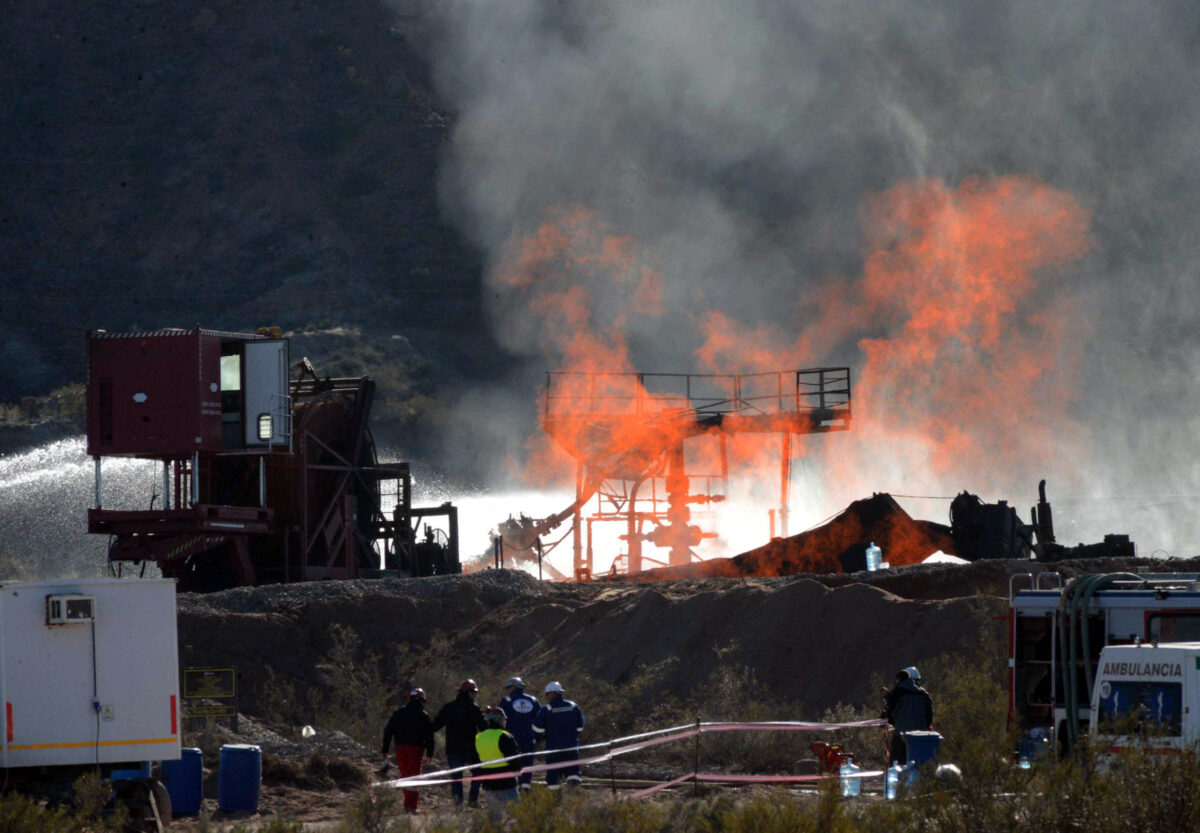
Gas and oil are pleasure and “economy,” a term of surprising semantic breadth that alludes to homeland, sovereignty, well-being (material and spiritual), rights, progress. The discursive avalanche in favor of gas and oil extends to exploration, exploitation, transportation, conversion into fuel, and marketing. A giant among giants: such is this industry, and yet, there used to be other “giants” that were replaced here.
Gas and oil are also pollution and plastic.
It’s hard to go against such a mass of meanings. But why should we oppose an overwhelming discourse and its consequences? Well… it’s a minor detail, but gas and oil are also pollution and plastic. They are the spills on land and sea, the plastic bag hanging on a tree branch in the town square, and the invisible plastic that comes with our food. As always, “everyone” is responsible, but beware! Not everyone is equally responsible.
Let’s leave these details aside. One wonders, is there a relationship between the floods that killed 16 people in the Argentine port city of Bahía Blanca in March, and the hydrocarbon panacea? Who knows… People talk about climate change, but they also talk about it being a lie. Is there a link between those who artfully use language to praise the benefits of gas and oil, and climate change deniers?
A snake pit
The discourse of the star source of global energy is confident — even strident — and covers up “pollution” with other languages. It casts a shadow of doubt over the only language that can lead us to want an energy that doesn’t turn against us with storms, droughts, heat waves, cold waves and human suffering. It is heavy, sticky and difficult to remove.
How do we promote lower-impact energies when the mechanisms that crush arguments in their favor are in charge? It would seem easier to shift the Earth’s axis than change our energy culture: that must be the case when you think this change may need a language more complex than a planetary cataclysm.
Humans are not fit to wield the power of the tool we have been given.
Language establishes itself, deepens and digs a snake pit so no one can penetrate it. Language sets parentheses and raises barriers. The discursive ramifications of gas and oil are almost infinite, and each branch freezes us inside a paradigm. Language turns us into a particular form of life, like penguins with their wings for swimming. Only, the penguin doesn’t complicate its life because it doesn’t fly. Humans, on the other hand, are not fit to wield the power of the tool we have been given.
The argument against the hydrocarbon god paradigm is that the penguin dives deep to catch fish, which it then takes back to the nest to feed its chicks. This essential language of life sounds comical when compared to the language of gas and oil. And yet, it’s the only one that allows us to understand what happiness and well-being mean to the human way of life. It’s a shame we’ve been given the ability to say so much, without the reassurance of understanding our words.