
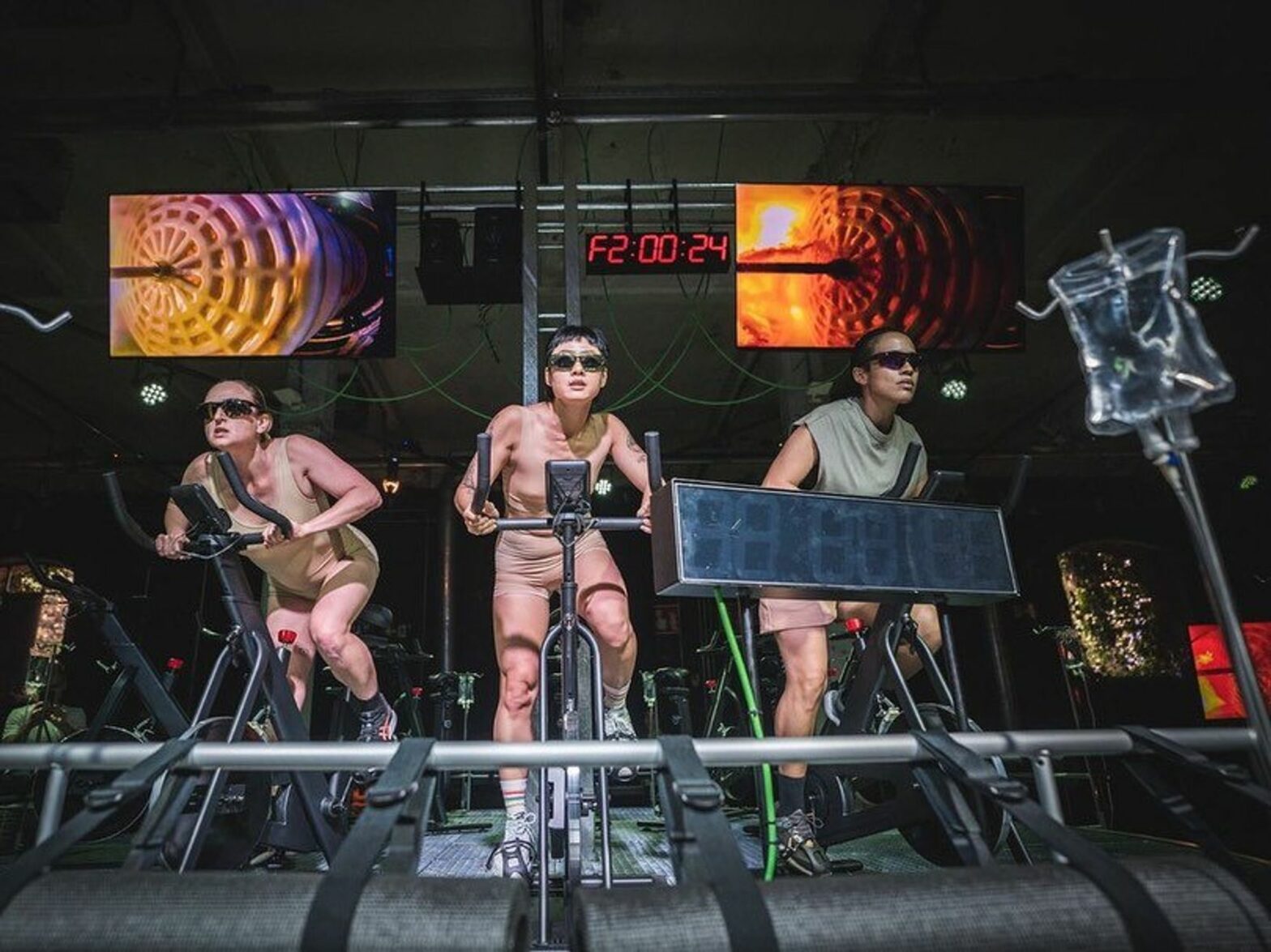
MADRID — Upon entering the concrete hall, what you see looks like a strange gymnasium in a post-industrial landscape. The textures of tires, metal and machine are in different structures scattered around the room. In the center, exercise bikes, droppers, sports mats are arranged into a kind of ring with wheels. A display shows the time in digital numbers; another, the temperature. The lights are dim. Enigmatic sounds are heard and, from time to time, some voices.
We are at Intermediae, a space in Madrid’s Matadero cultural center that, until July 28, is hosting the exhibition “Clima Fitness — Rituales de adaptabilidad” (Climate Fitness, Rituals of Adaptability). According to its curator, Maite Borjabad, the exhibition is intended to be an invitation to think: “We are more capable of imagining the end of the world than a different world. This pessimism is a comfortable space.”
“I’m more interested in taking a step back, in asking myself how we got here in this process, and what is the social and cultural background that imposes limits when it comes to thinking about change,” she continues. In a previous work called “Designs for Different Futures,” this Spanish architect and artist had already worked on a similar idea: “The future is multiple. We always talk about it as if it were singular, but understanding it as plural allows us to gain agency, instead of thinking of it as a given”.
Two meanings of climate fitness
This is why the works in this exhibition do not offer univocal answers, but rather make suggestions that open up different possibilities.
The five works at the heart at the exhibition are displayed along the architecture, in a space created by the design studio Common Accounts. Igor Bragado and Miles Gertler of Common Accounts are also the authors of the essay “Planet Fitness” (2019), which develops an idea that offers at least one interpretation to the exhibition: that of “climatic fitness”.
The concept, which comes from biology, originally designated the capacity of an organism to adapt to an environment and its transformations. But in recent decades, it has been used in popular culture to refer to the physical and mental preparation that people undertake to face a possible environmental collapse. Borjabad tries to connect both interpretations in the exhibition — as a reminder of the enormous kinship between a body and an ecosystem.
For example, projected on the screens hanging over the central structure are fleshy masses that rotate around an axis. Meanwhile, the silhouettes of skaters, gymnasts and other athletes rotate on other small adjacent screens. They are part of the installation “Faster, Higher, Stronger” by the Chinese-American artist Mary Maggic.
The hard-to-identify masses that appear on the screens are being recorded live. They are a reserve of scoby, symbiotic cultures of bacteria and yeast used to make the fermented drink kombucha, that is being held inside drums that rotate every time a visitor gets on one of the connected exercise bikes and pedals. So while the visitor’s muscles produce lactic acid, other matter grows in another acidic space. Everywhere you see wires, duct tape, connections.
Part of a continuum
For Borjabad, an important characteristic of the artists whose works make up the exhibition is that their practices are based on research: “Each of these pieces is like a crystallization that is part of a continuum,” she says. Thus, “Clima Fitness” is also a small showcase of contemporary art-based responses to climate change.
“When we think about how we got here, we find that it has often been through binomials: man-woman, natural-cultural, human-machine. For me, the question is how we can reconfigure ways of adapting that don’t take hierarchy for granted,” Borjabad explains. That is why several pieces work with these binomials. Spanish artist Itziar Barrio, for example, looks at the relationship between the natural and the technological, and intertwines the idea of the cyborg with the queer.
Her piece in this exhibition, “Robota MML” — the names come from a Soviet play that first introduced the word robot — is part of a trilogy in which Barrio questions the relationship between work, matter and identity. Projected in a loop, “Robota MML” is a film that fills the room with bodies and mist. Through the recurring image of a bodybuilder, it “reveals how the human body is a production, a manufacture,” according to the exhibition’s room sheet.
The exhibition suggests that there are many ways to think about all these and many other open questions.
The exhibition’s invitation to think aims, above all, to go beyond the most obvious thoughts about the climate crisis. For example, something that looks like strange insects are attached to several columns of the hall. Seen up close, they are the soles of sneakers, on which honeysuckle, daffodil, rosemary or sunflower seeds have become entangled and are unwittingly being carried from one place to another as they run through the city.
But the work to which they belong — “Carriers,” by Turkish artist Faysal Altunbozar, which is on display alongside his “Chicago Gears” — has more elements, pointing to more ideas.
Two other pieces that look like unfolded camouflage backpacks, with fabrics and zippers between mysterious silhouettes in shades of orange, brown and red, allow him to represent the different layers that overlap in a specific place: a bird sanctuary that is also a public park and a cruising spot, and that in the past was a military base. Perhaps there is never only one way to read a site, Altunbozar seems to remind us.
New mythologies
British Nigerian artist Ibiye Camp also speaks of movement and narratives, although in her case on a planetary level, in “Mutant-Tees Replicants of a Mutated Kola-Nut Production Line.” The work is made of two worn-out T-shirts and a video screen that takes us to West Africa, where the raw material of the famous soft drink comes from.
The video art, reminiscent of collage, evokes a historical journey that goes from the colonial exploitation of natural resources to the boomerang-like return of counterfeit sportswear displaying the advertising of the brands that profit from it. The shapes of the screen are almost as dizzying as the idea itself.
But let’s remember: the idea of the exhibition is not only to make the right diagnosis, but also to imagine ways out. The last of the works on display, “Ejercicios a Ofelia,” by Spanish artist Irati Inoriza, is a bid to invent new mythologies. Based on the well-known painting by English artist John Everett Millais, she proposes an audiovisual recreation in which Ophelia recovers her protagonism and her capacity for action.
Inoriza was helped by the synchronized swimming team from the town of Getxo, architects of a dance in which the bodies are constantly entering and exiting the water. Framing the screen, two dreamlike sculptures build a ladder and a diving board with pieces that also evoke parts of the body. The poster explains that, for the artist, the work also refers to the figure of the lamia, a Basque mythological character who inhabits riverbeds.
But, beyond the exhibition panels, nothing is explicit in the works of Clima Fitness. The exhibition’s proposal is precisely to suggest that there are many ways to think about all these and many other open questions. And that the most convenient is perhaps to take them all in — the more the better.
“From the mere enunciation of ideas we reach the limit of the system itself. That is where art’s power lies: as it works from fragmentation, in the spaces of emptiness spaces of possibility open up, a gap of thought,” Borjabad explains.