Updated Feb. 13, 2024 at 11:20 a.m.*
-Analysis-
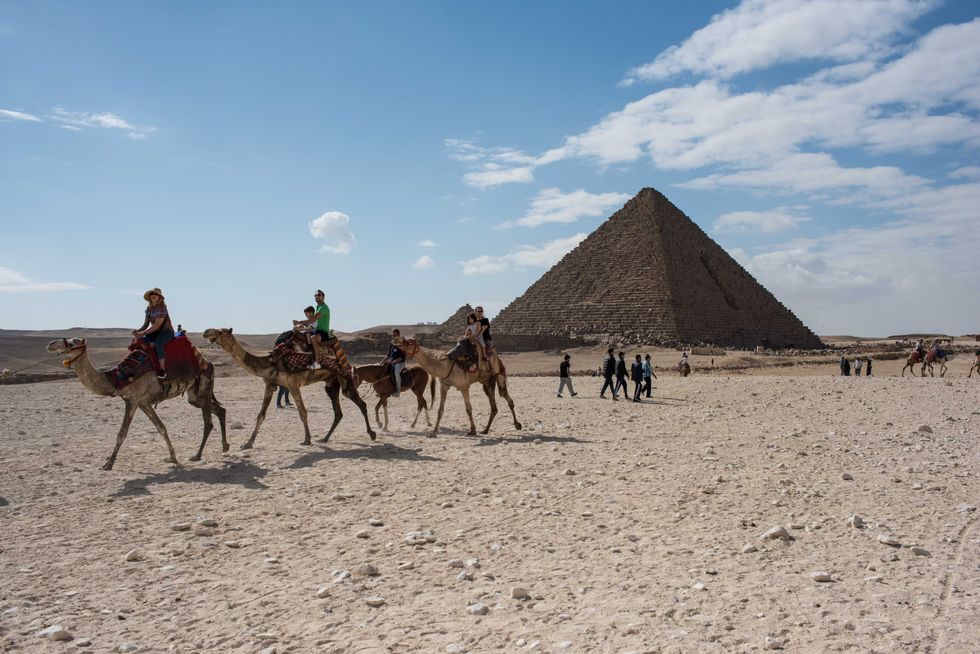
CAIRO — It was more than two weeks ago, on Jan. 25, that a senior Egyptian antiquities official took to social media to announce what he called: “the project of the century.” The project in question was an Egyptian-Japanese archeological mission to rebuild the outer granite face of the smallest of the famed Pyramids of Giza.
Mustafa Waziri, Secretary General of the Supreme Council of Antiquities, which oversees all archaeological projects in Egypt, was seen in a video standing among workers beneath the pyramid, Menkaure. The three-stage project, he vowed, would last for three years.
For the latest news & views from every corner of the world, Worldcrunch Today is the only truly international newsletter. Sign up here.
The announcement triggered a sea of controversy and no shortage of sarcasm on social media. One Facebook user captured the nature of the reaction, posting a picture of the Leaning Tower of Pisa, with the quip: “The project to restore the Tower of Pisa to its existing state!”
Waziri’s announcement stirred the ire of many archaeologists and Egyptologists. Monica Hanna, one of the best-known Egyptian researchers, slammed the project, saying on X (formerly Twiter): “When will messing with Egypt’s antiquities end!”
Menkaure is the smallest of Giza’s three pyramids. It was built by Pharaoh Menkaure, the grandson of Khufu, the owner of the first Pyramid, and the son of Khafre who built the second Pyramid. Khufu was the first Egyptian Pharaoh to build a pyramid.
It is not known exactly when the pyramid was built, but most likely, dates back 26th century BC, that is, more than 4,500 years ago.
Waziri says that Menkaure is the only pyramid that was covered with granite, but for unknown reasons, most of the stones fell off. He said seven out of up to 18 courses of stones that formed the facade remain.
The project aims at restoring the facade through stones littered around the pyramid. Such stones would be laser-scanned to determine its exact location on the facade, according to Waziri who appeared in another video clip along with Sakuji Yoshimura, head of the Egyptian-Japanese mission. Yashimura has worked in Egypt for more than 50 years.
“Cinematic presentation”
Hanna, the researcher, said in televised comments that it’s been long known that the stones scattered around the pyramid were not installed by the ancient Egyptians. This was definitively proven early last century by American Egyptologist George Andrew Reisner.
“We must not do what the ancient Egyptians did not do,” she said. “Our installation of these stones will affect the authenticity of the pyramid.”
None of the former Egyptologists, Egyptians or foreigners, dared to submit such a project.
Dr. Mohamed Abdel Maqsoud, former Secretary-General of the Supreme Council of Antiquities, agreed with Hanna. He said that not all of the stones around the pyramid were part of the facade: some were specific to the funerary temple, and some were never used because Menkaure had died, and his son didn’t finish the pyramid.
Hanna also said that to proceed with any renovation, reliable scientific references published in a well-known periodical were needed first. She said a “cinematic presentation” is not enough to embark on such a huge project.
Dr. Muhammad al-Kahlawi, President of the Arab Council of the General Union of Arab Archaeologists, issued a statement titled: “Stop messing with Egypt’s Antiquities.”
“None of the former Egyptologists, Egyptians or foreigners, dared to submit such a project,” he said.
Al-Kahlawi recalled an incident in which a former antiquities minister attempted to research the tomb of Tutankhamun in a way that would have led to its destruction. That project was stopped only after archaeologists appealed to the country’s president at the time, he said, and urged authorities to stop the Menkaure project.
Step back
For Salima Iktam, professor of Egyptology at the American University in Cairo, the idea of restoring the facade of the pyramid could be acceptable if it depends on the original stones without any additions.
The backlash prompted a remarkably rapid reassessment by the government, which announced it will put the project on hold until a committee of experts studies it and decides on the best way to move forward.
The backlash reflects the public’s deep mistrust in the government in handling the country’s treasures.
Waziri attempted to tone down his original description, telling local media that it is just a study that would be examined by independent experts including Egyptologists from the U.S., Germany and Egypt.
He added that the project will then be presented to UNESCO “for coordination and opinion.”
The backlash reflects the public’s deep mistrust in the government in handling the country’s treasures. Many still feel outraged by the demolition of graves at centuries-old cemeteries in Cairo over the last few years.
*Originally published February 9, 2024, the piece was updated on Feb. 13, 2024 with additional background material and enriched media.