Overview:
Central Asian presidents have been fixtures at Moscow's Victory Day parades since 2022, but this year, their visits were preceded by a wave of diplomatic tensions.
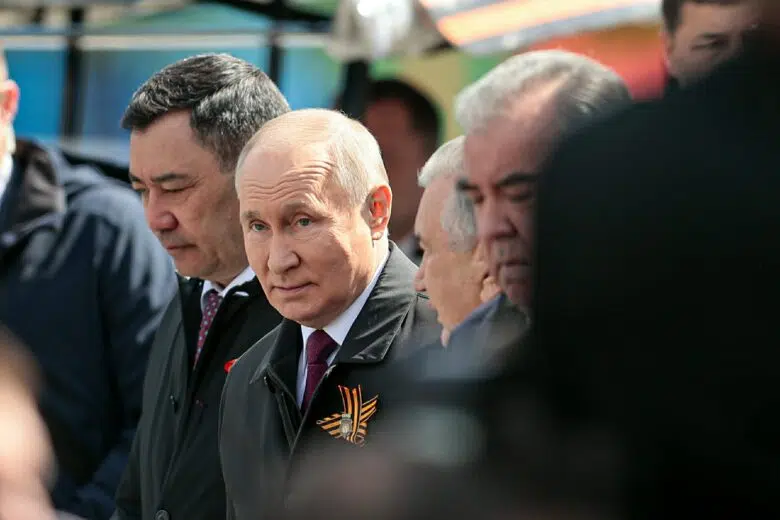
BISHKEK — Since Russia’s full-scale invasion of Ukraine in February 2022, the regular presence of Central Asian presidents at Moscow’s Victory Day parade has been seen as a symbol of their continued dependence on Russia. They’ve been among the few foreign leaders to appear on Red Square year after year.
For the latest news & views from every corner of the world, Worldcrunch Today is the only truly international newsletter. Sign up here.
They also attended this year’s 80th anniversary of the capitulation of Nazi Germany to the Red Army — an event marked even by the presence of the Chinese and Brazilian presidents. But this year, their presence at this year’s parade, held on May 9, was preceded by a wave of diplomatic tensions.
For the first time, Kyrgyzstan arrested Russian recruiters. In Uzbekistan, Russian Foreign Minister Sergey Lavrov received an unusually blunt rebuke. And Russian and Turkish media reported that Kazakhstan plans to deploy eight of its 20 Territorial Defense units near the Russian border. Kloop spoke with experts to understand what this series of sharp diplomatic gestures could signal.
A shift in tone
Mere days before the Moscow parade, Kyrgyzstan’s State Committee for National Security announced the arrest of four people on charges of recruiting mercenaries. These included Natalya Sekerina, an employee of the Russian House in Osh, and Viktor Vasilyev (AKA Lukovenko), a nationalist political strategist linked to Yevgeny Prigozhin’s network and alleged to be a GRU agent. The arrests came shortly after a wave of brutal assaults on Kyrgyz migrants by Russian police in Moscow. Until now, Kyrgyz authorities had only detained their own citizens for involvement in mercenary activity — and one of those was quickly released with Moscow’s help.
On the same day, Russian Foreign Minister Sergey Lavrov faced an unexpected public rebuke in Uzbekistan. While visiting Samarkand, Lavrov expressed surprise that a monument to the eternal flame included an inscription in English but not in Russian. In response, Sherzodkhon Kudratkhodja, rector of the University of Journalism and Mass Communication, retorted that Uzbekistan is not a colony and decides for itself what languages to use — adding that Russia should instead focus on protecting the rights of migrants. Although Kudratkhodja is not a government official, in the Uzbek political system such statements are almost certainly coordinated at a high level. And this wasn’t the only sign of a shift in tone.
On May 2, Uzbekistan’s Foreign Ministry announced that it was investigating reports that 1,110 of its citizens had signed contracts to fight in Ukraine. That same day, the ministry also expressed concern to Russia’s ambassador over the harsh treatment of Uzbek migrants.
There’s a definite sense that statements have become tougher.
April, in general, was a month of bold moves in the relationship between Central Asia and Moscow. On April 16, Kazakhstan’s Mazhilis (lower house of parliament) passed a law on territorial defense. In response, Russian and Turkish media speculated that the largest deployment of territorial defense forces would be positioned along the Russian border — though in reality, this is due to the number of border regions.
Then, on April 23, Kazakhstan’s Ministry of Culture announced an investigation into the state-run outlet Sputnik Kazakhstan, after social media users accused it of war propaganda—specifically over a report featuring a Kazakh national fighting for Russia against Ukraine.
Just four days later, on April 27, Andrei Grozin, head of the department of Central Asia and Kazakhstan at the Institute of CIS Countries, was denied entry into Kazakhstan. Orda notes that Grozin had previously spoken about Kazakhstan in a chauvinistic, imperial tone.
“There’s a definite sense that statements have become tougher — although I’d single out Uzbekistan in particular,” says Temur Umarov, a research fellow at the Carnegie Russia Eurasia Center in Berlin. “Uzbek officials have regularly and sharply responded to Russia’s claims, but this was the first time it involved someone of Lavrov’s rank. As for the other countries, they may have been influenced by the example of Azerbaijan, which began to behave rather boldly with Moscow.” This is especially true since an Azerbaijani airplane was shot down over Chechnya in December 2024.

Moscow’s sphere of influence
According to Umarov, Kyrgyzstan’s actions are also likely to influence its neighbors. Other Central Asian states may begin scrutinizing the activities of Rossotrudnichestvo (the Russian government’s cultural outreach agency) and Russian-affiliated individuals on their own territory. Moscow, he says, has overstepped the bounds of implicit agreements with local elites, over-exploiting the region’s political loyalty.
“It’s one thing when migrants in Russia are told, ‘Don’t go to war or you’ll be jailed.’ But it’s another thing entirely when that [recruitment] is happening at home,” Umarov explains. “It’s highly unlikely that Moscow ever approached our elites with an offer like: ‘Let us recruit through Rossotrudnichestvo, and you just look the other way.’ Maybe they would have agreed — if Russia had offered something meaningful in return. But apparently, it didn’t.”
“I don’t think our elites are particularly principled or concerned about casualties among the people being recruited,” he adds. “What’s really going on is that they’re raising their asking price. Even in this area, they could’ve struck a cold, cynical deal behind closed doors — but that clearly didn’t happen.”
The Kremlin still holds leverage over Central Asian regimes.
Overall, no fundamental shift has yet occurred in the relationship between Russia and the Central Asian states, says Kazakh political analyst Dimash Alzhanov.
“Yes, we’re seeing responses from political leadership to specific incidents — information attacks, the war, recruitment efforts and the mistreatment of labor migrants,” he explains. “But these reactions don’t lead to a meaningful revision of either domestic or foreign policy aimed at strengthening economic resilience or independence to reduce Russian pressure. Despite the occasionally sharp rhetoric in the media space, the Kremlin still holds leverage over Central Asian regimes to keep them within its sphere of influence.”
The deep and multi-layered ties with Russia continue to exert significant influence on the economic and social stability of Central Asian states. Most of their exports are routed to global markets via Russian territory. Russia remains their key trading partner and investor.
For Uzbekistan and Kyrgyzstan, it is the main destination for labor migration, as well as a critical source of energy, food supplies, and military equipment. Moreover, for Kyrgyzstan, Russia is still viewed as a guarantor of security — though Moscow’s actual capacity to fulfill that role is increasingly being called into question.