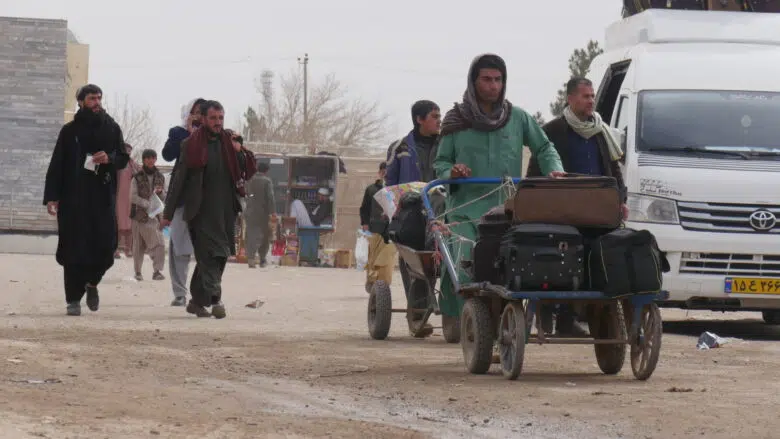
LONDON — Iran has stepped up deportations of undocumented Afghans in recent months, claiming it lacks the resources to support them. “Iran does not have the capacity to accept so many guests,” Interior Minister Iskandar Momeni said back in March, adding that “job opportunities have been taken and subsidies are being spent on these nationals, so God willing, they’ll return and develop their country.”
For the latest news & views from every corner of the world, Worldcrunch Today is the only truly international newsletter. Sign up here.
Since then, more than 1.3 million Afghans have returned to Afghanistan, according to the Office of the United Nations (UN) High Commissioner for Refugees. Iran has redoubled its effort since the 12-day Israel-Iran war in June. Kayhan-London spoke to several Afghan migrants to further investigate the matter.
Confusion at the border
Omar Kamal is an Afghan citizen who says he was expelled from Mashhad in northeastern Iran and sent back to Afghanistan in mid-June. He says Afghan migrants are expelled on the border with their passports, census cards and other documents; their SIM cards are blocked. He said that when they are identified, they are tortured. Young, single men without families who are found alone are subject to harassment, especially if caught working.
“They took one of my friends and electrocuted him with an electric cable. They harassed him a lot and sent him out,” Kamal says. He adds that “contrary to what they claim, they did not send us back with a cheerful goodbye. The place was full of officers. They dropped us off 300 to 400 meters from the border, then charged us 1.5 million [tomans, roughly 15 to 20 euros] to drive us [to the border] They charged each person two or three times. The treatment was very rough.”
It goes without saying they torture a lot.
“It goes without saying they torture a lot. They’ll harass and beat you before sending you back to Afghanistan. They arrest people with census and residency papers in Iran, while their homes are abandoned and their families are still there. They throw them out with their wives and children still at home. Their money is still in Iran, their rent deposit is with the landlord, the months of wages they are still owed, all that stays in Iran.”
Towhid Khan, an Afghan migrant living in Canada, told Kayhan-London about the experience of a relative, who had just been deported from Iran: “My cousin worked in a workshop, his employer didn’t give him his money and said, ‘Go, and I’ll wire you.’ My cousin said ‘Okay’ and tried to return to Afghanistan, but had lot of problems.” At the border, the agents told him to return to Mashhad, Iran, because his passport was not registered in the system. When he did so, they his passport into his pocket and told him, “You came here illegally” and expelled him.

At a reception center
Kayhan-London spoke with an employee at a migrant reception center, the Islam Qala border point in western Afghanistan’s Herat province. He said the “camp belongs to UNICEF and its costs are covered by donations from the UN, UNICEF, Norwegian Refugee Council, and Afghan philanthropists and businessmen.”
The staffer, who works 18-hour shifts at the camp, says “we are currently distributing food and managing shifts in this camp. The Islam Qala and Nimroz Customs are ready to receive, transport and temporarily or permanently accommodate refugees 24 hours a day. It should be said, the Islamic Emirate [the term used by the Taliban to describe their government] has done absolutely everything to defend and welcome the refugees.”
He says most of “Afghan migrants who were deported were people who, for example, were working in construction with a tourist visa, digging wells with a business passport, or stealing or selling drugs with a pilgrimage visa. The Afghan migrants’ visas were valid between 30 and 90 days and could be extended for three three-month periods, or up to a year, although most of these people quietly stayed on after their visas expired. Some were denounced by Iranian citizens, like landlords for example who did not want to repay a migrant’s rent deposit, calling [the authorities] to say he was a spy.“
80% of these migrants presented themselves voluntarily, for fear of being caught.
He says: “80% of these migrants presented themselves voluntarily, for fear of being caught.” Afghan border authorities, he adds, were treating them appropriately: “Young women and girls are coming into Afghanistan wearing overcoats and trousers and with their hair hanging out [of the headscarf] but the Taliban treat them well. They are given care and attention, provided with temporary accommodation, then free transportation, and financial, food, clothing and charity assistance. They have made preparations so migrants are properly received and do not have bad memories of crossing into the country. They are also very harsh with anyone being abusive with the migrants or their belongings.”
He said that the head of the Islam Qala Customs authority has announced that arrangements had been made by Afghan authorities for the free transportation of returnees’ belongings from just inside Iran as far as their home towns. The customs chief had even told returning Afghans not to pay anyone to take their goods home.
The camp staffer adds, “All facilities have been provided in terms of provisions, mineral water, tea, powdered milk, maternal hygiene supplies, treatment from the Red Crescent, and the migrants who arrived tired and uncomfortable in Afghanistan cannot believe they would see such a favorable, open and warm treatment from the Taliban and people of Herat.”
Special services
The staffer said, “Every day, the people of Herat divide all the migrants into private cars or buses to take them to Herat, and from there, to their provinces by bus. They take many families to shrines, mosques and sports stadiums so that they can take a bath, wear clean clothes, etc.” There is even an order not to interfere with the returnees’ clothing and hijab until they return to their homes. He stressed in conclusion that every day, arriving migrants were moved from the customs authority camp to a migrant camp.
“Upon entering Afghanistan, they are welcomed with open and cheerful faces. Every night, they are transported to their provinces for free, with full hands and full bellies, with peace of mind.”
He added they were also given an immigration card upon arrival, “a medical card and an education card for their children and are insured in every way. They are also given papers so that once they are settled in their own city, each family is given land in specified areas. Currently, they are given 2,000 afghanis (about 25 euros) upon arrival and from what I have heard, 25,000 afghanis will be given to each family or each person when they are moved.”