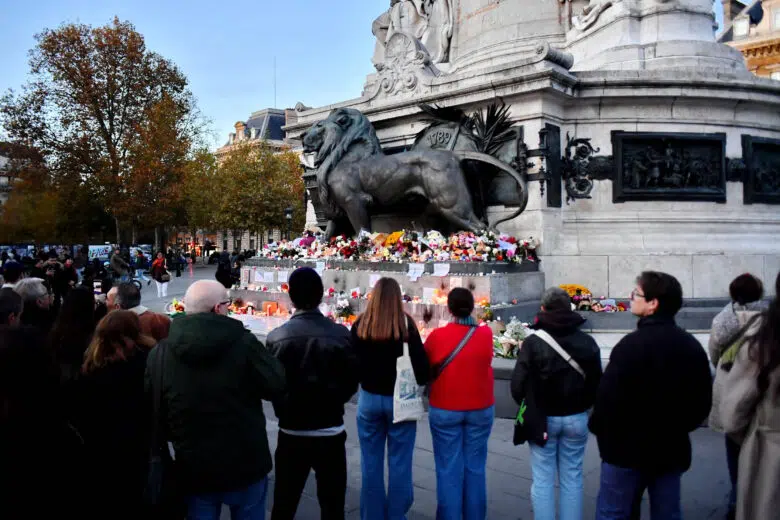
PARIS — In the chaos sown by the terrorists, 10 years ago, the video went almost unnoticed. Like a distant light in the darkness. In the aftermath of the Paris attacks, on November 13, 2015, messages of solidarity poured in from around the world. Among them was one from four Americans offering their support to the children of the victims, urging them “not to be afraid of terrorists, they are more afraid of you” and “not to live their lives in hatred or anger.” They knew exactly what their French “cousins” were going through.
They too had been there: 14 years earlier, they had lost a parent in the attacks of September 11, 2001. They too had been confronted with the aftermath of a terrorist act when they were just children, growing up with grief as their invisible companion. In the footage shot by the media outlet Vox.com, the freckled face belonged to Juliette, originally from Glen Ridge, New Jersey. She was just six years old when her father, John Candela, was killed in the attack on the World Trade Center.
For the latest news & views from every corner of the world, Worldcrunch Today is the only truly international newsletter. Sign up here.
Since his death, she has been on the lookout for the number 33, her father’s favorite number. When she sees it on a locker, building, or floor number, she knows she will have a good day. It was this anecdote that resonated with another orphan 6,000 kilometers away, with the same first name Juliette, this time French. Her father was killed at the Bataclan music venue while attending an Eagles of Death Metal concert with an old friend.
“Of all the testimonials, hers struck me the most. We share the same attachment to symbolic numbers,” she told Le Figaro. Through a photo exhibition organized by photographer JR’s Inside Out Project platform, they met for the first time in October in Paris. From both sides of the Atlantic, a delicate friendship has developed between these two orphans, “twins born in different eras” linked by a close destiny.
One last big hug
The reunion takes place under the arcades that surround the famous black-and-white Colonnes de Buren, in the courtyard of the Palais Royal, in the French capital. The 21-year-old Frenchwoman and the 31-year-old American exchange knowing glances and finish each other’s sentences.
On September 11, 2001, Juliette Candela was at school when, at 8:56 a.m., a passenger plane crashed into one of Manhattan’s iconic skyscrapers. Then a second one, at 9:14 a.m. Less than an hour later, the two twin towers of the World Trade Center, symbols of American power, collapsed in front of the world’s cameras. Some 17,000 people were inside the towers at the time of the collisions, including Juliette’s father, who worked on the 104th floor of the north tower.
At a school in New Jersey, a teacher had to tell a little girl that she couldn’t attend the next gym class. She had to pack up her things because her mother was waiting for her. “I was quite stubborn, so I insisted,” she recalls, her throat tightening. “In the United States, teachers don’t touch students, but she grabbed my wrists and dragged me into the hallway, repeating, ‘You have to go home.’” In the car, six-year-old Juliette talked about nothing but her gym class. With a heavy heart, her mother was forced to say the words that would change her daughter’s life forever: “There’s been an attack where Daddy works. We don’t think he’ll be coming home.”
In as many tragic echoes, the words spoken by one woman resonate with the other. So do the silences. In France, it was a Friday evening like any other for Juliette when a phone call brought the news to her mother that an armed attack was underway at the Bataclan concert hall. Inside were 1,500 spectators, including Juliette’s father. A few hours earlier, she had tried unsuccessfully to go with him, saying goodbye with “a big hug.” A final one. She was 11 years old and spent the evening frantically trying to call her father on his cell phone until she finally reached him for a few moments: “Juliette, I’m hurt but alive, I love you.” These were the last words Christopher Neuet-Shalter-Bodineau would say to his daughter.

After a sleepless and terrifying night, sitting motionless on the sofa, his loved ones called Parisian hospitals one by one. “It’s scary how similar it is,” the American woman immediately noted. Between the two Juliettes, tears now mingled with laughter, one ça va aller (“It’ll be okay”) follows a reassuring “Don’t worry” … In New York, too, John Candela’s family called all the emergency rooms in Manhattan, praying for him to come home. The door left open, a rosary in hand. They too had taken over the living room sofa as a waiting room for despair. Two families, two continents, the same sofa, and time stretching out in a terrible sense of unreality.
“Your father won’t be coming home.”
For Christopher Neuet-Shalter-Bodineau’s family, the inevitable call came in the afternoon. Juliette’s mother’s face fell, her grandmother collapsed, and her daughter rushed to her bed before breaking down. “We were lucky in our misfortune because we were able to see him the next day at the Medical-Legal Institute.” Juliette remembers very well the “painful and morbid atmosphere” and then her father’s face on the stainless steel table. “Despite everything he had endured, he was still incredibly handsome.”
My childhood ended early.
In the days and weeks following 9/11, John Candela’s family continued to call hospitals. The American remembers her birthday four days later, when she asked her uncle if her father had lost his memory and perhaps no longer remembered where he lived. “He said ‘no’. ‘You have to understand that your father is dead and he’s not coming home.’ At that moment, I understood.” Like nearly a thousand American victims, Juliette’s father’s body was never returned to his family: “The only thing we found of him was his wallet.” His relatives also recovered his car, inside of which were “crumbs of his favorite pastry.” The last fragments of a stolen life.
Both grew up with this absence that has become part of their daily lives, and the silence of a father who is gone forever. In the aftermath of the Paris attacks, Juliette was immediately treated like an adult. Though she was barely into her teens, she listened to conversations that are usually had away from children, and watched television reports on the attacks. “My childhood ended early.” Over the years, she built a “shell” that “protected her from outside influences” but that she couldn’t escape from, and she felt as if she were trapped.
Being younger at the time of the tragedy, Juliette Candela was spared the violent images on television. Her mother made it her mission to “be strong for her children” after her husband’s death, but the attack left indelible scars. “From the age of seven, I would hide under the covers every time a plane flew over our house.” Some memories remain, while others will never be made. Turning 16, then 21, getting married, having a child… “At some point you realize that he won’t be there for all the important stages of your life,” she says. To help her cope with her grief, she went to see a therapist who used music during the sessions. One melody, in particular, helped to ease her pain: Camille Saint-Saëns’ Le Carnaval des animaux, XIII. “The Swan.” This became her calling, she took up music therapy, and now works with children with developmental disorders.

From Ground Zero to the garden of remembrance
Whether it’s 10 or 24 years later, both fathers continue to live on through the voices of their daughters. “You know, there are people who are too good for this world, and you think to yourself that they were taken too soon. That was the case with my father,“ says the American woman. The youngest of this touching duo saw her father as “kindness incarnate, the joy of life. He had a sense of justice; he was an honest man who inspires me greatly today.” Tears well up in Juliette’s eyes, while her American “big sister” places a comforting hand on her shoulder.
This tragedy gave rise to an unlikely friendship, an unexpected natural bond.
The summer before the attacks, the French family had taken a trip to New York, and Juliette and her mother returned there in 2022. They visited Ground Zero, and the teenager was struck by this “majestic” place, where life had resumed. “While being very respectful, people were smiling and children were laughing.” While walking through the streets of Manhattan, she photographed a newspaper rolled up in front of a door. She later realized that the sum of the numbers on the door added up to 13, her new lucky number. It was like a sign to her.
While traveling in Paris with her boyfriend, Juliette visited the garden of remembrance for November 13, 2015 on Place Saint-Gervais, opposite Paris City Hall, which was officially inaugurated on Thursday. Every September 11 and November 13, she thinks of those who have passed away, “it brings them back to us in a way.” This tragedy gave rise to an unlikely friendship, an unexpected natural bond. Their reunion continued in a small Asian restaurant on Rue Sainte-Anne. “If you come to the U.S., let me know!” insists Juliette Candela. To which her French twin adds, “It’s like we’re one big family.”