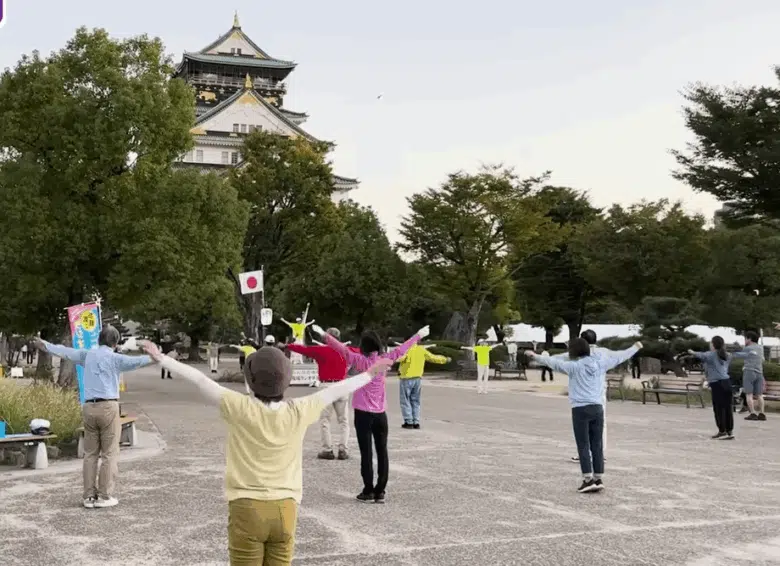
TOKYO — “And now we move on to level two!” calls out a male voice. Then, over some cheerful piano notes: “We’re marching in place! Now, one by one, bring your knees up to your chest. Yes, just like that!” The voice doesn’t know whether everyone is doing the moves correctly. It’s coming from a portable speaker someone brought along. But chances are, most of the people here know exactly what they’re doing. They’ve been doing it every day for years.
For the latest news & views from every corner of the world, Worldcrunch Today is the only truly international newsletter. Sign up here.
Just before 6:30 a.m. on a Wednesday in May, about a hundred people gathered in a wide-open clearing in Rinshi-no-mori Park in western Tokyo. They’re spaced a few arm lengths apart. At 6:30 sharp, one of Japan’s most important daily rituals begins: the 10-minute exercise routine known as Radio Taiso. It’s broadcast every day on radio and TV by the public broadcaster NHK. So this park isn’t special. People do the same routine in other parks, in offices, in schools and even in their kitchens.
Around 27 million people in Japan follow the Radio Taiso program at least twice a week. Studies show that older adults who do the 10-minute routine regularly are significantly more flexible, have greater endurance, and are physically stronger than those who don’t. Health experts see Radio Taiso as a major reason why the country is known not just for longevity, but for healthy aging too.
More popular than calisthenics
“No doubt about it!” says Tsuyoshi Ueda. “If I weren’t doing this, I’d probably be bedridden by now.” Ueda, 93, in a bright green raincoat and baseball cap, lives nearby and rode his bike to the park. A former construction worker, he’s been showing up in all weather for over 30 years. “It rained yesterday. There were just a few of us.”
Today, a group of people in their 80s and 90s move through the exercises as if it’s the most natural thing in the world. The first three minutes of level one focus mostly on slow arm rotations. The remaining seven minutes engage the whole body. A little sweat begins to drip.
The global trend of calisthenics, or bodyweight strength training, popular on social media and in gyms, barely raises eyebrows in Japan. Radio Taiso may not promise chiseled abs like the shirtless influencers on YouTube, but it’s been around far longer, is more widely practiced and is arguably better for long-term health. The secret? It’s done consistently.

Move a little, every day
A few meters away from Ueda, 73-year-old Kazu Shimomura is winding up the speaker cord. He’s retired, too, comes every day, and like the rest, is up before 6 a.m. “The physical side is one thing,” says the man in the gray sweater. “But it’s also about seeing people. That keeps your mind sharp.” And the subtle social pressure helps everyone get out of bed.
“The great thing is that anyone can do it, anywhere!”
In aging Japan, most of the millions who practice Radio Taiso daily are seniors. But school kids do it, too. So do office workers. “You don’t need much space,” says Ueda. “We used to do it on construction sites sometimes.” You don’t have to be athletic; the exercises activate many parts of the body and boost circulation. “The great thing is that anyone can do it, anywhere!” Ueda adds. Radio Taiso is like brushing your teeth. You just do it. And it’s been that way for almost 100 years.
In the 1920s, two representatives from Japan’s postal service visited the United States and discovered a radio fitness program broadcast in several cities with piano accompaniment. They were impressed and brought recordings back to Japan. Soon after, the postal service sponsored the NHK’s version, and 20,000 postal workers began doing the exercises in the streets. Before long, the whole country joined in.
“You have to stick with it”
After World War II, which Japan lost as part of the fascist alliance with Germany, the occupying Americans first banned Radio Taiso, then reworked parts they considered too militaristic. New exercises were added over time, but the core idea has stayed the same: Move a little, but every single day.
It’s just after 7:00 a.m. Most of the morning crowd has already left, off to make breakfast or go to work. Minoru Ogawa lingers, launching paper airplanes with a rubber band. “I do these exercises every morning,” says the 81-year-old former fruit seller. “But I haven’t been able to jump much the last three years. My knees hurt.” So now, he says, he’s putting in extra effort. “You have to stick with it,” he adds, watching his paper plane glide.
In the morning sun, a few older men who skipped today’s session begin to gather. “Good morning, Ogawa-san!” calls one gray-haired man, holding a slingshot and a stapled paper airplane himself. “Let’s see whose flies farther today!” Challenge accepted. And just like that, even those who skipped Radio Taiso today find themselves stretching, moving and bending down.

