
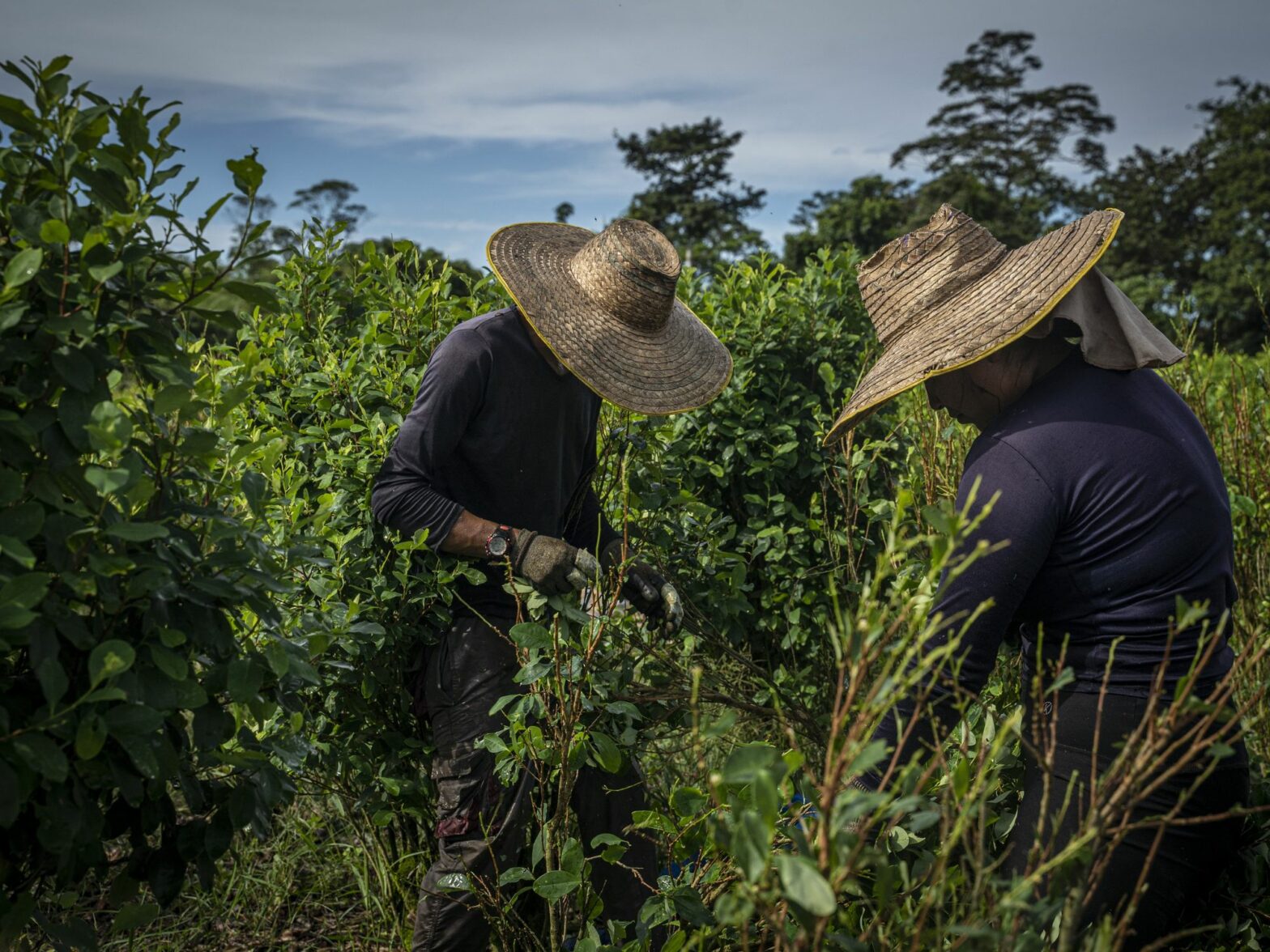
CAQUETÁ — “Don’t say my name, I don’t wanna risk losing my account,” says Marcela*. Two years ago she opened her TikTok account, which today has more than 10,000 followers. The first video that is pinned on her profile, with over 11,000 views, shows her lip sync La Mula, one of the most popular Colombian narcocorridos, a music subgenre with Mexican roots, that narrates the stories of drug traffickers and their activities, blending popular tradition with themes of crime and violence. This song is one of the most famous in Caquetá, Colombia, where Marcela lives.
Her second video on TikTok has more than 900,000 views and 25,000 likes, very high numbers for content on social media in Colombia, especially for topics that are not necessarily tailored to go viral. Marcela’s video shows mountains plagued by a thick crop of various shades of green: low-lying bushes that extend for meters and meters.
They are coca crops, the same ones that, until not long ago, were hidden out of fear of the authorities to avoid aerial and ground fumigation with glyphosate. These crops are in areas where illegal armed groups rule and seek to exercise their control over the population.
The videos, which began to appear since the pandemic and continue to appear today, show young people heading towards their work in the fields, collecting coca leaves or planting. Others show the same people scattering leaves on the floor of a “laboratory.” There they show how they process coca leaves to transform them into the paste that will then leave the country and become cocaine. This laboratory is crammed with blue and black barrels, built with thin stakes as supports and a thick plastic sheet for the roof.
Daily life in coca fields
These are TikTok videos with millions of views, as well as Facebook groups and profiles on X (formerly Twitter), showing daily life in coca fields. The phrase “la mata que mata” (the plant that kills) became popular due to a government campaign launched in 2008 by the National Narcotics Directorate. Though it became ingrained in Colombian culture, the campaign was banned in 2010 by the Constitutional Court after Fabiola Piñacué, a Nasa Indigenous leader, proved the plant’s ancestral and medicinal significance for Indigenous communities.
Social media accounts now show labs that were once only seen in news reports about seizures or crop destruction. Some accounts, with fewer followers, even describe the routes for smuggling coca paste out of the country, as we found after reviewing the content online.
Marcela* has one of the accounts with the largest number of followers on TikTok. When you search for the word “coca” in the platform’s search engine, hundreds of videos appear, but very few accounts actually have more than 100 or 200 followers.
The use of social media becomes common, like in any other business.
This 19-year-old woman began publishing content in early 2022 and is one of the few who shows her face, calling herself a “Coca influencer.” She belongs to Colombia’s new generation of coca growers, who, since the pandemic, have used social media — both public and private, like WhatsApp and Telegram groups — to market products, seek or offer jobs in the fields, negotiate prices, and even set the base price of coca paste in some regions.
“This content, especially the posts with the greatest reach, such as TikTok videos, are general enough not to cause problems. They generally don’t specify a region, nor do they specifically talk about a place that identifies the person or makes it easy for the authorities or armed groups to go looking for them,” says Kyle Johnson, researcher at the Conflict Responses Foundation, which studies the Colombian armed conflict.
“But there is also a generation that no longer criminalizes the crops as it used to happen in the past. They understand it as part of everyday life, and the use of social media is a natural response to this vision,” he explains.
Armed groups control and an online escape
The pandemic brought about changes in coca cultivation, its processing into paste and the movement of the product out of the country. With the limitations on transportation, both growers and the armed groups that control the business turned to social networks to implement new strategies to maintain communication.
“Although the pandemic was the trigger, it is strange that it did not happen even sooner,” says Elizabeth Dickinson, senior analyst at Crisis Group in Colombia. For Dickinson, the use of social media becomes common, like in any other business.
“What we have seen in recent years is that in agricultural markets the use of networks has become essential for the flow of all inputs, transportation routes, base and sale prices, and so on. This management has also been normalized by the increase in phone and internet coverage,” says Dickinson.
“What we should focus on here is the control armed groups seek to exert, as it largely drives the escalation of violence. We’ve seen cases where a criminal group enters an area wearing a rival group’s bracelets to trick farmers into revealing if they’re selling coca to others. If so they are singled out and that becomes a problem for the farmers,” he adds.
This is something Johnson also finds problematic. He assures that in many areas the armed groups have tried to carry out control that even involves the cell phones of the farmers that collect the coca leaf. “There are areas in which they are the ones who determine what can or should be published. They even determine who can have cell phones or not. But, although the groups try to control people’s cell phones in many places, in the end it is very difficult for them to be able to do so fully. That is why the videos we see are so general and that makes it easier for the content to circulate so widely.”
For this reason, Marcela explains, she never says where she is or who she works with. Even when in the comments of her videos she has been asked to help in other areas, “because my bushes are very strong and beautiful,” she has refused.
“You have to be distrustful because you don’t know who is speaking to you from the other side. I post the videos and I have given advice out there, but nothing more than that, because that could bring problems,” she says.
Why don’t platforms censor content?
What really worries Marcela is losing her followers: “I have dedicated a lot to that account and I have already seen other accounts shut down because people start reporting them and I don’t want that to happen to me too. It takes a lot of effort to get an audience for it all to be lost in a second,” she says.
Valentina Ortega is a lawyer and researcher at Linterna Verde, a non-profit organization that works to strengthen civil society action in the digital public debate. Ortega has found that such posts not only have high engagement on the platforms and are rarely censored, but they also allow an interaction with users that search for employment, with other users even offering them work growing or processing coca.
But, with all this, Ortega points out that platforms are not necessarily obliged to ban or penalize content. In fact, for this content to stop circulating, it would require local governments to ask the platforms to penalize it. “But it is the social media platforms that decide whether or not they want to cooperate with local governments. They must comply with international laws, but not necessarily with local ones. Here in some cases antiterrorism laws would apply, but that does not necessarily cover coca plantations,” says Ortega.
“Platforms have had to adapt to the variety of things people post on social media, leading them to create very specific rules,” says Luisa Isaza, a consultant on freedom of expression and internet issues at the Press Freedom Foundation (FLIP).
Rules based on trends
Isaza explains that these rules are built on the basis of what trends on the platform itself, which sometimes results in vague regulations. This makes it difficult to enforce rules, and users often find ways to evade potential censorship, which is also influenced by context, she adds.
Moreover, Ortega assures that the increase in illicit crops in the country may be allowing normalization and a change in perceptions. “The more something exists in the material world, the more it will also grow on social media, naturally.”
During 2020 and 2021, the years of the pandemic, Colombia registered a 43% increase in crops for illicit use, according to the United Nations Office on Drugs and Crime (UNODC). At the same time, the country’s connectivity increased, as indicated by the United Nations Development Program (UNDP). “The impact of COVID-19 allowed an increase in Internet penetration in the country and became an opportunity for connectivity to fuel digital inclusion, especially in rural areas.”
The data shows that in 2019, 51.9% of households in Colombia had an Internet connection and by 2021, that figure rose to 60.5%, although there is still a gap between urban and rural areas. The main cities reached 70% coverage of households in 2021, while in rural areas it was 28.8%.
For both Dickinson and Johnson, the advancement of technology and social media coverage has ended up giving the tools to a new generation that no longer sees being a coca grower as problematic. Marcela, the coca influencer, confirms this. “You post because you want to and can, don’t you? It’s just like posting from any other place. You want others to know how you live and what you do. It’s no different.”
*The name has been changed at the request of the source.