
PARIS — “Since my bachelorette party, I haven’t spoken to my best friend.” Camille and Alma* were so close that when Camille got married, she naturally asked Alma to be her bridesmaid.
“I had prepared the announcement to be personalized with references to our childhood. It was a very emotional moment,” Camille says. “Alma accepted right away and was very involved in organizing my wedding and therefore my bachelorette party.”
For the latest news & views from every corner of the world, Worldcrunch Today is the only truly international newsletter. Sign up here.
While it is difficult to date the creation of this tradition, it seems that bachelor parties have existed since the 18th century. Yet for a long time, they were reserved for men who celebrated the eve of their wedding in brothels. These festivities only became open to women two centuries later, in the 1970s, in a Western society that was then celebrating sexual liberation and a profound change in customs.
Bachelorette parties thus have been “a visible social phenomenon since the late 1980s, reaching unexpected proportions in the late 1990s,” writes Martine Segalen, an ethnologist and professor at the University of Paris-Nanterre, in an article entitled “The invention of a new ritual sequence of marriage.”
A party reserved for the upper classes
However, bachelorette parties were still rare at the time and reserved for brides-to-be from the upper classes of society, says Florence Maillochon, a sociologist and research director at the French National Research Center (CNRS). “In the 1990s, the event was intended for women who were marrying for the first time, then it spread to remarriages,” she says. “Today, women marry around the age of 30. They are no longer ‘young girls’ in the strict sense of the term, they already live with their spouse with whom they have a sexual relationship.” So they’re not marking the end of their single life, just the end of their singleness in the civil registry.
In France, the concept has thus become established over the years as “a new stage of marriage,” according to Segalen, seen as “a tradition” for Camille.
“It’s almost a mandatory step before marriage,” the young woman says. “I see it as a rite of passage that should be both festive and emotional, and I was keen to gather my closest friends around me before the event that was set to change my life.”
It was terribly embarrassing, but I did it.
“Brides have very high expectations when it comes to organizing increasingly sophisticated weddings, so the preparations for the bachelorette party are left to their friends,” Maillochon says.
Like Camille, more and more women are celebrating their bachelorette parties, according to a 2019 study by the French state Institute for Demographic Studies (Ined). While only 12% of French women celebrated in the 2000s, 72% of women under 30 now do so. This percentage is reflected in a 2023 analysis by Mariage.net, a leading website in the field, which indicates that 74% of couples celebrate their bachelorette parties before getting married. As a result, they often have very high expectations for this “little” big day.
Choosing your best friend
In her friendship with Alma, Camille has always been the introvert and her friend, the extrovert. “We grew up together, but we developed very different personalities,” Camille says. However, Camille was not worried about entrusting her with the organization of her bachelorette party. “I trusted her completely, she was supposed to be the person who knew me best.” Her choice of organizer ultimately proved disappointing.
“I always said that I wanted a small, quiet party, without any eccentricities. On Saturday morning, when I saw my friends arrive at my house screaming and wearing costumes, I immediately knew that the weekend would not be what I had imagined,“ she says.

The 30-year-old was decked out in rabbit ears and a neon tutu and then ”kidnapped” in a van. “In the car, I could sense that the atmosphere was strange. Some of my friends didn’t seem comfortable, and I wondered if they had really all decided on this plan together.”
The group drove to Paris. “As soon as I set foot in the street, I felt terribly ashamed of my outfit. We were in the Sacré-Cœur neighborhood, and they gave me a basket full of obscene lollipops that I was supposed to sell to passersby. It was terribly embarrassing, but I did it.”
After that, the six friends went bar hopping, ending up at a strip club with Chippendales dancers. “At that point, I couldn’t pretend anymore. I had always said that I didn’t want to go to that kind of show, which I felt was disrespectful to my fiancé. I got angry and asked my friends how they could have thought I would enjoy it. That’s when I found out that Alma had actually imposed her agenda on the other girls, without taking their opinions into account.”
The bachelorette party is not necessarily enjoyable but not organizing anything would be unpleasant.
A clarification was then necessary. “When we got back to the apartment they had rented, I tried to discuss it with Alma. She got defensive, telling me that a bachelorette party is supposed to be fun, that I didn’t know how to enjoy myself and relax, and that I was being difficult because it had taken her a lot of effort to organize the day. The tone quickly escalated, and we both started yelling.”
The next day, the atmosphere was frosty. “In the van, no one dared to speak. We all went home and didn’t talk about it anymore. Alma remained silent for several weeks until one day I received a message informing me that she no longer wanted to be my bridesmaid and that she didn’t want to attend the wedding either.” After a few days of reflection, Camille decided not to hold it against her friend. “Even though it made me very sad, I realized that she didn’t know me very well and that I had perhaps idealized our friendship a little too much.”
“A somewhat forced moment”
The bachelorette party is “a somewhat forced moment that people impose on themselves, like Valentine’s Day,” Maillochon says. “It’s not necessarily enjoyable but not organizing anything would be unpleasant, as it is welcomed by the bride as a sign of love and recognition of her value. The intensity of the investment in these preparations has become an indicator of the intensity of the bond and the importance of the person who is being evaluated within the group.”
As a result, the moment is often fantasized about. Gone are the simple gatherings between friends, replaced by weekends filled with parties and activities. All of this comes with the pressure to make the event a success. And when it comes to planning, there is a tendency to go overboard in order to meet the bride’s expectations.
“Excess characterizes the ritual…An evening at a mutual friend’s house, in a bar, in a restaurant, or at a karaoke bar is the most classic version, often seen in working-class circles,” Segalen says. Among young women from wealthy backgrounds who have attended prestigious schools, the party is more like a so-called “orientation weekend.” Here, it takes time and money to take the bride-to-be on a two-day boat trip, skydiving or bungee jumping. According to Mariage.net, 38% of French people take a trip with their friends for their bachelorette party.
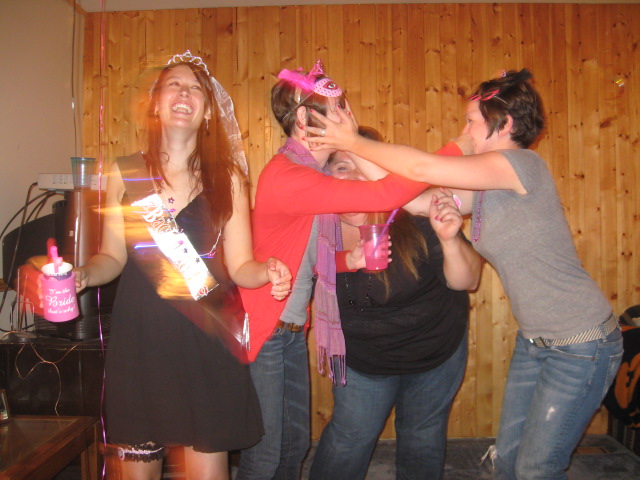
It was precisely this issue that led to the cancellation of Marina’s bachelorette party. “My friends come from very different social backgrounds. When I drew up the guest list and gave it to my sister, I had a slight fear, but I thought they would manage to organize something out of friendship for me.” But a month before the wedding, there was still no bachelorette party in sight.
“I started to think that they hadn’t organized anything for me, so I got upset and talked to my sister about it. I learned that some of them wanted to take me to Ibiza to party, while others preferred to stay closer to home, in Nice, for budget reasons.”
By mistake, Marina was added to the group conversation created for the occasion. “I was very hurt when I read the exchanges. The girls had a violent argument, and I discovered that one of my closest friends didn’t really want to celebrate my bachelorette party, while another thought it was strange that she had to pay my share.”
Organizing a bachelorette party requires a lot of investment in terms of time and money.
Disappointed, Marina decided to send a decisive message to the group. “I wrote that since they were unable to agree on my behalf, there would be no bachelorette party, and I canceled everything. My sister and my other bridesmaid organized a spa day for the three of us. On the wedding day, I put on a brave face with the others, but our relationship has changed nonetheless.”
This testimony attests to the evolution of expectations “in line with the growth of the wedding industry.” According to Maillochon, “marriage is an event that appeals to feelings, relationships, and bonds. During the preparations, the bride interprets events only through an emotional lens.”
Yet organizing a bachelorette party requires “a lot of investment in terms of time and money, even though the guests also have their own personal projects to attend to at the same time.” This leads to a double standard. “In the romantic ideal, the event transcends materiality. In reality, the material investment is noted but never acknowledged,” Maillochon says.
Tension and jealousy
Eléa’s* evening at her best friend’s bachelorette party also turned into a nightmare. “I’ve been a bridesmaid eight times. I’ve been to some disappointing bachelorette parties, but this one was important because I’ve known the bride since I was born,” she says.
The bride isn’t a fan of the bachelorette party concept. “She hates being the center of attention, but when she got engaged, we were 27 or 28 years old, in the midst of a wave of weddings, so it was inconceivable for us not to organize something for her.”
Tensions quickly arose. “Her two groups of friends were mixed: childhood friends and current friends. We had to be careful not to make all the suggestions, to give everyone their place. But there were some hurt feelings pretty quickly, especially with one of them, Laura*,” Eléa says.

On the day itself, the scathing remarks flew. “She was very mean, it was very unpleasant, and I had a hard time hiding my emotions.” During the evening, Laura got drunk. “Suddenly, I felt someone pulling my hair violently, and I realized it was her,” says Eléa, who was unable to react because Laura then fell into “a kind of mini alcohol coma,” and they had to call the fire department. “The bride accompanied her to the hospital.”
The next day, Laura apologized to the bride but not to the other guests. “During the bachelorette party, Laura had teamed up with Sophie*, a girl I had known for years. Until the wedding, Sophie continued to be obnoxious to me. Her behavior reached the bride’s ears, and when she wanted to discuss it with me, I took the opportunity to tell her everything, which I had refrained from doing before.”
I’ve never mentioned that bachelorette party again, even though it had a profound effect on me.
Against all odds, the bride chose to defend Laura. ”It was very hard for me. It was the first time we had ever had a disagreement. I decided not to hold it against her and understood that she didn’t want to take sides. The same went for Sophie, because I realized she was jealous of me, as if we were competing to be the best of friends.”
Since the incident, the two women’s paths have crossed again. “There’s still a bit of distance between us,” Eléa says. “I’ve never mentioned that bachelorette party again, even though it had a profound effect on me.”
A true “test of the other,” Maillochon says, a bachelorette party is a time when “many things crystallize in friendships.”
For Eléa, “it’s an exceptional event that leaves no one indifferent, and therefore lends itself to the best as well as the worst.”
*First name has been changed.