
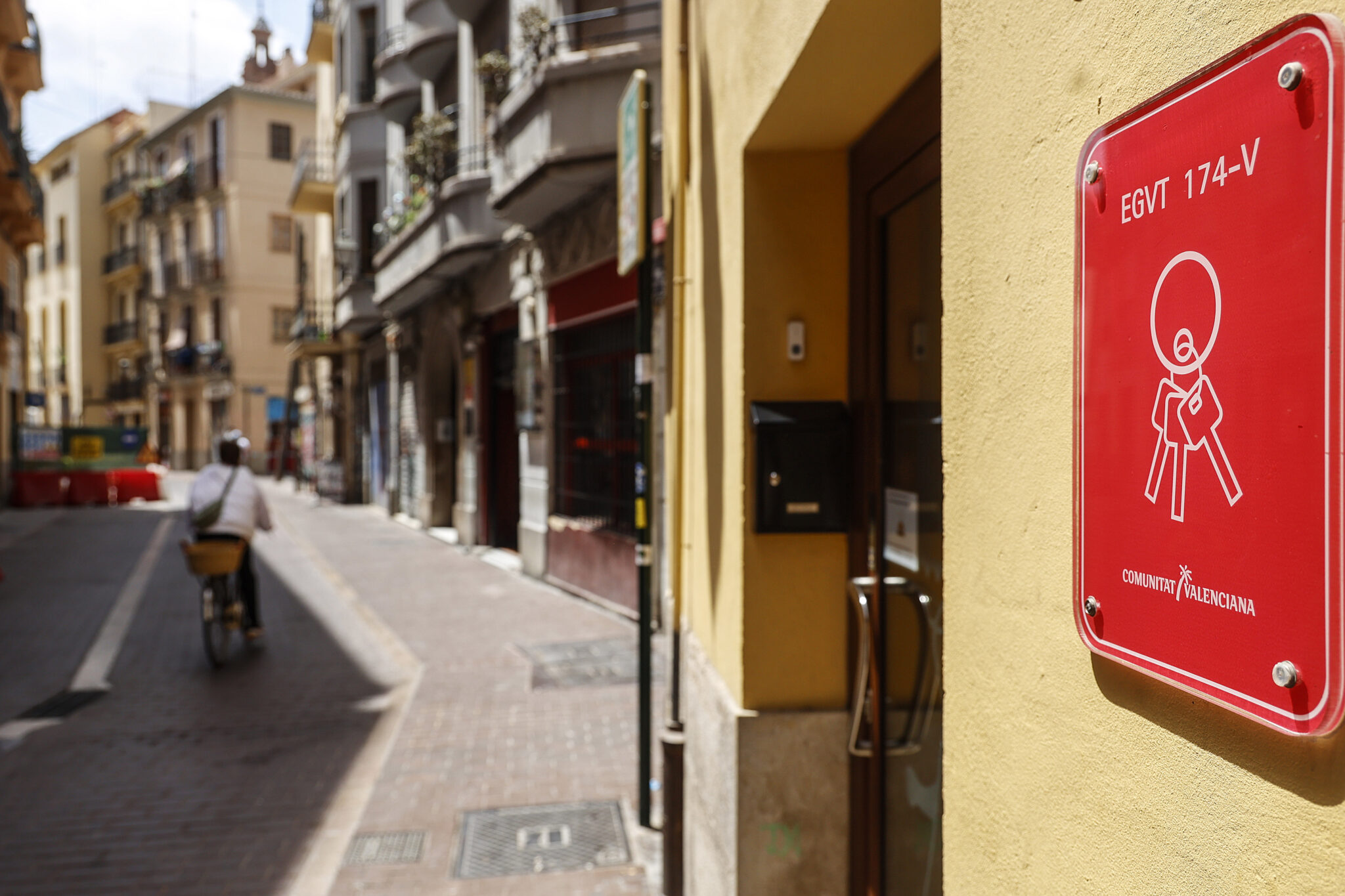
MADRID — Elisa Estellés has a shop in the Saïdia district of Spain’s eastern city of Valencia, where she distributes boxes. She doesn’t sell them; she gives them away for free. Estellés doesn’t run a stationery shop or a courier service but a tobacco shop. For a while now, some of her regular customers have been asking her if she has any spare boxes.
“Sure,” she says.
“I need them for when I move. I’m being kicked out of my house.”
One of those customers is Baldo Montero. The first time he came into the tobacco shop to ask for a box, Estellés noticed that something was wrong. He was nervous, confused. When he explained why, the tobacconist understood everything: His landlord had given Montero, 58, two months to vacate the apartment alongside his partner, Ana Ariño, 48, and her two daughters, aged 19 and 17. “And the dog,” Montero added. And the dog.
According to the 2024 census, Saïdia has 48,383 inhabitants. In soccer terms, that’s equivalent to a nearly full house at Valencia’s Mestalla Stadium. The district is located on the left bank of the old Turia riverbed, directly opposite the city’s historic center. Of the five neighborhoods that make up the district, Morvedre occupies a central, privileged position.
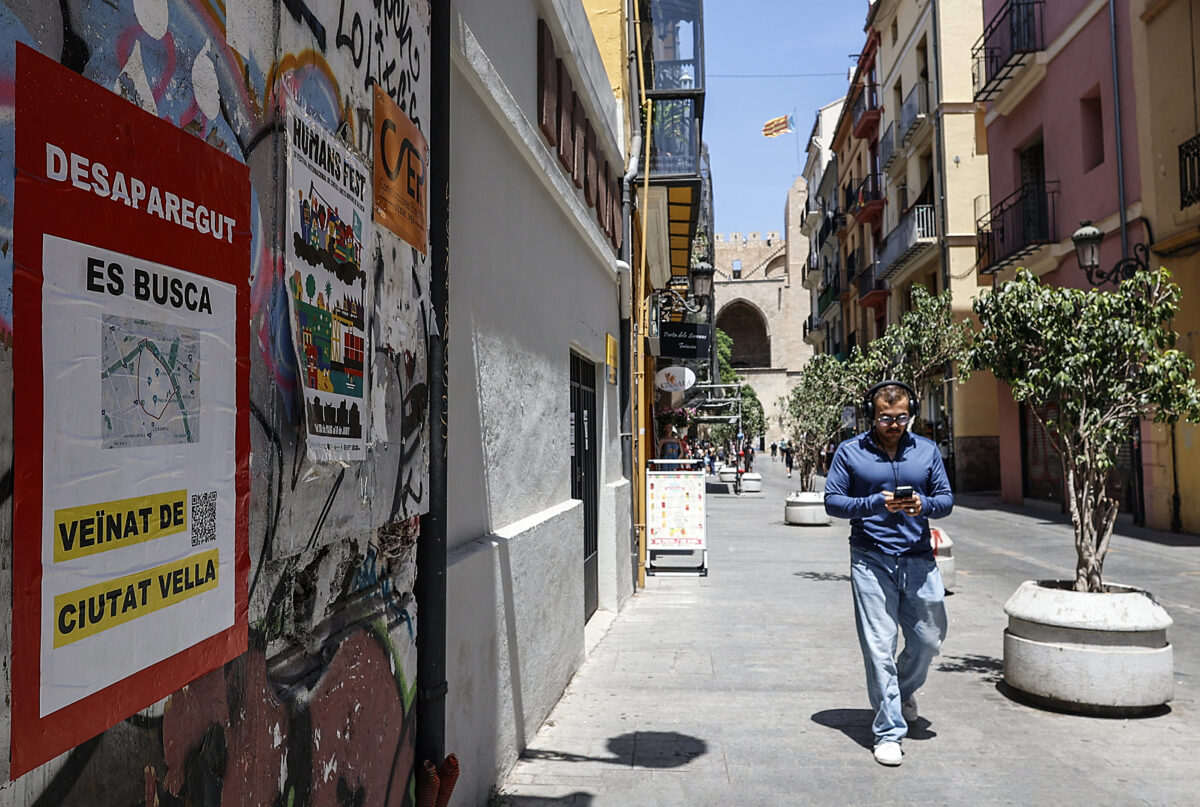
Crossing the Serranos pedestrian bridge, a short walk of just over 200 meters, takes you to the towers of the same name, one of the city’s most popular tourist attractions. 200 meters. That is the distance that separates the tranquility of a working-class neighborhood from the groups of tourists crowded around flags, souvenir shops, and bike and Segway rental shops. The tranquility of a working-class neighborhood… The tranquility of a working-class neighborhood? Something doesn’t seem right.
Something is changing
Jacobo Cruañes, 33, a social worker at the NGO Movimiento por la Paz (“Movement for Peace”), is another of Estellés’s customers. In his spare time, he tracks down illegal tourist apartments that have proliferated in the area: He checks whether the property is officially registered and, if not, reports it. In addition, if he finds cameras pointed at the street without the corresponding warning sign, he files another complaint with the Data Protection Agency.
We all know each other here, it’s like a village.
That’s how he shows his commitment to his neighborhood, a neighborhood he describes as “working class” and “very diverse” that is suffering the onslaught of tourism, “an activity that is not harmless.”
“We all know each other here, it’s like a village,” Cruañes and Estellés each say at different times, as if they had read each other’s minds. There’s Iñaki, the lifelong plumber; Lucas, the guy from the bike shop and workshop; Electricidad Turia, the bakery on Ruaya Street, the Emilia fish market… And yet, something is changing.
More and more foreigners are coming into Estellés’s tobacco shop. At least it gives her a chance to practice her English: “It’s normal Camel. It’s the same.” The shopkeeper tries to convince the girl who just walked in that the product she asked for is the same as the one she has in shop, but it’s a lost cause. The disappointed customer turns around and leaves.
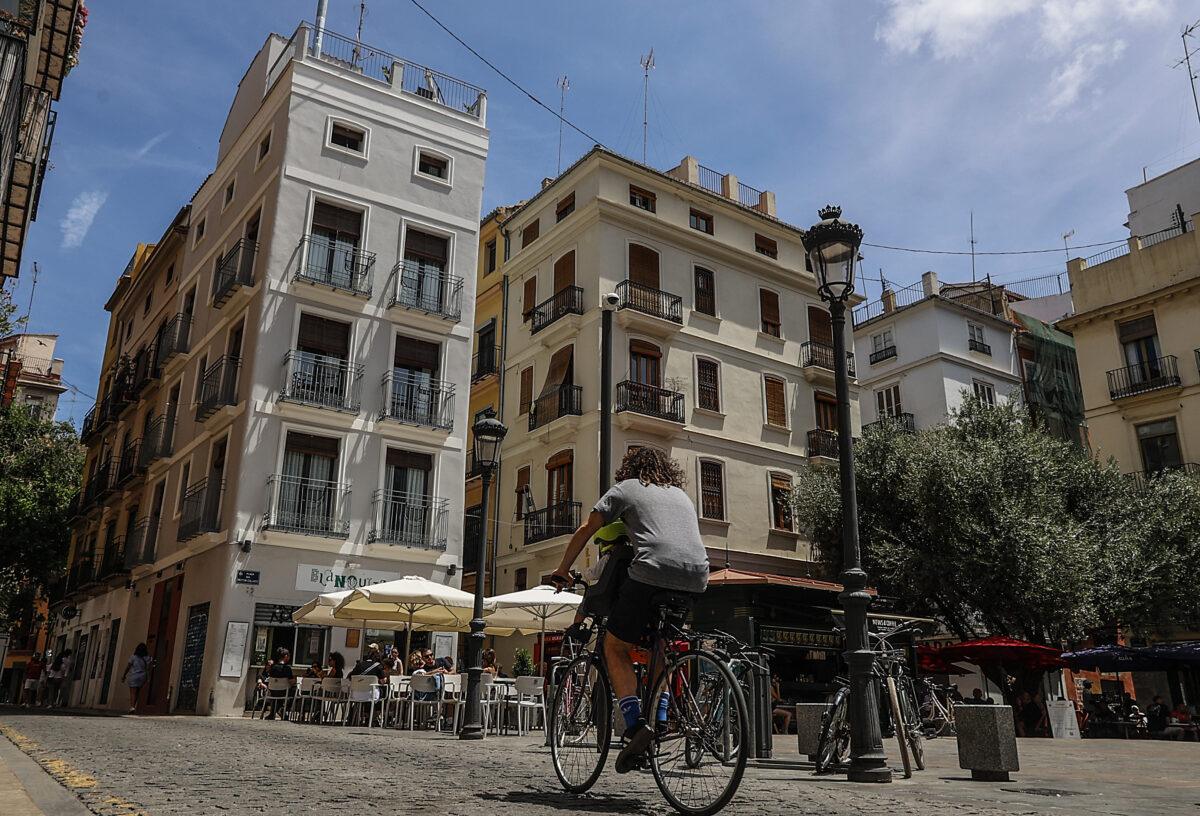
Maybe she’ll go back to the Limehome building — which isn’t registered as tourist accommodation — around the corner. “Choose the apartment that suits you best. No in-person contact, no check-in required,” they advertise on their website.
Or maybe she’ll go to the Livensa Living residence, which is a couple of blocks away and, in addition to private rooms equipped with a kitchen and bathroom, offers “incredible common areas such as a rooftop pool,” as advertised on their website. Or to one of the other licensed or unlicensed tourist accommodations offered in the neighborhood.
Unlicensed tourist apartments
Estellés’ tobacconist’s is on Visitación Street. While Morvedre is the central neighborhood of Saïdia, Visitación is the heart of Morvedre. It is the main street, where everything happens. Right there, is the Colegio de las Trinitarias school, the neighborhood’s leading educational center for decades.
The Valencian government has nine tourist apartments registered on Visitación. Yet a quick walk down the street — almost 400 meters long, according to Google Maps — reveals many more.
The digital keypads at the entrances — there are a couple in doorways that provide access to multiple apartments — and the security cameras are a definite clue. At the end of the street, two ground floors have been set back to provide a small terrace for guests, who are greeted with a “hello” on the doormat. On some balconies, protest banners hang: “Veïnat sí! No hotels or touristification of the neighborhood. Saïdia for those who live there!”
He knows of cases of people who have moved back to their parents’ villages.
Montero isn’t too keen on tourism either. His speech, with a strong Sevillian accent, is an unstoppable torrent of words: He defends housing as a right and says that cities are lost, that residents have to leave because tourists can pay more, and that he started to fear being evicted when he saw how the facades were being renovated. He told his friends, and they told him yes, that they were renovating to rent to tourists, and that they even offer money to cancel rental contracts.
That’s what they told him: that the ground floors are no longer commercial premises, they are tourist accommodation; that Saïdia is becoming an extension of the historic center and that the apartments’ values are rising; and that if you are a landlord you want to earn twice as much, you tell your tenants that they have to leave; that he knows of cases of people from the neighborhood who have moved back to their parents’ villages.
“No longer any empathy”
Montero says that since the pandemic everything has changed: that there is no longer any empathy among us; that we are no longer as we used to be; that social classes are being redefined; that neighborhoods no longer belong to those who live in them, they are what the owners want them to be; that before you could live in a house for 30 years but not anymore, and that he has realized how things work in life so, so late.
Ariño and Montero lived in an apartment owned by Ariño on Calle San Ramón, in the center of Valencia, but it became too small for them because they wanted each of their daughters to have their own room, so they put it up for rent and looked for something bigger at an affordable price. They found it in the Morvedre neighborhood. That was three years ago. The sudden notification that they had to vacate the property left them feeling disoriented and upset.
After a friendly three-year relationship with the landlord, they did not expect something like this, although they admit that the motive — the apartment, the owner says, is needed for a family member — is included in the contract. After a long and fruitless search for another apartment to rent, the only solution they have found is a favor from Jayne, the Englishwoman who rented Ariño’s apartment, to leave before the contract expires. It would be a step back to where they started — but a lesser evil. Of course, their future depends on Jayne’s goodwill.
In their search for housing, Ariño and Montero scoured all the real estate websites, including Idealista. In mid-April, this platform had about 20 apartments for rent in Morvedre. On Visitación Street, a “beautifully renovated studio” with 32 square meters of living space, located on the ground floor, “with lots of light” and “a sofa bed for guests,” was offered for 975 euros per month.
Attractive but unaffordable
The crown jewel of the portal, however, was a 239 square-meter tourist-licensed property “designed to redefine the urban living experience with innovative design and high-quality comprehensive renovation,” according to one of the real estate agencies that had it in its portfolio, which highlighted among its attractive features “a spectacular terrace” with “a chill-out area and private pool.”
Also located on the ground floor of — the same — Visitación Street, it is on sale for 880,000 euros, “a unique investment opportunity,” according to the real estate agency. Montero and Ariño would love to seize this undoubtedly unique opportunity, but they cannot afford it. An apartment similar to the one they used to live in (800 euros per month for a four-bedroom home) now costs no less than 1,300 euros, an unaffordable amount for them. “It’s impossible to find anything for less than 1,000 euros,” Montero says.
The average rent has almost doubled in recent years.
It’s the same story Cruañes’ side, the social worker is not looking for an apartment for himself — he is lucky enough to live in his grandmother’s house — but for the NGO he belongs to, which provides shelters for immigrants. Finding them in the neighborhood has become impossible: The average rent has almost doubled in recent years, he says.
A few days later, Montero returns to the tobacco shop. Estellés sees that he looks better and happier: Jayne has kept her word and given them the keys to the apartment, so they can finally move in.
Another customer enters the shop to ask for boxes: “They’ve given me a year to leave the apartment. I asked them straight out if they wanted to make more money, and they said ‘yes.’”