Updated August 19, 2025 at 4:30 p.m.*
-Essay-
HAVANA — On the plane from Bogotá to Havana there were no more than 20 of us, including the crew. According to the stewardess, what justified such flights was the freight. I gave up reading Ivan Denisovich’s A Day in the Life when I saw through the window what looked like lizard tails about to be flooded by the calypso water of the Caribbean.
Next, the barely cultivated fields bordering the city and the fear that they would not let me in. A year before, I had been sent back to Venezuela on the same plane I arrived on, with the intention of reporting on the elections that Maduro stole, and it is a well-known fact that Cubans provide security services there.
For the latest news & views from every corner of the world, Worldcrunch Today is the only truly international newsletter. Sign up here.
The José Martí airport was practically empty. On some of its walls hung Chinese advertising posters. When I presented my passport, the immigration officer asked me to wait beside the window. I was afraid that history would repeat itself, but while she continued to attend to the rest of the line, a plain-clothes officer arrived and kindly warned me: “Since you are traveling on a tourist visa, you can go around the island without any problems, as long as you do not intend to do anything else.” He then ordered the lady to let me in.
Journey revolution’s end
I hadn’t been back to Cuba since April 2018, when Raúl Castro, at age 86, resigned from the presidency of the State Council and the Council of Ministers to hand over his seat to Miguel Díaz-Canel, a fifty-something from Santa Clara, once long-haired but now with short, short, well-groomed gray hair.
The truth is that the very day the National Assembly unanimously elected him, nobody paid attention to the news in the streets of Havana. I was gathering with a group of young Cuban journalists, former students of my friend Grillo with whom they had studied Truman Capote, Norman Mailer, Guillermo Prieto, and who in recent years had participated in the creation of online magazines where they tried their hand at narrative journalism. Not even they were interested in the change of command, probably because they guessed that everything was already well tied up.
It was as if the priest suddenly proposed celebrating the devil.
“The generational change in our government should not delude the adversaries of the revolution. We are the continuity, not the rupture,” Diaz-Canel said as soon as he took office.
At that time I was finishing writing my book Viaje al fin de la revolución (“Journey to the end of the revolution”), a book to which I had dedicated almost 4 years. On December 17, 2014, Raúl Castro and Barack Obama appeared on television, at the same time, one from Cuba and the other from the U.S., to communicate that they intended to reestablish their countries’ diplomatic relations, that had been broken since Jan. 3, 1961.
It seemed to be the closure of one story and the beginning of another, and for reasons that would be redundant to develop, I wanted to record it. In the forty months that followed, John Kerry showed up to reopen the embassy and state security prompted the Anti-Imperialist Tribune’s supporters to give him a warm welcome. It was as if the priest suddenly proposed celebrating the devil. The same Marines who, in their 20s, had lowered the American flag there, raised it again in their 70s.

Madonna’s birthday
Cuba became fashionable: Luxury stores opened in the Parque Central, Gucci held its annual fashion show in the Paseo del Prado, Fast and Furious filmed a chapter of its saga on the Malecón seafront boulevard, Madonna celebrated her 58th birthday at La Guarida restaurant, and The Rolling Stones, whose music had been banned for decades, gave a concert for 300,000 people in the Ciudad Deportiva. Mick Jagger shouted from the stage “I think the times are changing!” and the crowd shouted back “yes.”
Cubans who had moved abroad came back to make a new start on the island. Obama visited Havana and its inhabitants came out to greet the passing of his presidential car “The Beast.” He praised the creative talent of a population capable of maintaining a Studebaker and other cars that are already junk cars back home, and he even confessed that he envied the Cuban health system.
My friends founded media such as El Estornudo, Periodismo de Barrio, El Toque and others in which they allowed themselves, if not to report on power, something unimaginable, at least to tell the lives of their fellow citizens in a very different way from the way Granma, official newspaper of the Central Committee of the Communist Party of Cuba, continues to misinform. Even the most nihilistic allowed themselves to imagine an opening for good.
On Nov. 25, 2016, Fidel died and nine days of mourning were declared, with dry law and prohibition of partying. His cremated remains, after remaining on display at the José Martí Memorial, traveled the 900 kilometers that separate the capital from Santiago de Cuba in a small cedar urn, retracing the route of The Caravan of Freedom that led Castro and his bearded men to take power in January 1959. At some point, the jeep carrying the coffin broke down, and his escorts had to push it. I was there, in the cemetery of Santa Ifigenia, that Dec. 4, when he was buried under a huge rock brought from the Sierra Maestra, a few steps away from the mausoleum of José Martí.
Times change
In April 2018, when I left the island for the last time, Donald Trump — for whom Cuba did not deserve any kind of consideration — had already begun his first term as U.S. president, and the communist regime had put the brakes on that process of change — probably because it felt it was getting out of hand — some echoes of a dying hope were already in the air.
At that time, American and Canadian diplomats reported having suffered mysterious sonic attacks that caused them dizziness, vertigo and sharp pains in their ears. Although these cyber-attacks were never fully clarified, they did greatly spoil the atmosphere and the last remnants of understanding between the U.S. and Cuba.
Trump put Cuba back on the list
Then came the COVID-19 pandemic that closed the borders, the San Isidro Movement, its Museum of Dissidence, the detention of its main leaders (who remain in prison), the protests outside the Ministry of Culture, those of July 11, 2021 — the largest since the Maleconazo of 1994 — the song Patria y Vida of the Gente de Zona group, the decline of the Venezuelan support, the obstinacy of a lousy economic management, the Social Communication Law that completed the prohibition of private property of any media, a food crisis that had the government begging for powdered milk from the UN World Food Program, and a collapse of the energy system due to lack of fuel and lack of maintenance of the generators, keeping the country with permanent power outages.
Every day, in every neighborhood, at a certain hour, the electricity is cut off.
Just before leaving office, U.S. President Joe Biden removed Cuba from the list of countries sponsoring terrorism, but as soon as Trump took office for the second time, he reinstated it. Today, the measures implemented to suffocate the island’s precarious economy (the truth is that practically nothing is produced there, not even sugar!), go far beyond the historic blockade and are of an unprecedented cruelty.

In recent months, Trump suspended licenses for transactions with the company that receives remittances, suspended the humanitarian parole and family reunification processes for those who were admitted to the U.S. He also stopped granting visas for cultural, sports, academic and scientific exchanges; restricted and suspended visas to people related to international cooperation programs with Cuba, particularly programs linked to health; included Cuba in the decree that limits access to artificial intelligence at universities; decided to prosecute as criminals potential investors in the national biopharmaceutical industry; and, while I was there, decided to suspend the Airbnb platform and freeze the payment of outstanding bills.
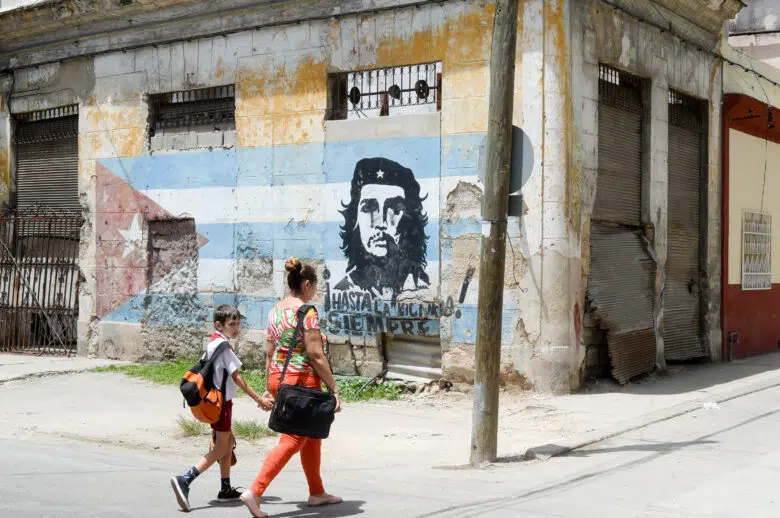
Walking around the old part of Havana today, one of the most extraordinary historical downtowns in Latin America, if not the most, like the song by Bebo Valdes, brings out black tears: “I suffer the immense sorrow of your loss… and my cry flows with black tears.”
The city is empty. At least 2 million people have left in the last three years and there are no young people to be seen. My friends have all left, absolutely all of them. Tourists disappeared, and beggars say they don’t have anything to eat.
Winners and losers
At the same time, a bourgeoisie is emerging. While some are unable to make do with the few yuccas, onions and beets that float like wreckage on the tables of the street markets, a merchant class that is living in a world of its own is on the rise. There are more new cars than there used to be, many Chinese, but not only Chinese, and restaurants where you can eat very well at international prices.
If in the past they attracted successful artists and musicians, members of the nomenklatura and foreigners, now they have among their regulars the owners of small and medium-sized companies and their families.
The economy is highly dollarized, and it is not difficult to exchange dollars on the black market at almost three times the official price. In the best-stocked stores you can pay directly with that currency. New immense and uninhabited hotels have appeared which are owned by the State, but whose management is in the hands of private individuals, mostly from Spain or India.
Those who can afford to leave are leaving.
There is a new drug called El Químico (“The Chemical”) which is causing havoc. The drug dose — a piece of impregnated paper — costs less than a dollar and contains carbamazepine and other benzodiazepines, as well as animal anesthetic, formaldehyde, fentanyl and phenobarbital. A level of violence has proliferated which, although much lower than in the rest of the continent, is alarming considering the country’s history.
Raúl Castro, who is turning 94 sometime soon, is expected to die. Nobody dares to say how this story will continue. Those who can afford to leave are leaving, although those deported by Trump could soon return.
For a long time now, very few people work in Cuba, the fields do not produce, and it is one of the most aging countries in Latin America. It is expected that by 2025 the population over 60 will exceed 25% of the population. And even though amid the reggaeton — the trendy kind is called reparto — you can still listen to the continent’s best jazz, the truth is that, basically, what prevails is hopelessness.
*This piece was originally published in in El Dínamo and reproduced with the author’s permission on July 24, 2025. It was updated August 19, 2025 with enriched media.