REYKJAVIK — Imagine ordinary life, but no one shows up. Anywhere. Not at high school or kindergarten, not at the office or the shop, not in the fields or on deck — not at the stove or the changing table. That is what Icelandic women did. On October 24, 1975, an estimated 90% of the nation’s adult female population went on strike, and unlike in Lysistrata, the ancient drama, it was about more than withholding sex. This was a general walkout that hit both paid work, often poorly paid, and unpaid work that was not even seen as work.
For the latest news & views from every corner of the world, Worldcrunch Today is the only truly international newsletter. Sign up here.
“In Iceland today, beds were not made and dishes were not washed,” reported the U.S. broadcaster NBC. “Newspapers were not published, theaters were not open, the national airline canceled flights, and most schools were closed.”
For many men, it was the first time they had spent a whole day caring for their children. Some had to bring them to the office. Shops that stayed open reportedly sold out of sausages, since they only needed heating on the stove. “The Long Friday” is what Icelandic men called the day no one forgot.
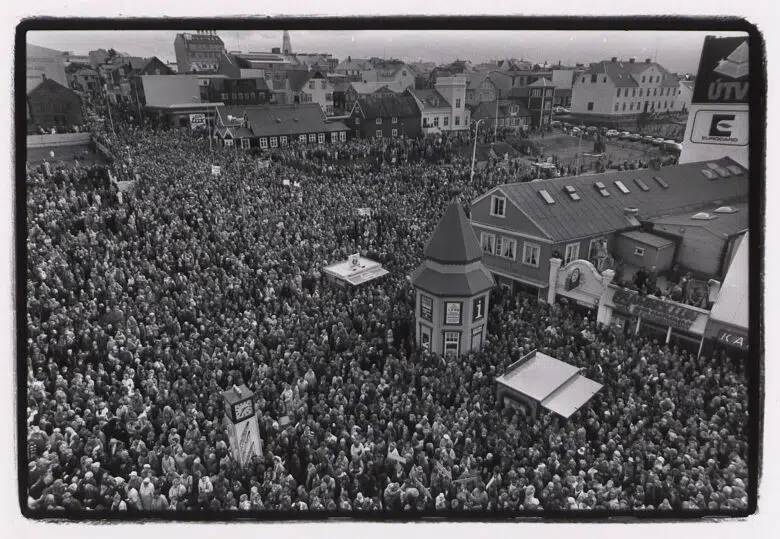
Where were the women? Many were out on the streets. Demonstrations took place across the country, and 25,000 people, more than one-tenth of the population, packed Reykjavík’s main square, Lækjartorg. They marched shoulder-to-shoulder, as the lyric goes in the old suffragette song played by a brass band. Women of all ages and social classes were there, along with some men and many children, on an unusually mild, dry autumn afternoon. There were speeches, chants, songs, “I dare, I can, I will,” and plenty of laughter.
So it is with the contemporary witnesses in the lively documentary “The Day Iceland Stood Still,” which looks back at the strike. The film by Pamela Hogan and Hrafnhildur Gunnarsdóttir opened in cinemas in the spring, and now, for the 50th anniversary, the French-German broadcaster Arte has added it to its media library. The interviewed lawyers, farmers, nurses, and housewives laugh at the astonishing success of their resistance, at the men, and at themselves. One participant likens the strike to a volcano that had been simmering for a long time and erupted that day.
Long way off
In the 20th century, Iceland went through a tremendous modernization. It slowly freed itself from Denmark and declared itself a republic in 1944. Meanwhile, more and more people moved from the countryside to the capital, Reykjavik. And in 1915, Icelandic women were among the first in Europe to gain the right to vote.
Sixty years later, as in most countries, equality was still a long way off. Girls were largely told what they could not or should not do, apart from getting married. There were just three female members of parliament, five percent. In general, women were either underrepresented or not represented at all, from trade unions and political parties to the farmers’ association. They earned far less than men for the same work, and often ended up in low paid jobs anyway.
They saw the women’s struggle as a class struggle, and the class struggle as a women’s struggle.
The year 1975 marked a turning point. The United Nations had declared it International Women’s Year, and the Icelandic government set up a committee of various women’s groups to prepare for it. Leading the way were the Rødstrømperne, the Redstockings, who went beyond this officially supported engagement. Inspired by groups of the same name in the U.S. and Denmark, they saw the women’s struggle as a class struggle, and the class struggle as a women’s struggle. They made their first big appearance at the May Day demonstration in 1970, in red stockings, of course. Even then, they floated the idea of a nationwide walkout.
Looking back, it is hard not to marvel. A strike in which 90% of the country’s women took part, how did that ever come together?

The simplest answer is that in Iceland 90% is not that many people. The island had 218,000 inhabitants at the time, and today it has just under 400,000. On the other hand, Iceland is the most sparsely populated country in Europe. Women lived far apart, and there were no digital media. But because the country is so small, everyone knows someone who knows someone. In the documentary “A Day Without Women,” participants describe how they set up telephone chains.
From September onward, the organizers worked flat out. Twenty-five organizations spanning the entire political spectrum joined the preparations. The goal was to reach as many women as possible, not just feminists in the capital. Those who felt a general strike was too radical were reassured by relabeling it a “day off,” even though unofficially and in many reports it was still called a strike.
Resounding success
The organizers printed tens of thousands of leaflets, and newspapers, radio, and television reported on the action. International media also pounced on the story. The South China Morning Post wrote, “Women are freezing Iceland.”
Resistance to the “day off” was limited. Although individual bosses, and some female bosses, tried to stop employees from joining in, most tolerated or supported the protest. “No one was fired,” says producer Gunnarsdóttir. It was not an illegal strike, after all. For the Redstockings, October 24 even felt a bit too well mannered.
All the more striking was the success. Anyone who had not understood how pivotal women were learned it that Friday. Future president Vigdís Finnbogadóttir called it “a day that opened men’s eyes.” It opened women’s eyes too. Finnbogadóttir, then director of Reykjavík City Theater, marched in the mass demonstration with her three-year-old daughter. She has often said that without the strike, she would not have run for the presidency five years later.
The hostility she faced in the 1980 campaign was fierce enough. Opponents and critics tried to discredit her as a divorced woman and single mother of an adopted daughter. In a televised panel, a rival asked the 50-year-old, who had undergone a mastectomy due to breast cancer, whether she thought the people wanted to be ruled “by a woman with only one breast.” She replied, “I had no intention of taking the Icelandic people to my breast.” Finnbogadóttir won by a narrow margin. She served for 16 years, becoming the first democratically elected female head of state in the world.
October 24, 1975 is described in the documentary as “the day that changed everything.” One participant says that aside from the birth of her children, it was the most significant event of her life.
Other parties had no choice but to bring in more women.
Writer Steinunn Sigurdardóttir is more cautious. At 25, she marched in the huge demonstration, holding her 18-month-old by the hand. “The atmosphere was fantastic,” she tells Die Zeit. At least as groundbreaking, though, were the election of Vigdís Finnbogadóttir and the entry of the Women’s Alliance into parliament in 1983. The party included many Redstockings. Particularly influential was Ingibjörg Sólrún Gísladóttir, later foreign minister. “They changed everything,” says Sigurdardóttir. Other parties had no choice but to bring in more women.
Pay gap
Just one year after the strike, parliament passed the first equal rights law. While only 15.3% of university graduates were women in 1970, a decade later the figure had nearly tripled.
Today, Iceland is seen as a model feminist country. In 2009, Jóhanna Sigurdardóttir became prime minister, the first openly gay head of government in the world. At present, the two highest state offices are held by women, women form the majority in the cabinet, and Reykjavík has a woman mayor.

According to the World Economic Forum, Iceland has had the smallest gender pay gap in the world since 2009. Eighty-seven percent of women of working age are employed, despite one of the highest birth rates in Europe. Each parent is entitled to six months of parental leave, which most men take, since it cannot be transferred to the other parent.
Yet Icelandic women do not live in a paradise of emancipation. Violence against women, as in other Nordic countries, is disproportionately high, a phenomenon known as the Nordic paradox. Many women also still feel that the pay gap is too wide and that women remain underrepresented in leadership roles. Added to that is growing pressure on young families, as historian Erla Hulda Halldórsdóttir explains. Real estate prices are rising, and daycare centers lack staff, because the pay is poor. In the end, it is often women who, with lower salaries, opt for part time work.
Halldórsdóttir served on the documentary’s scientific advisory team. Like writer Steinunn Sigurdardóttir, she urges a clear-eyed view of the historic day. She is skeptical about the oft quoted “90 percent of women.” How do you measure that? Her own mother, she says, was not there. The family kept a farm an hour’s drive from the nearest village. Her father went to the slaughterhouse that day, and her mother had to tend the animals.
The guy 59-year-old wants more stories about women who did not take a “day off.” They too belong in the picture. Halldórsdóttir certainly does not doubt that the 1975 strike mattered. It was a catalyst, an accelerator, and it still inspires. Filmmaker Hrafnhildur Gunnarsdóttir puts it plainly. “October 24,” she says, “planted different ideas in our heads. It gave us shoulders to stand on.”