

-Analysis-
Here’s a bit of fresh and slightly scandalous gossip from the internal chat at Die Zeit‘s digital department: Last Wednesday evening, my colleague Henrik Oerding dropped in a link to a German-language song playing in the press lounge at Meta’s Connect conference in California, which he’d been able to identify with the music discovery app Shazam. The title of the apparently AI-generated track has a pornographic ring: “Stick your finger in.”
How that song ended up on the playlist of a company notorious for deleting even the faintest trace of a nipple from its social media platforms will likely remain a mystery. Chances are hardly anyone there, apart from Henrik, understood the lyrics anyway. Still, I’d like to share with you my reaction, which is exactly what I wrote back to Henrik: 🤯.
Since its Llama model has fallen behind those of OpenAI, Anthropic, and Google, many in the industry now consider Facebook-owned Meta a second-tier player in the AI race. That may be true when it comes to the fabled superintelligence that may (or may not) ever be built. But in terms of imagining how we might interact with AI in the future, Meta is right at the forefront.
Meta’s smart glasses
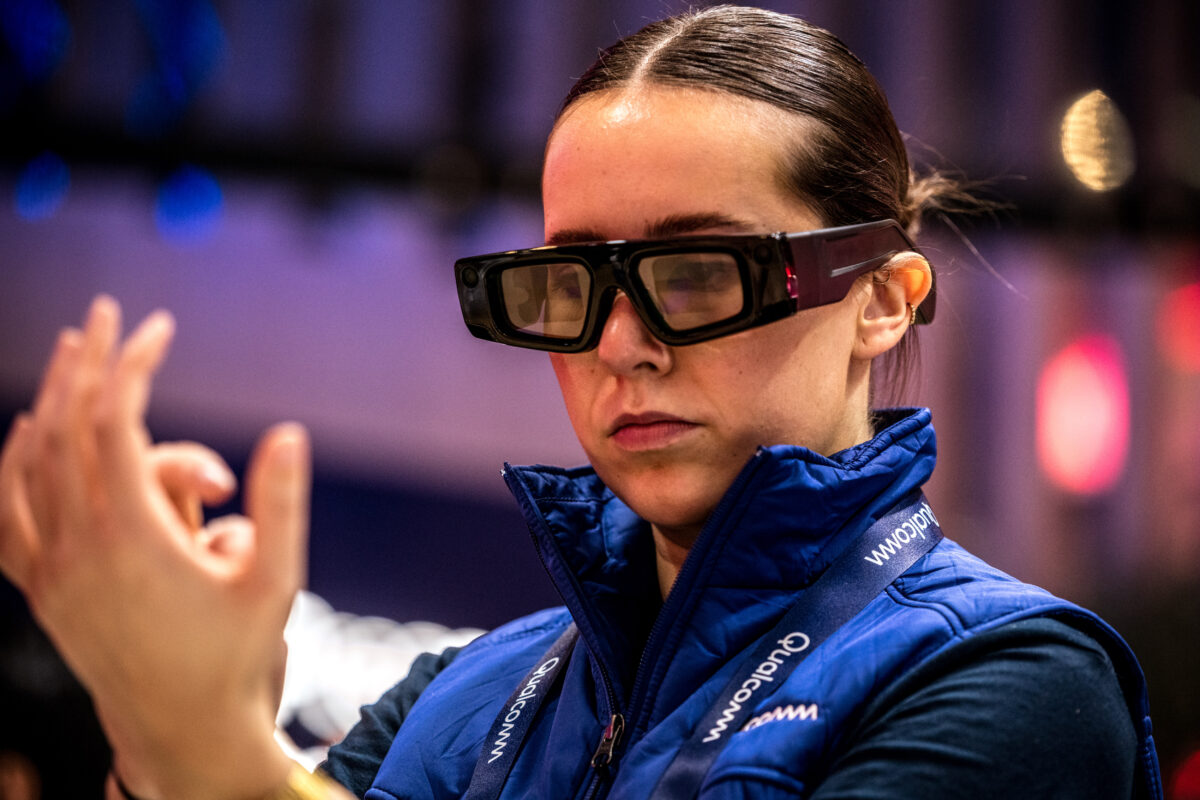
At last week’s presentation of new versions of its smart glasses, one model features a tiny display that can, for instance, project real-time subtitles during a conversation. It also comes with a wristband that tracks electrical signals on the skin triggered by muscle contractions. A control system built directly into the body, though still far less invasive than a brain chip. Naturally, Meta’s AI assistant is integrated into the glasses too.
Do we really want to be constantly sending everything we see to the servers of an American corporation?
As glasses equipped with cameras become more common, privacy concerns inevitably follow. Do we really want to be constantly sending everything we see to the servers of an American corporation?
Even so, I admit I am a little jealous of my colleague Henrik, who already got to try them out. Because I suspect they contain ideas that, in one form or another, might one day be as ubiquitous as smartphones. AI assistants need to know our physical environment in order to be genuinely useful. And we need to be able to control them without having to talk all the time.
Will AI wipe us out?
Artificial intelligence could, in the near future, develop superhuman abilities and use them to harm or even annihilate humanity. This is not a new fear. Since ChatGPT’s arrival, it has resurfaced in mainstream debates, but among AI researchers, variations of it have circulated for decades.
Much of the new buzz can be traced to Eliezer Yudkowsky. The author and self-taught researcher co-founded the Singularity Summit 20 years ago with Ray Kurzweil and Peter Thiel, where the future of superintelligent machines was on the agenda. In 2010 he introduced Demis Hassabis and Shane Legg, who went on to found DeepMind, now Google’s AI division. OpenAI’s CEO Sam Altman also credits Yudkowsky as a major influence. In short, Yudkowsky and his ideas carry considerable weight in the AI world.
Now Yudkowsky has published a book meant to set out his perspective on artificial intelligence for a broad readership. The message is so stark that the title says it all: If Anyone Builds It, Everyone Dies. The “it” is a superintelligent AI. The book is co-authored by Nate Soares, director of the Machine Intelligence Research Institute, which Yudkowsky founded.
They will have strange, incomprehensible priorities that they will pursue all the way to humanity’s extinction.
While early in his career Yudkowsky focused on researching how to build safe AI, he has since become convinced that once powerful enough, it will kill us. The authors write that people “assume artificial intelligences will not hate us,” but that it will have strange, incomprehensible priorities that they will pursue all the way to the “extinction” of humanity.
Over the years, I have had long conversations with people who share such worries, including Yudkowsky himself. The “doomers,” as these AI pessimists are often called, have not really persuaded me. I lean more toward researchers like Arvind Narayanan and Sayash Kapoor, who treat AI as a “normal technology”: significant, capable of reshaping society, like the steam engine or electricity, but not an alien, superintelligent life form.
That said, I should admit I’ve only skimmed Yudkowsky and Soares’ book so far. Perhaps it will win me over yet. If it does, that will a scary day.