The Portraits by Volodymyr Krychovskyi That Disarm Authority
By Daria Iv
A professional photographer and content creator operating at an international level has introduced an original format that reshapes how the public perceives authority figures and uniformed professionals.
Police officers, guards, military personnel, and others in uniform are often seen as emotionally distant. Professional discipline requires restraint, which leaves little room for visible expression in public settings. This distance has shaped an assumption that those in uniform are defined solely by their function, not as individuals. To avoid trust erosion, institutions usually respond through official communication and public campaigns, yet these tools rarely address the everyday, human interactions where trust is actually formed.
Volodymyr Krychovskyi proposes a fundamentally different solution. An independent photographer and content creator based in Prague, Czech Republic, he works without institutional backing or organizational affiliation. Despite this independence, his work has achieved a scale and level of public engagement more commonly associated with national or government-supported campaigns. Under the name Printographer1, his YouTube channel has grown to approximately 5.8 million subscribers and more than 3.4 billion views worldwide. He is also a recipient of YouTube’s Silver and Gold Creator Awards, recognizing sustained, large-scale global reach.
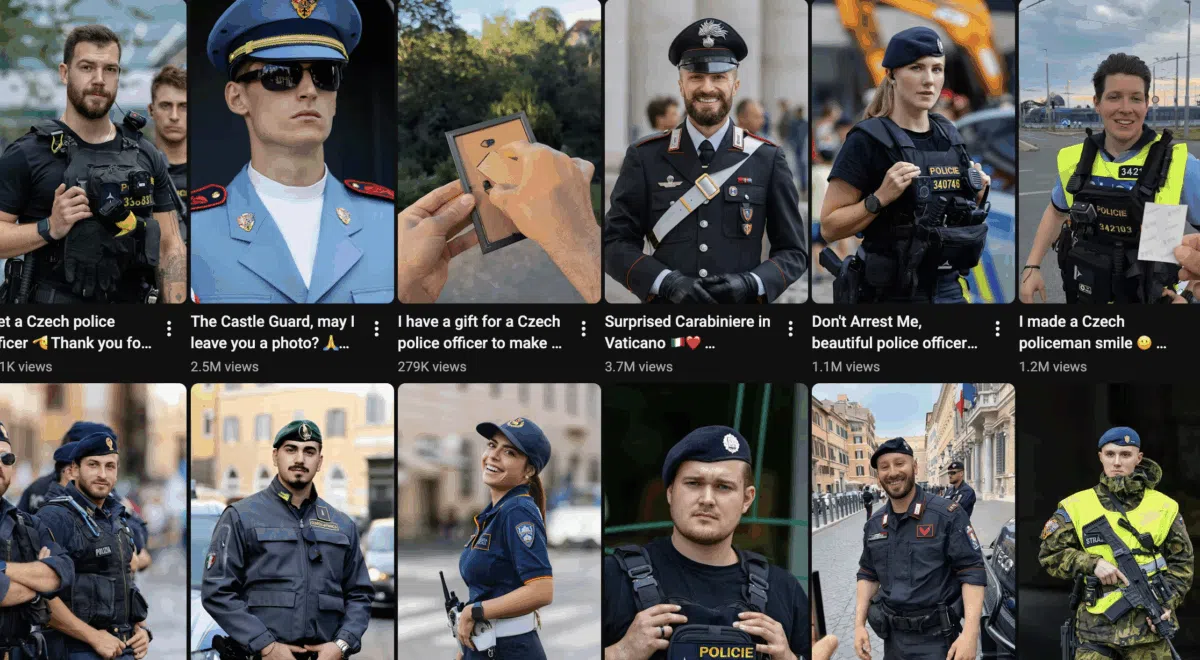
Volodymyr’s approach combines street portrait photography with instant printing and the immediate gifting of the photograph to the subject. This methodology represents an original shift in how visual content about authority figures is created and consumed. His work captures spontaneous, unscripted interactions that reveal officers and uniformed professionals through ordinary, human moments.
“I usually approach an officer in a public place, introduce myself, and ask if I can take a portrait. I take the photo, print it on a small portable printer, and give it to them right away. I don’t plan anything. People react the way they feel in that moment, which I highly appreciate,” he says.
Instant printing is not a technical detail; it is central to the method. In a digital environment dominated by temporary content, a physical photograph signals intent and respect. For the officers themselves, it is also an opportunity to see what they look like when they are at work, while the audience gets the confirmation that the interaction is real and unedited.
The resulting footage captures reactions rarely associated with people in uniform: hesitation, surprise, quiet smiles, and moments of visible appreciation. Through these encounters, Volodymyr introduces an original and socially significant approach to trust-building communication. By presenting respectful, ordinary interactions between civilians and authority figures, his work interrupts automatic assumptions and reduces emotional distance without confrontation.
This impact is measurable. In comment sections across platforms, discussions around policing and authority often shift from abstraction or hostility toward empathy, recognition, and personal reflection. Short-form videos documenting these encounters regularly reach millions of viewers across YouTube, TikTok, and Instagram, particularly among younger audiences encountering authority figures through casual, non-adversarial contexts.
Independence remains a critical factor. Because the project is not affiliated with any institution, it avoids skepticism typically associated with official messaging. View ш-ш-шers engage with the content as an individual initiative, which enhances credibility while amplifying social influence.

In 2025, the project expanded beyond the Czech Republic. In Rome, Volodymyr photographed officers of the Italian Carabinieri. One portrait, featuring an officer named Domenico, became widely shared. The video accumulated more than 280 million views across platforms. Within days, Domenico’s previously private Instagram account gained over 90,000 followers, leading to outreach from modeling agencies and unexpected professional opportunities outside his primary role.
“I want people to see police officers as real people. If a simple portrait and a small gesture can bring a smile, change how someone feels, or make people look at police differently, then that is exactly why I do this,” the creator says.
The trend Volodymyr Krychovskyi is setting has been adopted by other creators, demonstrating its transferability and influence on broader practices in social media photography and visual storytelling. His work changes how professionals in uniform are portrayed — not solely as enforcers of authority, but as individuals with emotions, limits, and everyday human experiences.
Through an independently developed methodology, exceptional international reach, and demonstrable influence on public discourse and professional practice, Volodymyr Krychovskyi has established himself as one of a small number of creators whose work meaningfully reshapes contemporary visual communication surrounding authority and public trust.