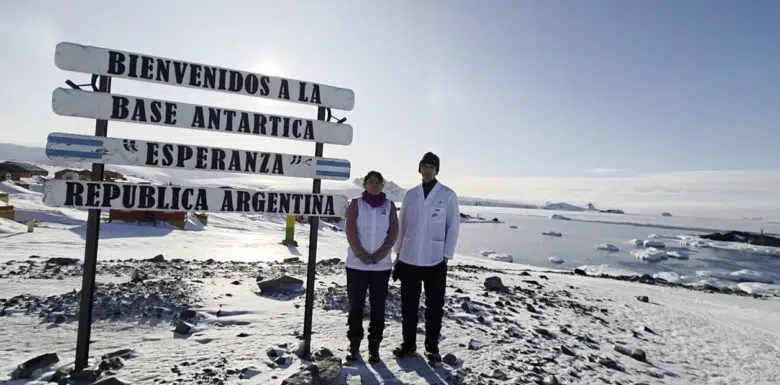
BUENOS AIRES — Every day of the academic year, Antarctica’s only school begins the day by raising the flag, with average temperatures ranging from -14 °F in winter to 34 °F in summer.
Provincial School No. 38 “Presidente Raúl Ricardo Alfonsín” welcomes the sons and daughters of the Esperanza Base staff, which is unique in that it is the only establishment in Antarctica where scientists, armed forces personnel, technicians, and civilians live for a year with their families.
Using a system similar to that of rural schools, the institution offers three levels of education: preschool, primary, and secondary. In the latter, students take their courses through SEADEA, the Argentine Army’s Distance Education System.
For the latest news & views from every corner of the world, Worldcrunch Today is the only truly international newsletter. Sign up here.
This year, one child is studying in the 3-year-old class, two in the 4-year-old class, one in the 5-year-old class, two in first grade, one in third grade, two in fourth grade, and one in sixth grade. Another five are attending secondary school. Two teachers are in charge of the group: Pablo Monzani and Lis Mendoza, who is also the school’s principal. And yes, their two children are in the school.
Living and studying in Antarctica is unlike any other experience: the winter season lasts all year and, obviously, it is not the place to just wing it. That’s why everything, down to the smallest detail, is planned before arriving in the Great White South.
Life in Antarctica
The current staff consists of 58 people, including eight families and four individuals who came alone. All of them have a specific role, in addition to the collaborative tasks that are required, beyond their particular duties.
Major Sergio Jarmel, head of Esperanza Base, explained to Clarín that the operation is divided into different areas: the kitchen; the mechanical workshop; healthcare; communications personnel (internal and external); radio personnel; environmental personnel; and installation personnel, who are responsible for all base maintenance.
The healthcare sector is where Lieutenant Commander Marcelo Dumrauf, a doctor, and his wife Alejandra Reartes, a dentist, work. The couple lives there with their children, aged 9 and 5. Reartes said that although in her specialty the priority is functionality over aesthetics, here necessity presides over everything: “You have to be very creative with what you know and what you have in order to solve everything. It’s a tremendous challenge.”
Her husband, meanwhile, said that his current work is “very interesting and rewarding. It’s a type of medicine that brings you closer to patients, all within the confines of an Antarctic base.” He added that the experience is “rewarding, both personally and for the family, as well as professionally.”
“It’s a unique experience; you fall in love with Antarctica.”
The decision to spend the winter there was made by the whole family, the couple said. The children quickly accepted it, seeing it as a total “adventure.” Their daughter even writes her own travel log.

Jarmel noted that it’s “like a reward” to get a military assignment in Antarctica. “Normally, because of our profession, you don’t get to spend much time with your family and children. Here, however, even though there’s a lot to do, you are just a stone’s throw from home. It’s a unique experience — you fall in love with Antarctica.”
Rural school model
So, what is it like to go to school in Antarctica? At Provincial School No. 38, the day begins at 8:30 a.m. with Presidente Alfonsín raising of the flag. Until noon, students work on basic subjects: language practice, mathematics, technology, natural sciences, and social sciences. In the afternoon, twice a week, between 2:30 p.m. and 5:30 p.m., there are other activities, such as literacy, computer science, programming, carpentry, folklore, and physical education workshops.
Recess, meanwhile, is weather-dependent, so it tends to take place inside the school. Monzani, the teacher, explained that they organize “play stations where they can paint, play board games, or do other fun activities.” The kids get together, play, bring something from home (a toy or something to share), and turn that time into the recess that every educational institution has.
“It changes your outlook and your way of life.”
In addition to the very unique context of being in Antarctica, Monzani says the school stands out for being a rural style set-up: it follows a multi-grade or multi-classroom teaching system in the lower grades. So, the children in the early years are in a classroom with different ages, as are those in the primary school.
“This gives it a very special kind of dynamic and character, because you have to work in a different way and use other teaching strategies to be able to teach children who are in different grades or years of schooling at the same time,” said the teacher.
Beyond the cold and the difficulties inherent to the place, the teacher (and father of two students) touts the experience from both sides. “Teaching in Antarctica is a big professional challenge, a very intense, valuable, and constructive experience, both professionally and personally,” he said. “It changes your outlook and your way of life. Doing this as a family is also a privilege and a luxury that, fortunately, we are able to enjoy.”
Different mindset
Above all, the 58 people who currently live at Esperanza Base will take with them lessons that are not taught in school.
Sergio Jarmel noted that throughout the winter, people’s moods change, and that is when it is most important to practice empathy. “Understanding others and being able to compromise” is part of everyday life,” he said. “Here in Antarctica, everything seems beautiful when you first arrive. But as winter comes, it turns into a kind of plateau where people fall into a different rhythm. Now, with spring approaching (in the southern hemisphere), things are shifting again—everyone knows their time here is limited, and people begin to adopt a new mindset.”
For Reartes, the dentist and mother, the most important thing is companionship. “Here we all need each other; one person couldn’t do it alone. And resilience too: adapting, readjusting, and just keeping going.”