HAMBURG — You can’t help but feel a bit sorry for dogs. Just look at what they have to put up with via the German language. Bad weather? Hundewetter, “dog weather.” Exhausted? Dog-tired. Down on your luck, no money, no job? You’ve gone to the dogs.
They don’t get a much better deal in cartoons either. Think of Goofy, Mickey Mouse’s pal: well-meaning, but bumbling through life. Or Wum, the 1970s TV dog by German cartoonist Loriot: lovable, but not too smart.
For the latest news & views from every corner of the world, Worldcrunch Today is the only truly international newsletter. Sign up here.
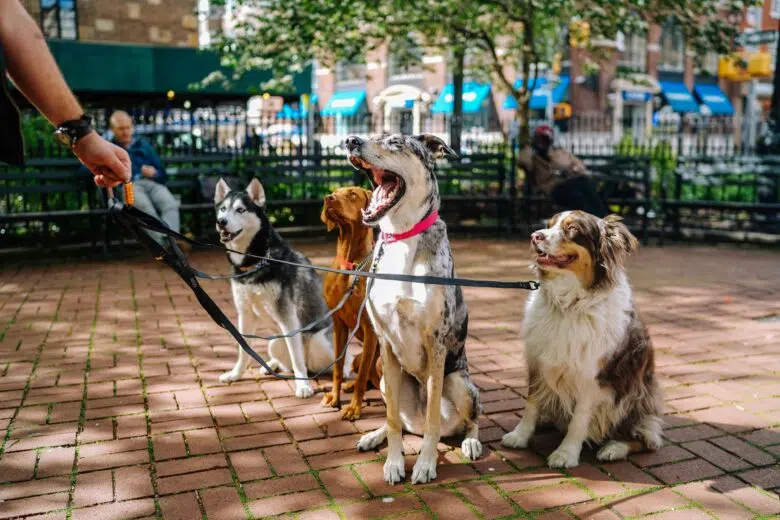
Dogs are strange creatures. They come in every shape and size, from the comically tiny Chihuahua or Miniature Pinscher to the enormous Great Dane or Mastiff, and in every shade of white, beige, brown, red, gray, and black.
If an alien were to land on Earth by mistake, it would hardly guess that they all belong to the same subspecies, descended from the wolf. Hard to believe, but the Miniature Pinscher really does trace back to the wolf.
Elegance is not exactly the first thing you associate with dogs. When they get wet, they stink. They pant constantly, tongues lolling, flinging drops of saliva. They tear madly across fields without warning, then spin clumsily in circles before lying down, once, twice, three times.
Goofy as a strategy?
Yet millions of dog owners adore them. They delight in their pets’ little tricks. Fetching a stick. Offering a paw in return for a hand. Isn’t that wonderful? Long ago, non-dog owners rolled their eyes. No, dogs have never had the reputation of being particularly brainy. That badge has gone to chimpanzees, elephants, and dolphins, the real prodigies of the animal world.
But dogs have more to say than you’d think. Their goofiness has long hidden the fact that Canis lupus familiaris is actually one of evolution’s great success stories, and humans still have something to learn from it.

The year is 15,000 BC. Northern Europe lies under a sheet of ice. Beyond it stretches a bitterly cold tundra, shading into endless scrubland. Thin forests cling to the northern Mediterranean. Of the predators that once roamed this unforgiving landscape, only two remain in any number: Canis lupus and Homo sapiens.
Human numbers keep growing. Both need ever more meat to survive.
The wolf, Canis lupus, has ruled Europe for more than 300,000 years and is still the dominant predator of the Northern Hemisphere. By contrast, modern humans are recent arrivals, landing less than 30,000 years ago from Africa via the Middle East. But their brains have made them ruthless hunters, steadily wiping out the competition. Their closest cousin, the Neanderthal, is already gone. Lions, leopards, wolverines, hyenas will follow them into extinction within a few thousand years. The brown bear only rarely crosses their path.
But the wolf remains a rival, sharp-nosed, clever — and like humans, able to cooperate in packs. Human numbers keep growing. Both need ever more meat to survive. Berries and tubers will not do for humans, who have yet to invent agriculture. What happens when the two great hunters go head-to-head?
Some wolves, the less suspicious ones, begin lingering near human encampments. They scavenge the scraps. They watch the humans. The humans watch them back. They notice that the wolves howl when game is near. They head out, kill the animals, and leave some of the meat for the wolves. No one knows how many generations this goes on.
Self domestication
Over time, the friendly wolves change. Some ears droop, tails wag, coats shift into new colors. Male heads begin to resemble females more closely. Most importantly, these wolves learn to read human gestures.
After 5,000 years, part of the species has transformed into Canis lupus familiaris, the family wolf. They live in human settlements, guard them, and soon help herd domesticated animals, cattle, pigs, sheep. Some wolves have become dogs. “Humans didn’t domesticate wolves; the wolves domesticated themselves,” says evolutionary biologist Brian Hare of Duke University. “We only fine-tuned them later.”
Today it is clear the strategy of those first “friendly wolves” paid off. The dog, Canis lupus familiaris, now numbers around 900 million worldwide, many of them living semi-wild. The old Canis lupus, the wolf that stayed aloof, paid dearly. Humans nearly wiped it out, and in some places, it vanished altogether. Only about 250,000 wolves still roam the Earth.
Along the way, dogs mastered a skill that once gave humans the upper hand: intentional communication. Hundreds of thousands of years ago, long before language, humans used gestures. A hunter would point, another would follow his gaze, and together they’d track prey. For the first time, one mind could tune into another’s thoughts. This ability to share intentions marked a giant leap. Some researchers even argue it paved the way for language itself.

Michael Tomasello, an evolutionary biologist, calls this shared intentionality “the first and most important process in the early development of humanity.” It was his student Brian Hare who showed him that dogs have it too. As a boy, Hare would point out hiding spots or directions to his Labrador, Oreo, who always understood. Tomasello doubted him, until the two designed experiments. Not just Oreo, but many dogs proved they could read human gestures. Chimpanzees, by contrast, cannot — except those raised by humans. Wolves still cannot today.
A new kind of intelligence
Dog owners may not be surprised, but until the late 20th century, science overlooked it. Pets were thought to be dimmer than their wild cousins. “Instead of domestication making dogs dumber, our relationship with them gave them a new kind of intelligence,” Hare says.
Dogs can learn the names of up to a thousand objects. They open doors, fetch items, guide the blind through cities, assist the deaf, and track avalanche victims. Their mental powers are so striking that Hare coined a word for them: “dognition,” short for dog cognition.
This long co-evolution also made dogs empathetic. A human cries on the couch, and the dog pads over, lays a paw on their knee, nudges them. Some humans don’t even manage that.
Their senses are just as remarkable. With 300 million olfactory cells, dogs detect scents miles away. Smell is their main sense. “Dogs sniff their world first,” says biologist Alexandra Horowitz of Columbia University. But unlike our static vision, the world they smell is in constant motion, molecules drifting on the air.
Some call it telepathy. It isn’t.
When someone leaves home, their scent fades. Dogs track this. If their human always returns when the smell has dwindled to, say, one-tenth its strength, the dog takes it as a cue and waits at the window. Dog owners know this. Some call it telepathy. It isn’t. It’s a dog’s “smell clock.”
Dogs are not just sniffers, they are keen-eyed watchers too. Humans see smooth motion at 25 to 30 frames per second. Dogs still see the gaps, perceiving single frames as stills. “On old TVs, they even saw the black flickers between frames,” Horowitz notes. For them, it takes about 70 frames a second to look fluid. That’s why they catch fleeting gestures humans miss, micro-expressions lasting just 20 milliseconds. In fact, Horowitz found they use these tiny signals in their own communication.
Hare calls the dog’s triumph “survival of the friendliest.” Sometimes friendliness, tolerance, and attentiveness are the best survival strategies. Dogs proved it. And humans, he says, could learn the same lesson: “The best way to fight dehumanization is by bringing people together, creating friendships.” Some wolves dared to do just that 15,000 years ago. As dogs, they are still reaping the rewards.