
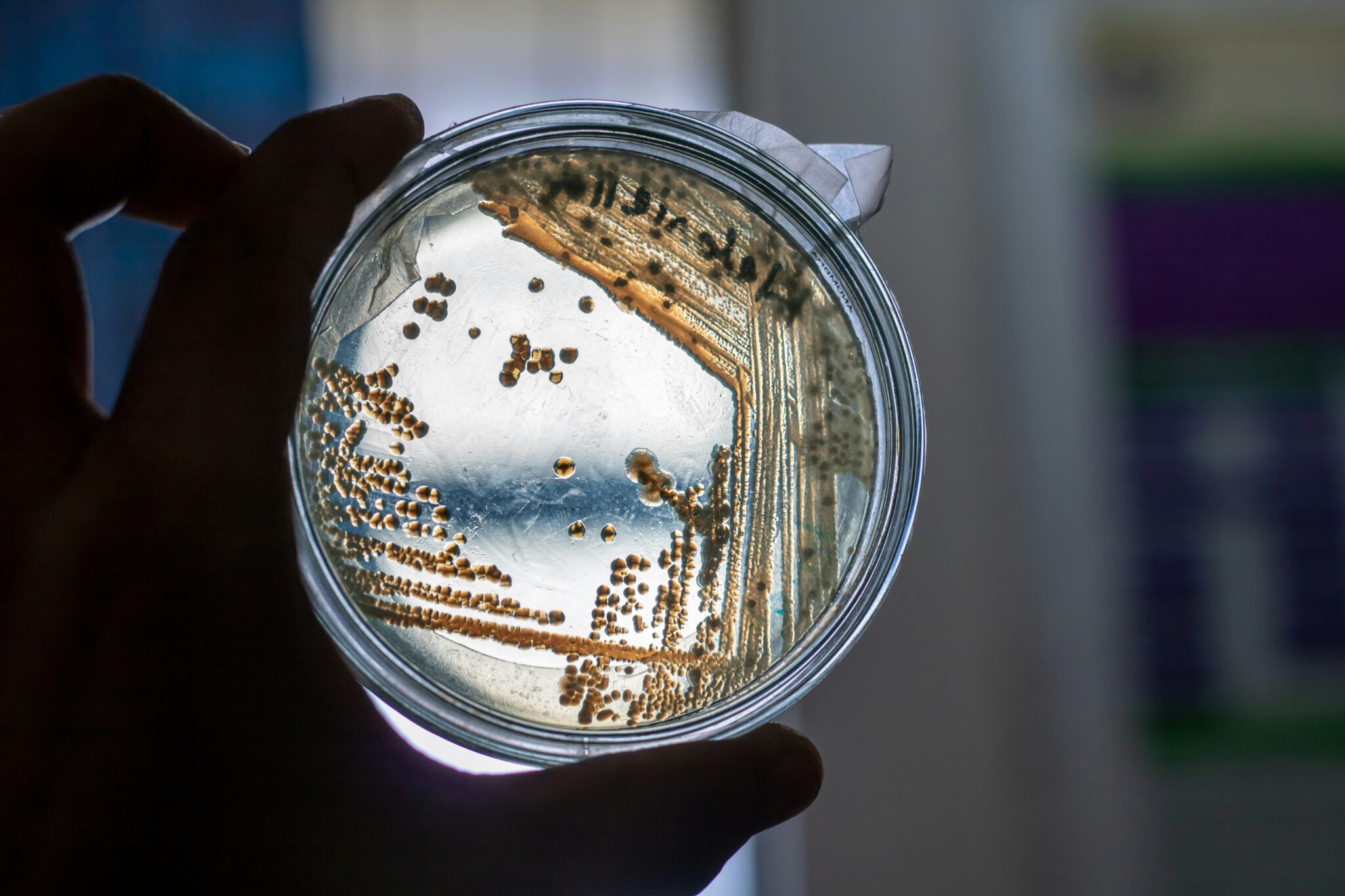
PARIS — They were never supposed to leave the laboratory. The mirror bacteria were supposed to remain confined, monitored, neutralized. Yet some escaped, and within months they multiplied, crossed borders, infiltrated ecosystems… and began killing humans and animals.
Was the escape of these pathogens, which should never have left the lab benches, intentional? Was it the work of a criminal, or an unfortunate accident? Whatever the case, the mirror bacteria colonized the environment and attacked a wide range of living beings unable to defend themselves, from soil microorganisms to humans.
To understand what a mirror bacterium is, picture your hands: they appear identical, share the same structure, and yet it is impossible to overlay them perfectly. One is the mirror image of the other: similar, but reversed. In chemistry, this phenomenon has a name: chirality. In the natural world, this property is everywhere. Each of the molecules that make up our cells, proteins, and DNA, exist in a form oriented either to the left or to the right, and never the opposite. A mirror image of an element, let alone a microorganism, can become ineffective or even dangerous, because nothing in the natural world is prepared to deal with it. For example our immune system, which is designed to respond to pathogens oriented in a certain way, would be completely helpless against the same pathogen, but inverted.
If nothing stops mirror bacteria, they could “make much of the world uninhabitable,” explains Filippa Lentzos, professor of science and international security at King’s College London. Once present in a natural environment, bacteria generally reproduce rapidly and uncontrollably if nothing stops them.
“Shampoo doesn’t make more shampoo, we all agree on that. But yogurt can produce more yogurt. Bacteria are the same: They reproduce, like yogurt that ferments,” John Glass, director of the synthetic biology group at the Craig Venter Institute, said at this year’s international symposium on mirror biology held in Paris.
Bacteria that spread extremely quickly
All this is still fiction: Mirror bacteria do not exist in real life, and researchers do not know how to create them. But “in 10 to 30 years, scientific advances will enable us to do so,” Glass says. Researchers around the world are therefore mobilizing to prevent the creation of mirror bacteria. Hundreds of them gathered in Paris in June for an international conference on the “unprecedented” risks of mirror life.
There is a consensus: we must not create them.
“There is a consensus: we must not create them,” Glass continues. But what if, out of scientific curiosity or with malicious intent, a researcher decided to break this rule? There is no such thing as zero risk, the researchers remind us. And if we do end up creating mirror bacteria, even with maximum precautions in the laboratories, a leak is always possible.
So why are researchers still interested in mirror life? “Mirror peptides, which are a sequence of mirror proteins, are very useful for certain treatments. There is real therapeutic potential,” explains Mélanie Ethève-Quelquejeu, a researcher at the Laboratory of Pharmacological and Toxicological Chemistry and Biochemistry at Paris Cité University. Mirror bacteria, meanwhile, could also potentially have uses.
“It’s easy to imagine,” says David Relman, a microbiologist at Stanford University, “a mirror bacterium capable of synthesizing a rare nutrient to boost agricultural yields, or producing a mirror protein with innovative, even revolutionary properties for medical treatment.”
But their unique characteristics would make them far too susceptible to uncontrolled spread. “They will resist all forms of predation, such as phages (viruses that specifically infect and destroy bacteria) or other bacteria that could attack them,” Glass comments. Indeed, these pathogens have receptors specific to bacteria that already exist in the “natural” world.
Furthermore, according to the researchers, “some mirror bacteria could survive in nutrient-poor environments by still finding sources of glucose.” Some hypotheses even suggest that they could be satisfied with achiral nutrients, i.e., those that do not really have a right or left orientation, such as glycine, water, or urea. And if nothing attacks these bacteria, even if we are lucky, and their rate of multiplication remains low, they will still be able to gradually colonize the planet without anything slowing their advance.
If they attack microorganisms in the soil, it will happen very quickly, and everything could collapse, including the human species
“If they colonize a niche, such as an animal species, it will be easy for them to spread and jump from one species to another,” Glas says. And a ripple effect like this “can change the entire balance of an ecosystem.” It’s feasible that a mirror bacteria could colonize a species of rodent or bird, which could easily, as history shows, be transmitted to humans. Glass gives another example: “If they attack microorganisms in the soil, it will happen very quickly, and everything could collapse, including the human species.”
What kind of epidemic could we expect?
“Anything is possible. Mirror bacteria could be capable of infecting humans through the skin, inhalation or orally,” Relman warns. The terrifying thing is that these bacteria would essentially be wearing an invisibility cloak against our immune system, which is trained to recognize pathogens, (viruses or bacteria), through specific receptors. This recognition can be innate (via the innate immune system) or acquired after initial exposure, owing to the adaptive immune system, which recalls the attack in order to act more quickly and effectively in the event of a second exposure. Mirror bacteria, which are reversed in relation to what our system recognizes, would therefore completely bypass our immune defenses.
“It is almost certain that they will evade PRRs (pattern recognition receptors), the immune system sensors that are responsible for identifying typical signals of viruses or bacteria,” Relman explains. Studies conducted on infants with defective PRR systems have shown that 100% of them died.” In other words, if the mirror bacteria pass through this PRR system, death is guaranteed. Similarly, the enzymes that direct pathogens to be digested by immune system cells work by recognition. If the bacteria are reversed, ”they won’t work,” Relman warns.
Possibilities include chronic disease, with accumulation in the cells of a particular organ, or acute infection
What would an infection by mirror bacteria look like? “We don’t know,” Relman says. “Possibilities include chronic disease, with accumulation in the cells of a particular organ, or acute infection. One of the worst-case scenarios is a bacterial infection in the bloodstream. Organs would fail one by one, leading to death.”
None of our current public health measures seem like they would be effective against an epidemic of this kind — antibiotics and vaccines are based on chirality. Moreover, a rapid response would be extremely difficult if mirror bacteria first infected a species like birds or rodents.
“It would take a long time to identify them, and once detected, options to eliminate or contain them would be very limited,” Glass warns. That is enough to convince many researchers: “Mirror bacteria must not be created.”