
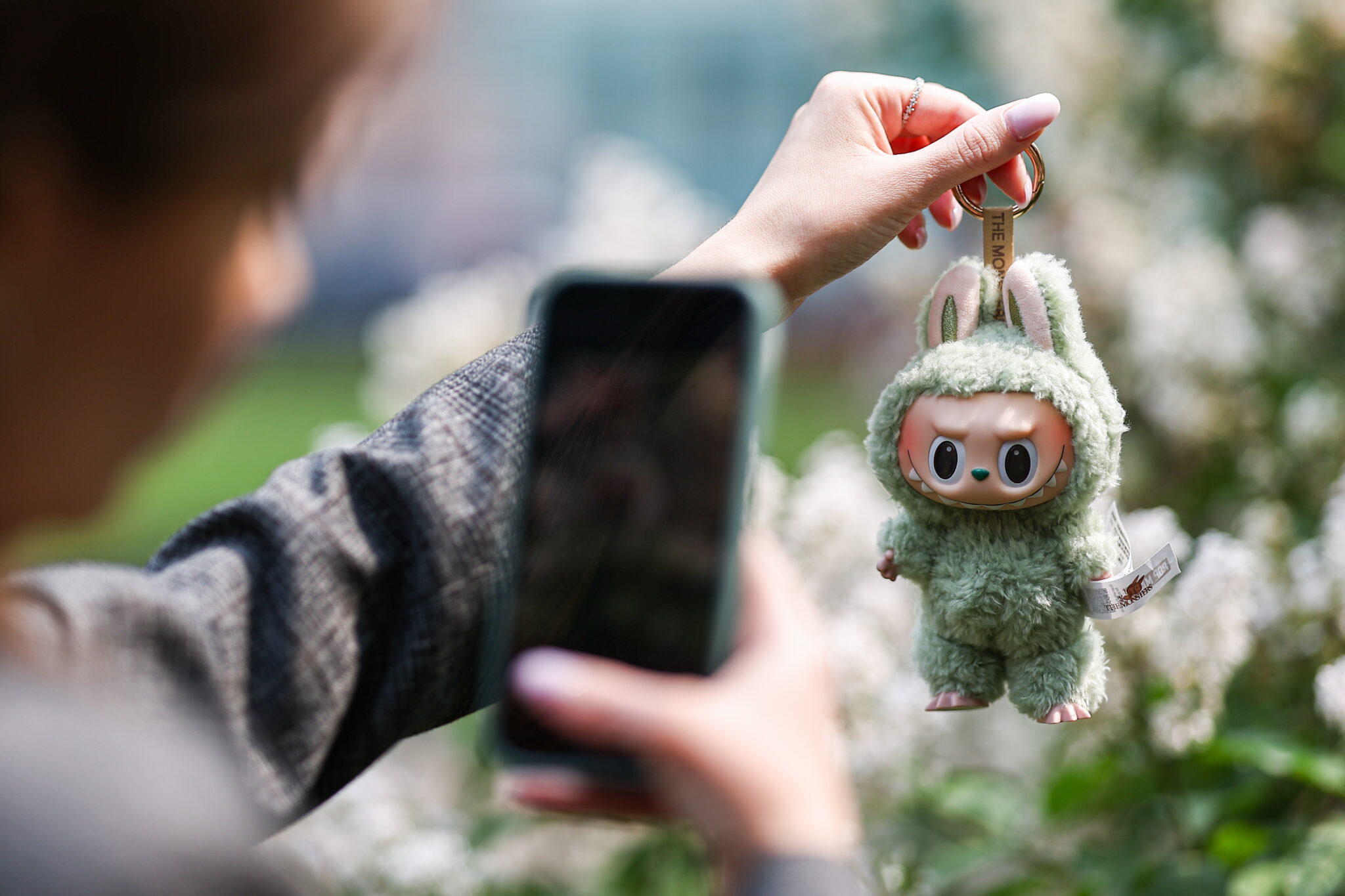
SHANGHAI — Labubu, the plush toy with bared fangs and pointed ears, went viral after Lisa of popular South Korean girl group BLACKPINK shared it last spring on her social media accounts. From its original price of 199 yuan ($28) to a rare edition fetching 3,000 yuan ($420), from a symbol of emotional support to social status tokens, this “ugly-but-cute” toy has taken on a meaning far beyond any obvious explanation.
Why are people willing to pay such high prices for these strange-looking toys?
Even before the custom-made storage closet she’d ordered for Labubu arrived, Zhang Yingying says she was already planning to quit this expensive fandom. The live-streaming sales had shown the Shanghai resident the same message: “Long queue, please try again later…” Meanwhile, black-market scalpers’ prices kept rising. Her coveted THE MONSTERS hidden edition had been driven up to a markup of over 30 times its retail price.
“I was on edge for hours, feeling anxious when I was rushing to buy, disappointed when I didn’t get anything, and angry when facing scalpers,” Zhang recalled. “It was really exhausting.” After her mood turned bleak, and several nights of bad sleep, Zhang felt something was wrong and decided she had to confront her Labubu obsession.
Reports in May and June spread of scalpers buying up Labubus across cities in China, with fights erupting in stores in South Korea and the UK.
In 2024, Labubu, the star of Pop Mart’s independent IP “THE MONSTERS (Nordic Forest Elves),” pushed sales of the entire THE MONSTERS doll series to soar from 368 million yuan ($50 million) to 3 billion yuan ($410 million). Between February 2024 and June 2025, Pop Mart’s stock price increased more than tenfold.
What exactly has driven the little monster’s popularity and its “emotional success”? People can’t seem to agree on the specific reasons, as each of its characteristics appeal to a specific demographic, ultimately fostering a vast fan base.
Chasing the trend
Zhang first became aware of the Labubu craze at work. The colleague who once said the Labubu on her bag looked “so ugly” suddenly hung a hidden edition on her own Louis Vuitton bag, and even asked her for buying tips. Another friend, who had once helped her queue in livestreams but declared she couldn’t fathom why anyone would pay high prices for toys, eventually paid a scalper 3,000 yuan for a Labubu card figurine (which is in transparent packaging with the design).
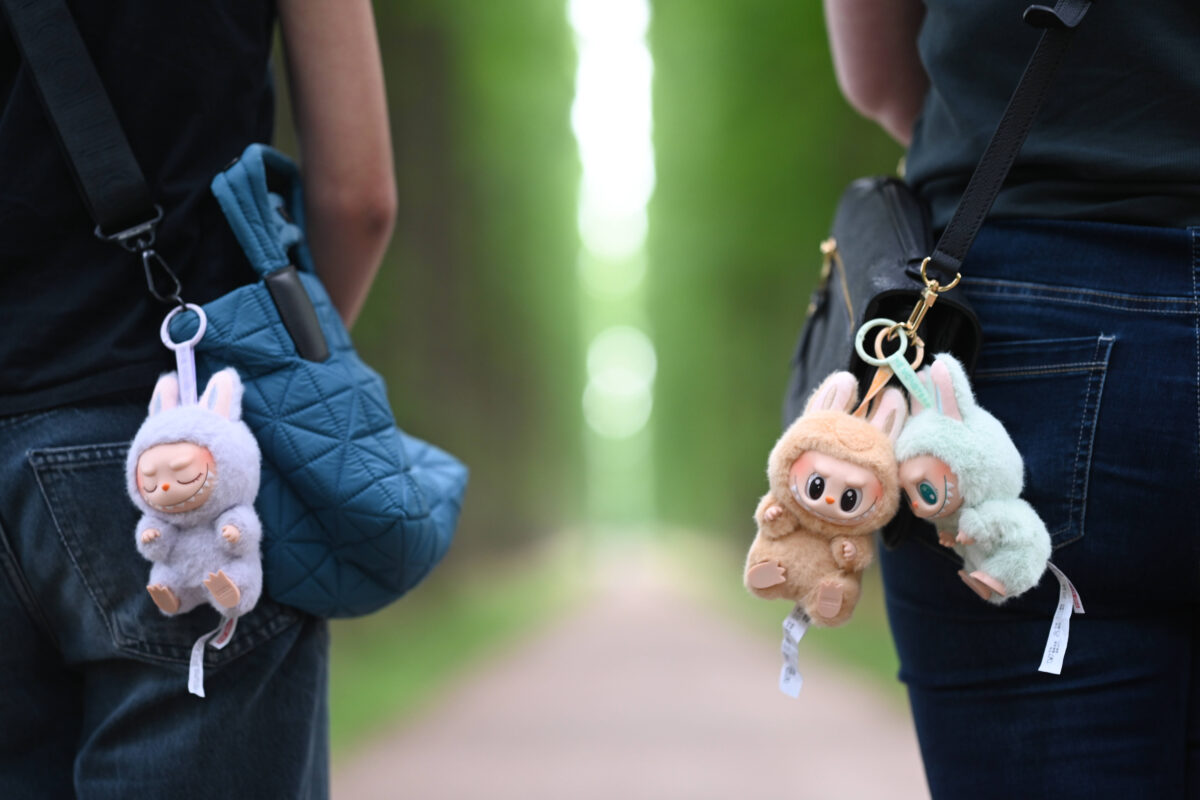
When asked why they changed their minds, the answers boiled down to: “Because it’s popular — if no one else was grabbing it, I wouldn’t either.”
“Labubu naturally became my emotional anchor and made me feel more at ease,”
Zhang doesn’t take her Labubu out, fearing they might get dirty. The over 100 Labubu she’s collected are neatly stored in a six-compartment storage cabinet at home. Zhang has loved plush toys since she was a child, spending countless evenings with them while her parents were away on business. Last June, she moved to Shanghai, rebuilding her social life from scratch and faced constant ostracism at work. “Labubu naturally became my emotional anchor and made me feel more at ease,” she says.
What stood out to blind-box enthusiast Zhang Linwei was the social value Labubu had acquired. As a programmer in Beijing who usually dressed casually, he was surprised when, carrying a hidden Labubu on his shoulder bag last month, he drew admiring glances and praise from stylish women — attention he had never experienced before.
Why in today’s uncertain economic climate would people pour so much time and money into collecting dolls that cost only a few dozen yuan to produce? Wang Yuning, who works at a foreign trade company in Fujian, explained that the logic is simple: consumers forgo costly luxury goods and compensate with cheaper alternatives.
Instead of spending tens of thousands of yuan on even an entry-level luxury bag, a few thousands can buy the very best Labubu
“The hidden Labubu editions are indeed expensive, but still cost-effective compared with luxury bags,” she explained. Instead of spending tens of thousands of yuan on even an entry-level luxury bag, a few thousands can buy the very best Labubu — a form of consumption downgrade that still lets her afford “the best.”
Not everyone sees the Labubu craze as tied to the economic downturn. Liu Chang, who works at a major internet company in Shanghai, says he likes Labubu because it stands apart from other popular IP products in China—“a sprite with fangs, a touch of mischief, and a hint of rebellion.”
“Its plush designs break convention,” he added, “which may explain why Labubu has also caught on in Europe and the United States.”
As rare as gold worldwide
Though created in China, Labubu’s fame was destined to go global. Google search trends show it first spiked in Thailand in April 2024, before rippling across Cambodia, Vietnam, Taiwan, Singapore, Hong Kong and beyond — all apparently sparked by BLACKPINK’s Lisa sharing a “Heart-Stirring Macarons” Labubu on social media.
Beyond Lisa, Labubu has shown up in the hands of more and more celebrities: the Thai princess carried one to Paris Fashion Week, Rihanna dangled one from her Hermès bag, and even David Beckham became an inadvertent spokesman.
A mint green first-edition Labubu sold at auction for 1.08 million yuan
In mainland China, however, the celebrity effect didn’t drive the craze. The real spark didn’t come until June 10, 2025, when a mint-green first-edition Labubu sold at auction for 1.08 million yuan, sending Baidu search interest to record highs.
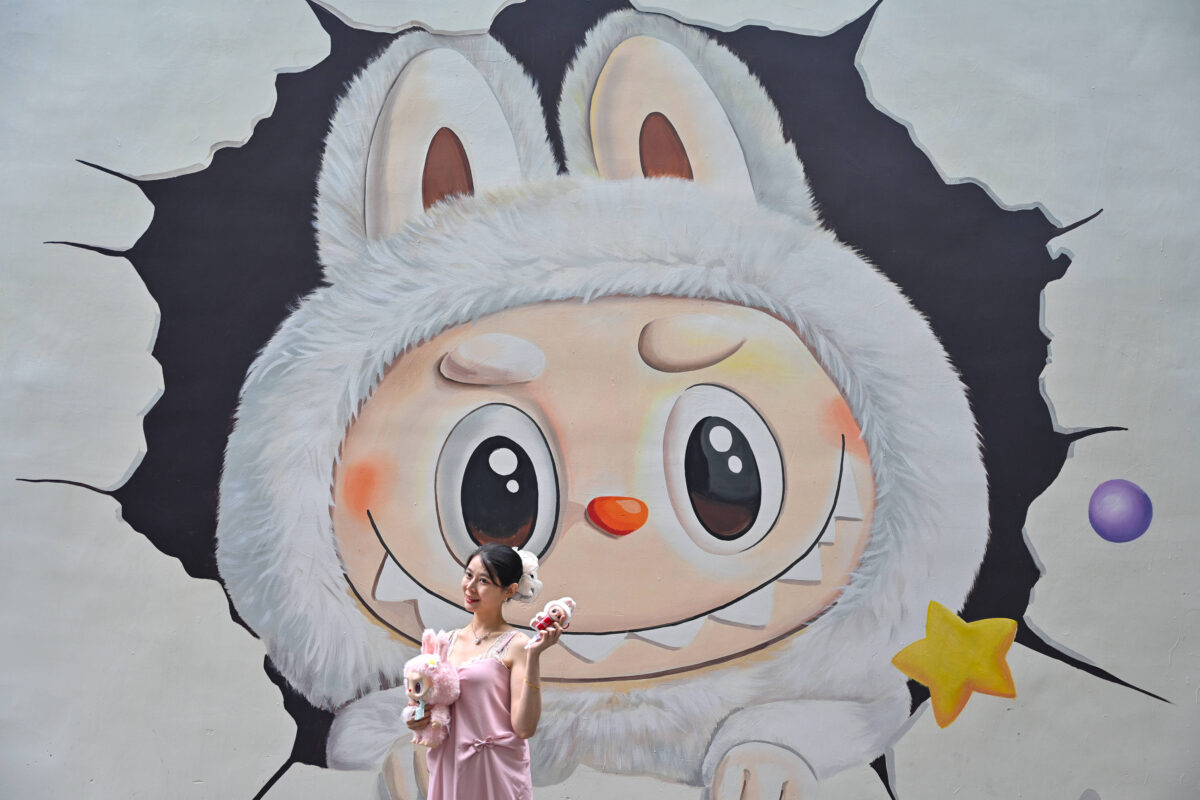
Scalpers were the first to seize on Labubu’s sudden boom. When Zhang Yingying fell into the Labubu rabbit hole last year, she paid 1,000 yuan for a discontinued third-generation doll. By June this year, its price had already soared to 5,000.
At first, Zhang was secretly delighted. She never expected that the figurines she had bought for fun would turn out to be the best investment of her life. But the joy didn’t last: once scalpers flooded the market, the already hard-to-find Labubus became nearly impossible to snag.
In 2021, PopMart shifted its sales strategy more heavily online. Some new releases were restocked only through platforms like Tmall, Douyin, and WeChat’s simulated virtual vending machines — at random times — forcing fans to camp out in livestreams if they wanted a chance to grab one.
Faced with these sudden surprise links, Zhang Yingying — like other fans — could only sit through the livestreams, listening intently to the ads. “After hours of commercials, you might not even get a few seconds of the real sale,” she says.
The market turns frenzied
Online sales have given scalpers even more room to maneuver. One scalper noted that, compared with the old days of manual ticket grabbing, everyone now relies on cheat plug-ins and automated scripts. “This isn’t fans versus scalpers anymore,” Zhang says. “It’s bots against more advanced bots.”
Beyond using bots, scalpers also buy Labubus in bulk. Gao Hui, a trendy toy enthusiast who also quit in June, says scalpers are often the best buyers when she wants to sell. “They don’t haggle endlessly like individual buyers — and they won’t shame you on social media afterward,” she says.
Last month in Singapore, student Xie Xinying saw scalpers outside a Pop Mart store with ten freshly bought “cases” of blind boxes (a full set purchased at once to raise the odds of drawing a hidden edition). They sat at the entrance, asking customers who had managed to get limited-edition Labubus if they would sell them back at high prices. Just upstairs from that store was a secondhand shop devoted entirely to Labubu, where every blind box cost at least double the retail price.
In Japan, Chen Zhou, who works in Tokyo, witnessed similar scenes outside a Pop Mart shop in Shinjuku. “Most of the people in line were speaking Chinese—probably scalpers from China,” he says. “But I wondered, where do they even sell them afterward?”
When Zhang Linwei brought his cousin — fresh from the college entrance exam — to Beijing in June, he noticed a Labubu dangling from his backpack. The workmanship was rough, clearly a fake.
Kids don’t care if it’s genuine; they just chase whatever’s hot.
Across many small towns, vendors sell these knockoffs, dubbed “Ladudu,” without knowing who Labubu is or why it’s popular — only that it outsells everything else. “Kids don’t care if it’s genuine; they just chase whatever’s hot,” one seller says.
While genuine Labubus have flowed back into China, “Ladudu” counterfeits have spread overseas.
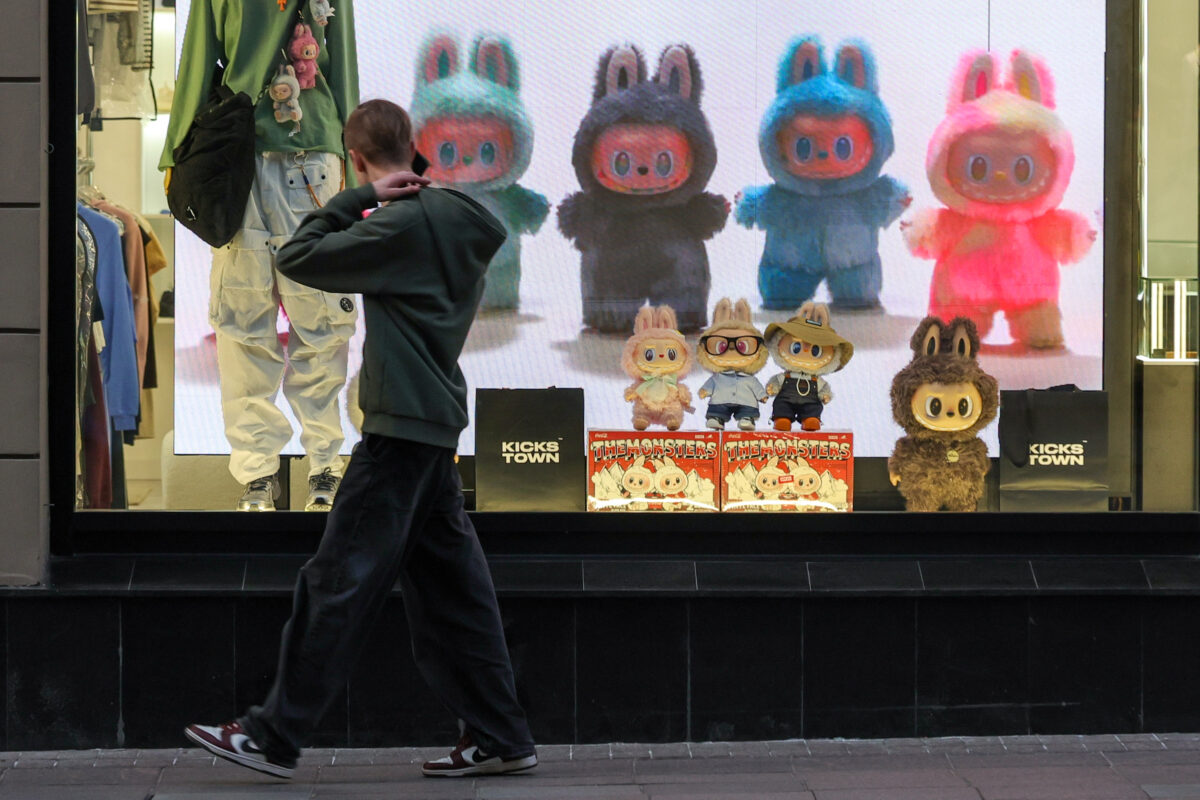
Jill, who lives in Melbourne, Australia, bought four blind boxes for $100 at a Chinatown shop called House&Party, only to find one was fake. When she tried to return the remaining three, the clerk refused.
In the U.S., graduate student Susie spotted Labubus for $20—which she knew was too cheap to be true. “The secondhand market for Labubu in the U.S. has already reached $55 each,” she says. While chatting with her classmates in the UK and Canada, she learned Ladudu knockoffs were turning up not only at street stalls but even on the shelves of big chains like 7-Eleven.
“It’s infuriating,” she says. “Don’t these Western giants claim to be the biggest defenders of copyright? Why can they counterfeit Chinese brands so easily?”
Cooling down
On June 20, People’s Daily, China’s state-run media, published a commentary titled “How Can Blind Cards and Blind Boxes Be ‘Unfettered’?” that thrust Pop Mart into the spotlight. The combination of official criticism and Pop Mart’s own restocking efforts sent Labubu’s resale prices plummeting.
But what was fading, many fans admitted, was not just the market — it was their enthusiasm.
With that money, I could buy other things that make me happy.
After several fruitless days glued to livestreams, Zhang Linwei thought about quitting. “When it went from giving me emotional value to draining my energy, I just didn’t want to continue,” he says. “With that money, I could buy other things that make me happy.”
Pop Mart’s founder Wang Ning once said the company’s early ambition was to become “China’s Disney.” Now, he argued, the goal is to become “the world’s Pop Mart,” a new-generation global Chinese consumer brand. The company has already registered animation rights for Labubu and Friends, hoping to extend the IP through film and television.
Zhang Yingying is unimpressed. “They’ve just had enough of their hunger marketing and don’t want scalpers making the money,” she says. “So they’re trying to cash in before the hype dies down.”
She also rejected Pop Mart’s claim that production capacity can’t keep up with demand: “That’s a slap in the face to ‘Made in China.’”