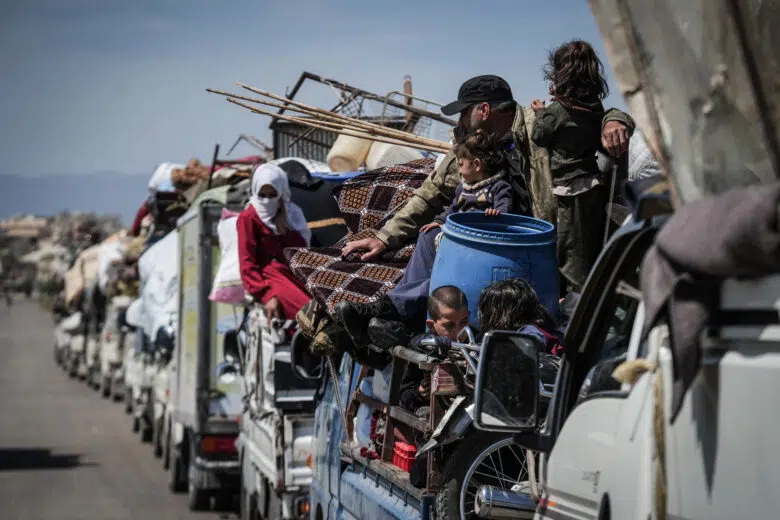
BEIRUT — Travel was no longer an option for Abdullah (a pseudonym), who, in 2018, had turned down the opportunity of discharge from the Syrian army and to leave the country. He had chosen to stay, to witness the collapse of the military institution he had worked for years during the “Deterrence of Aggression” — the offensive campaign launched by opposition forces.
“Surprise” and “chaos” were the two terms he used to describe the collapse of the Syrian army from late October 2024 until President Bashar al-Assad fled the country that December.
For the latest news & views from every corner of the world, Worldcrunch Today is the only truly international newsletter. Sign up here.
Abdullah says that the leadership betrayed them and abandoned their duties, and most of the commanding officers fled during the battles. After the fall of the regime, he remained skeptical of the idea of leaving; he told me via WhatsApp: “I didn’t feel I had committed a sin that warranted my escape.”
Amid the chaos, he left his last assignment in Homs and went to the countryside of Latakia, where his relatives live, hoping to find a safe haven. “I arrived at my relatives’ village at 4 a.m. and woke up to the news that Syria was without Assad. I was shocked at first, but the way the new authority and its forces dealt during the battles and their statements made me optimistic that I would have a place in the new Syria, but I was wrong,” he remembers.
Days after the regime’s fall, Abdullah heard of the first “isolated case” of the killing of a former officer under the Hmeimim bridge. Then he decided, as a former officer as well, to flee. Rather than go to the reconciliation centers in Latakia, he preferred to cross the border toward Lebanon.
He stayed for a week in one of the border villages in the Akkar plain. But rumors of the arrest of regime remnants in Lebanon, and his feeling of being lost and without prospects in Lebanon, pushed him to return. For the following months, his primary concern was finding another country to seek refuge in, and that country turned out to be Russia.
Moscow opens the door
In 2016, Amnesty International condemned the Russian government, which was seeking to deport three Syrian asylum seekers detained in Dagestan. The organization noted that in 2015 no Syrian obtained asylum in Russia, only 482 people obtained temporary protection, and that same year there was talk of Syrians failing to obtain asylum in Russia because “there is no humanitarian reason to obtain temporary asylum.”
Following Assad’s fleeing to Russia and his request for asylum there, Moscow opened the door for asylum and humanitarian protection to many Syrians. This included officers and soldiers and civilians who mostly entered the Russian Hmeimim base on the Syrian coast. Their influx increased after the massacres of the coast, and it is said that the Hmeimim base was hosting around 10,000 Syrians from the Syrian coast and the Alawite minority.
There is not much news about Syrian refugees in Russia. Russian reports, for example, point to the arrival of 95 asylum seekers this year to the city of Yekaterinburg, which is part of 12 regions in Russia that will host Syrian refugees, and they will undergo “integration courses.” Other reports indicated the arrival of about 150 refugees to Perm Oblast, and that about 100,000 Syrian refugees are expected to arrive in Russia during 2025.
Abdullah‘s asylum journey
On March 6, the sounds of gunfire echoed from every direction in the countryside of Latakia, and the echo of rumors was even louder. Abdullah, an officer who had not regularized his status, was immersed in a whirl of chaos and panic. That evening, he witnessed the crowds pushing toward the Hmeimim military base seeking safety. Violence and chaos reigned supreme.

After hours of confusion and concern for his family outside, Abdullah decided to head to the Hmeimim base to check the situation. On the way, he heard a new rumor about the withdrawal of government forces to the naval academy. When he approached the road leading to the base, he was surprised to see a group of young men wearing Syrian General Security uniforms.
Abdullah, who had avoided in recent months any action that might put him in danger, felt anxious. At the base, he found those who had applied for asylum through the consulate, and others called by relatives or acquaintances in Russia. There were also many former soldiers, all of them waiting for their turn to travel to Russia.
Seeking refuge in the base was the safest option.
As soon as he confirmed that most of the rumors he had heard were not true, he hurriedly wrote a short text message to his mother to come immediately: Seeking refuge in the base was the safest option. Abdullah had not thought that day would be the day he would reveal his military identity to put his name on the list of wanting to leave, waiting for “deliverance from this hell.”
The base guards confiscated Abdullah’s mobile phone, so he remained all day and the next in a state of anxiety and anticipation, ignorant of his family’s fate. At first, the flow of people was slow, but with time the number of arrivals began to accelerate terrifyingly. Hours passed, and no news arrived about his family. And the next day the news came: A relative who he thought his open opposition to Assad would protect him was shot and killed, and his house was looted.
With this news, Abdullah’s internal conflict mirrored the violence outside the base; he heard clashes and gunfire outside the base, while gray smoke rose from houses devoured by fire on the near horizon. With the fighting approaching the gate of the base, the reception hall and the inner and outer airport yards were crowded with pushing crowds looking for a safe haven.
Life inside the base
The base was not equipped to receive such a large number of people, so the sounds of fear and confusion mixed with the cold winds of March nights. Abdullah found himself forced to merge into this crowd, sitting on the ground in the inner yard of the airport, while the Russian forces distributed blankets and tents to children and women and the elderly.
The sounds of gunfire and clashes continued for two consecutive days, until things gradually calmed. The base did not suffer any direct strike, but all Abdullah heard in the following days were the buzzing of reconnaissance drones belonging to the current government slowly circling the base, reminding him that the danger had not completely gone.
Russia gave him a paper giving him temporary refugee status for two years .
Abdullah waited in the base more than three months. The time there was heavy as life turned into a strict routine; everything managed by purely military logic, and all people’s movements restricted by strict schedules. This was confusing for civilians, as Abdullah said: “But this is a natural situation, you are in a military base… the rules here are clear and security has its priorities, and the soldiers are not equipped to deal with the refugee situation properly, they are fighters not humanitarian workers.”

Each day began with a short meeting, where tasks were distributed among the tents; each tent had a civilian head responsible for basic tasks; these were simple but heavy in the context of a life surrounded by risks and waiting. The first winter days were the hardest, cold and winds battering the tents. The heavy rains left the ground muddy — as was seen in videos that spread from the base.
During that period, the base opened a tent to teach the Russian language to those who wanted to learn. Abdullah was cautious in describing the Russian soldiers. He said that the language barrier was a big problem; the soldiers did not master Arabic ,and communication with them was only through translators, but they helped people as much as they could.
Leaving for Moscow
On May 20, an unknown group attacked the Hmeimim base, killing two and injuring others. “We heard the sounds of gunfire and clashes, but we were used to hearing them every now and then because of the naval academy near us. We did not know what had happened until the next day from the news,” Abdullah recalled. Yet the attack raised the security alert in the base.
Weeks later, Abdullah boarded a cargo plane for Moscow. He and the others were received by a delegation from the Russian Ministry of Emergency Situations. He spoke with them about his situation and then signed applications for humanitarian asylum. Then they gave him a paper giving him temporary refugee status for two years in Russia.
Abdullah spent the first days in a complex near the airport, then he was finally transferred to a residential complex belonging to the Ministry of Emergency Situations. He learned that the complex had been prepared to receive Ukrainian refugees. When I asked him about his daily life there, he laughed and said: “It’s a different life routine, but it is better than what we had [in Syria]. My life is waiting. I hope to return to my country but…”