-Essay-
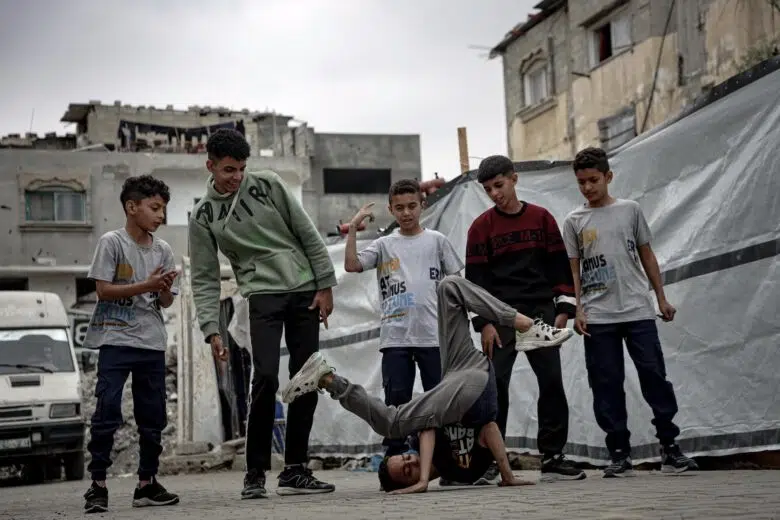
PARIS — I recently came across a surprising video filmed in Gaza City: In a dusty alley framed by crumbling stone walls and frayed electric cables, a boy drops to the ground — not to hide, not to crawl for cover but to dance. His hands slap the earth, legs twist in midair, and his body spins — not to music from a speaker but to the roar of warplanes echoing overhead.
This took me by surprise completely: There is breakdancing in Gaza — where people only see hunger, death, blockades and relentless bombing.
For the latest news & views from every corner of the world, Worldcrunch Today is the only truly international newsletter. Sign up here.
I began breakdancing in 2017, when I was living in Beijing, and later started popping. Since then, hip-hop and street dancing have been a constant passion in my life. When I moved from my native China to France in 2023, dance — and the dance community — played a key role in helping me integrate. I’ve immersed myself in hip-hop events and culture in France and Europe, making friends and exchanging with others under the values we share: “Peace, love, unity and having fun.”
So I was excited and intrigued to see that in Gaza — a place scarred by conflict — breakdancing has managed not just to survive but to thrive. And there is not just one boy breakdancing in Gaza, but a team, known as Breaking 48, that is still training and organizing activities in the enclave.
Dance as a response
Breakdance is one of the core elements of hip-hop culture, together with DJing, rapping and graffiti art. Hip-hop culture originated in the Bronx, New York City, during the early 1970s, as a cultural movement created by African American, Afro-Caribbean and Latino youth. It was a response to poverty, marginalization and social unrest, a way to reclaim space, identity and creativity.
Breakdance began around the same time in the South Bronx. It started at block parties, where DJs like Kool Herc would extend the instrumental “breaks” of funk records — dancers, now called B-boys and B-girls, would showcase their most creative moves during these breaks, hence the name “breakdancing.” Breakdance quickly became a symbol of style, strength, originality and battle culture, emerging as a powerful alternative to real street violence.
There is a deep link between situation now in Gaza and the four core values of breakdancing:
- Peace: Breaking stopped fights before they started.
- Unity: Crews formed tight bonds and supported one another.
- Love: The community supported creative expression and identity.
- Having Fun: It was a celebration of life, even in hard times.

Behind Breaking 48
How could breakdance exist and develop in Gaza? What role does it play? How big is the dancing family over there? How do they practice? What music do they listen to? Are there also dancing events?
I had so many questions, so I reached out on Instagram and was able to set up an online video meeting with the founders of Breaking 48, Ajjour and Karim, and Omar, a young member of the team.
Karim left Gaza on the last day of 2023 but continues to teach and support his team from Egypt. Ajjour remains in Gaza City, continuing to train with the children. Breakdance and hip-hop culture have existed in Gaza for more than 20 years — and with this new generation, their strength only grows.
“Breaking means breakdance, and 48 refers to 1948, the year of the Nakba when the Palestinian people were displaced from their homeland,” says B-boy Karim, who founded the team in April 2025.
Even on the rubble, we can dance.
At the UNRWA School, in the Nuseirat refugee camp in the Gaza Strip, breakdancing stands as one of the few available artistic outlets and sources of entertainment. It offers both children and adults a brief respite from the harsh realities of war. Karim, along with his teammate Ajjour and others, dedicates themselves to teaching, organizing activities and performing for the local community.
“I don’t feel the genocide when I’m with you,” one child told Karim. Those words became his greatest motivation to build the team and keep breakdance alive in Gaza.
“At first, I questioned how I could dance while my people were suffering and dying,” Karim admits. “But every time we held an activity, the smiles on the children’s faces and the positive feedback from their parents encouraged me to continue.”
Yet, life in Gaza is fraught with difficulties.
“I will never forget organizing an event while bombs were falling nearby. As we tried to bring a moment of comfort to the children, they were shocked and panicked, running for safety. Sometimes, we could maintain the circle of activity, sometimes not,” Karim recalls.
A spirit of resistance
Their dance school was bombed in February 2024. A video posted on their Instagram account shows children searching through the rubble with unusually peaceful smiles on their faces. Today, Ajjour has converted his own room into an indoor training space for the kids.
Teaching the younger generation, Karim has come to recognize the spirit of resistance inherent in breakdance and hip-hop culture — an ethos that resonates deeply with the resilience of Gaza’s people. The children continue to dance despite hunger, a testament to their determination. “There is no food in Gaza — not just for the children, but for everyone,” Karim explains. Bombing, homelessness, loss of teammates, and shortages of food, water, and electricity are not reasons to stop dancing in Gaza, neither the reason to leave Gaza.
“This is our resistance. We are here. We are human. People in Gaza are like anyone else in the world. We have dreams, goals and art,” Karim says, adding “Dancing is everything for me. I feel I am fine when I’m dancing.” For Karim, breakdance transforms negative energy into a positive force and passes that positivity on to others.
“In Gaza, breakdance is our way of expressing ourselves,” Ajjour says.
One of their students, Omar — known as Lil Kevin — shares his hope: “I just want the war to end so I can live and dance like other kids around the world and keep practicing my beloved breakdance.”
“You don’t need much to dance,” Karim says with a determined smile. “Even a small space is enough. Even on the rubble, we can dance.”
Before meeting Karim and his team, I could never have imagined such a talented group of dancers thriving in Gaza. Amidst the burning rubble, childhood and adolescence burn with passion.
As UN-backed global food security experts warn that the “worst-case scenario of famine is currently playing out” in the Gaza Strip, Karim updated me that the situation is getting worse, but the kids are still training — although with less time. They are still using their steps to send their message from Gaza. Their rhythm — a living, breathing heartbeat of resistance — now echoes in me when I dance.
Follow and share Breaking 48’s journey on Instragram: @breaking_48.
