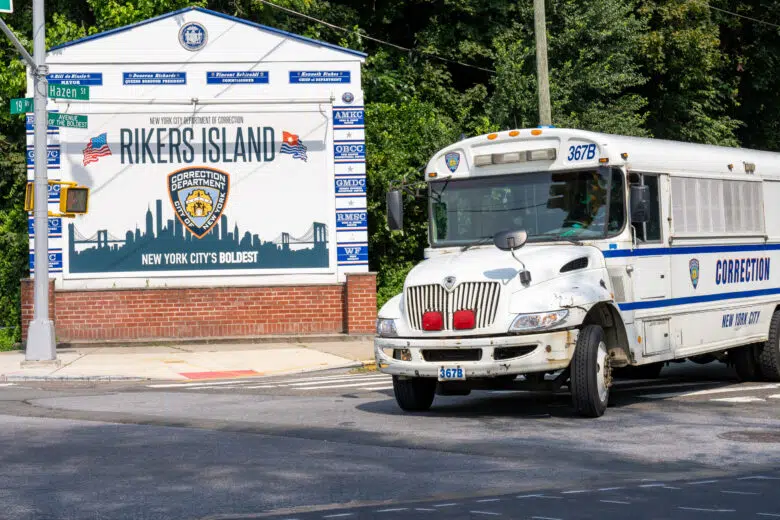
NEW YORK — “New York’s Boldest” reads a faded mural in the parking lot of Rikers Island, echoing the Department of Correction’s (D.O.C.) motto. The peeling paint blends into the backdrop of armored vans, barbed wire and overgrown weeds. To the east, a narrow waterway separates the jail from LaGuardia Airport, its runway ending just a hundred meters from the prison fence. Further west, the sleek skyline of Manhattan seems to look away from its troubled counterpart.
For the latest news & views from every corner of the world, Worldcrunch Today is the only truly international newsletter. Sign up here.
The four nights Dominique Strauss-Kahn spent in Rikers’ West Facility — reserved for high-profile inmates — seared the place into French public consciousness. During his stay, the former International Monetary Fund managing director received special treatment: a private cell, walks outside and solo showers. Harvey Weinstein now enjoys similar accommodations.
An old three-lane bridge from Queens is the jail’s only link to New York City. Of the 6,800 inmates currently held, nearly 6,000 are awaiting trial. But chronic gridlock in the criminal justice system defers the sentencing for months, or sometimes years.
Drug smuggling, violence and abuse are so commonplace that they rarely make headlines anymore. The situation has deteriorated so severely that on May 13, a federal judge ordered the D.O.C. to relinquish control of the facility. Management will be handed to an independent remediation manager, whose identity remains unknown. It’s the first step in trying to rescue a sinking ship — and a major setback for New York City Mayor Eric Adams, who made Rikers’ reform a cornerstone of his platform.
On a Saturday morning, many women wait in line to visit inmates. Some are dressed to the nines — high heels, lash extensions — unconcerned with who runs the jail. Between deafening jet takeoffs, they ask one another practical questions: “Which line is for the EMTC building?”, “Why don’t they hand out tickets when you get off the bus like they did before COVID?”, or “Why is that group getting in before us?” At the first security checkpoint, posters show slashed-up inmates warning: “This could happen to your loved ones if you smuggle in drugs or razor blades.”
Five people have already died at Rikers this year, as many as in all of 2024. Since Adams became mayor in 2021, there have been 38 deaths. But Rikers began unraveling long before. The recent ruling follows the long-running Nunez class-action lawsuit, filed 14 years ago after several incarcerated minors were beaten by guards out of view of security cameras.
Corruption and drug trafficking
The D.O.C. has little control over its own staff. From January to June 2024, only 16% of roughly 1,000 investigations into excessive force were completed on time. Of those, just 37 resulted in disciplinary action. Corruption and drug scandals involving guards are frequent; in 2023, a body scanner was installed at the entrance — mainly to search the guards themselves.
Rikers is a pressure cooker
Synthetic drugs are a growing menace, often sprayed onto letters, postcards, or even children’s drawings. These fentanyl-laced papers are cut into strips and smoked — a single A4 sheet can sell for up to $1,500, according to one inmate. Last year alone, guards administered Narcan, a fentanyl antidote, more than 227 times.
“Rikers is a pressure cooker,” one former inmate told Le Figaro. “In other prisons, you serve your time, can follow programs, think about the future. At Rikers, you just wait. The food is terrible — except Thursdays and Sundays, when they serve chicken. No cash allowed, everything is paid through a rechargeable plastic card. If you’re caught with cash, guards beat you. If you’re rich, you can buy cookies, drugs or a phone. Guards turn a blind eye to keep the peace. The young ones awaiting trial are the ones who make Rikers violent.”
Despite its problems, Rikers isn’t suffering from a lack of resources. With nearly 5,000 staff for 6,800 inmates — almost one guard per prisoner — it’s the most heavily staffed jail in the country. New York City spends over $500,000 per inmate annually. Yet detainees still face food shortages and inadequate medical care.

The powerful correction officers’ union has been criticized by various commissions for opaque scheduling, nepotism and overly generous sick leave policies that leave the least experienced staff doing the hardest jobs.
“It’s also the structure of the building that dictates staffing levels. Rikers is overstaffed because of the architecture,” explains Stanley Richards of the Fortune Society, a nonprofit helping former inmates reintegrate. He does not dispute the deep-rooted deficiencies that plague the institution but also insists on the intractable physical constraints of the place that weigh as much on the inmates as on their guards: “All the visual axes are truncated. The blind spots are such that two or three guards are used to move a single inmate to the visiting room or infirmary. The cross-shaped architecture of the main buildings — north, south, east and west — prevents any individual movement. You need an escort officer, a corridor officer, etc.”
Numerous mental health cases
Richards, once jailed at Rikers himself for armed robbery, represents the kind of redemption arc that Netflix would love. After serving his sentence, he found refuge at the Fortune Society, which offered him his first job 30 years ago. Today, he is its leader. He even served briefly as deputy commissioner of the D.O.C. under Mayor Bill de Blasio — the first former inmate to do so.
Their disorders are so severe that they do not understand the charges against them
The mismanagement, he continues, is also due to buildings’ advanced state of disrepair, which makes daily life dangerous for everyone. “Prisoners make weapons directly from the structure. A piece of metal hanging from a window, the frame of a bed… Anything can be used as a weapon in a ruin, the options are endless.” Plexiglas, ubiquitous because it protects televisions, light bulbs and windows, poses a huge problem: “a piece is easy to sharpen. We wrap it in an undershirt to make a handle. The result is a sharp blade without an ounce of metal, so it’s undetectable.”

In addition to all these problems afflicting Rikers, there is also the ever-increasing proportion of inmates with mental disorders. They now represent 57%, according to the Lippman Commission, an independent panel of 40 experts calling for the prison’s closure.
This figure reflects a fundamental shift in American society, which, since the 1970s, has been closing psychiatric hospitals in favor of outpatient care. Many of these patients are also homeless, drug users and regularly arrested for minor offenses. Unable to pay bail, they end up at Rikers. For hundreds of them, their disorders are so severe that they do not understand the charges against them or the proceedings of their trial.
In fact, Rikers is not so much the largest detention center in the United States as its largest de facto psychiatric hospital. “It’s a perfect recipe for disaster,” Richards says, as guards are trained in law enforcement not mental health care.
The notorious prison is scheduled to close in 2027, according to a law passed during de Blasio’s term. Four smaller facilities, spread across the city’s borough, are set to replace it, along with more beds for mental health patients scattered across several hospitals. But with two years to go, no buildings have been constructed. The next mayor of New York will clearly be in violation of the law. Failure to meet the deadline could lead to a series of legal proceedings, resulting in fines, orders to transfer inmates to other facilities, or even the early release of inmates.