

-Analysis-
MADRID — In the promising New York of the late 1990s, Carrie Bradshaw wrote about the romantic scene with a certain perplexity but, above all, very comfortably. Like the iconic Sex and the City character, I write about my sorrows and questions. I am doing so from the city of Madrid, in June 2025, with everything that is going on. Love, whether we find ourselves at the height of neoliberalism or in its critical phase, continues to move us and take up space in our lives. Yet the ways in which it is available at any given moment are by no means independent of context.
I have been thinking a lot lately about the perhaps banal or hackneyed idea that in a precarious context, love tends to be precarious. Materially unstable lives offer fewer resources for secure love and relationships where fear and anxiety are not central. And it is not just lives, but also unstable social environments that provide precarious relationship frameworks.
In this context, I find it particularly difficult to build attachments that seek to break away from the logic of patriarchal love. I understand patriarchal love as that which is based on the idea of possession. Feminist love, in my opinion, would have to do with the possibility of “belonging with,” which can have one or more participants. Furthermore, I understand it to be a way of loving that does not take for granted a lifestyle associated with that relationship. And finally, my understanding of it is based on the recognition of the parties involved and on a situated notion of reciprocity. That is, a reciprocity that is chosen, agreed upon, and built from within the bond.
Not a psychological disorder
Now, whether or not we share this experimental approach to feminist love, we all know — as women — that we have challenged the institution of the couple and its traditional implications. No doubt, it has been a breath of fresh air, if nothing else, for all those who could not live with a single model of romance. I include myself among the beneficiaries. The problem is that, for at least some of us, we don’t quite know how to articulate anything else. There is no manual for the non-institutionalized, of course, but I think the issue goes beyond that.
A present in crisis and a future in question are not particularly fertile ground for sowing seeds. If our lives challenge us ad nauseam in the present, we don’t have much room to get creative with what is not urgent. Imagining and devoting the necessary energy to materializing secure bonds that are not available as figures in social discourse comes at a cost that cannot always be borne. So, are love and friendship above good and evil?
Emotional insecurity is not a personal psychological disorder; it is the context available in a materially precarious environment. That is, a neoliberal environment lacking security, characterized by a flexibility that turns everything into quicksand with a touch of romanticism.
We are struggling to keep up. Changing work schedules, expiring rental contracts, low wages, the privatization of public services such as education at all levels and healthcare, the intensification of crackdowns on social movements, the rise of reactionary politics, the deterioration of public transportation networks, among other factors that make up the present in Spain’s capital city — and I dare say we can extend the geographical context—make the lives of many a kind of atomized emergency.
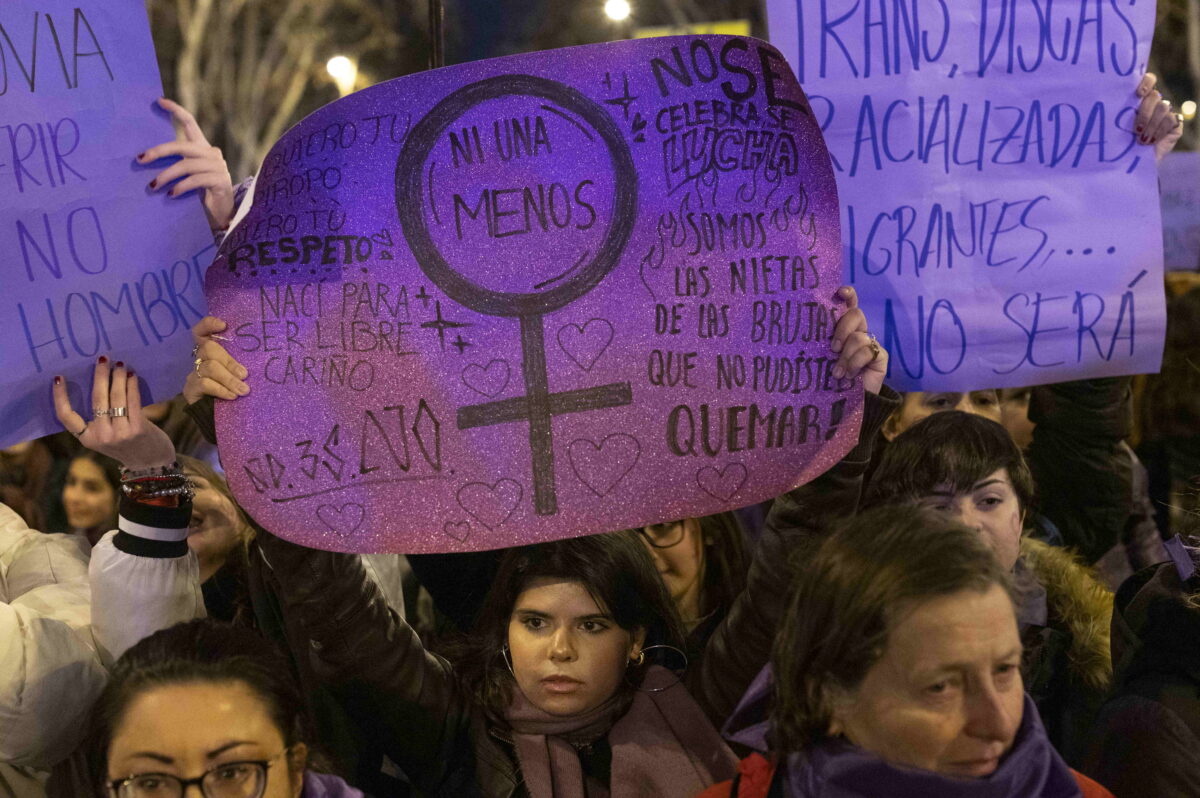
A precarious emotional environment
Because this is a contextual issue, inherent to the neoliberalism of permanent crisis, even those who enjoy materially dignified and secure lives find it difficult to access relationships that challenge patriarchal institutionalization because the emotional environment is precarious. It is fueled by the emotions of collapse: fear and anxiety. Faced with this, we either interact from a position of “liquid modernity” — as the much-quoted Polish-British sociologist Zygmunt Bauman would say — which is imprinted in the modus operandi of neoliberal relationality, or we embrace conservative practices that are symbolically available as salvation.
I don’t mean to be dramatic; I know that many women have found ways to enjoy fulfilling relationships and friendships within this framework. But I believe that it is becoming increasingly difficult to nurture relationships, and there is a growing tendency toward resignation. For some, resignation comes in the form of frustration, accepting situations that are far from what they want; for others, it leads to the decision not to engage in romantic relationships.
In these critical times, few are spared from making sacrifices in order to survive.
Crises come hand in hand with conservative shifts. Conservatism, rather than being embraced as an ideology, is embraced as security. It is a mechanism for self-preservation through what is familiar. Then there is the ideological layer of legitimization. For example, the tradwife trend fulfills this latter function. However, many of us who have participated in feminist criticism of the partnership institution suddenly find ourselves longing for that type of relationship associated with security.
My desire is not to question whether that is good or bad in itself. Yet I believe that in many cases this responds to fear. We are afraid of trying too hard for other types of relationship and failing repeatedly in a context that seems to scream “ Every man for himself.”
The conventional couple serves as a lifeline, even though we know full well that it is only an existential relief. I have a partner, therefore I am not alone, I am safe while the outside world is crumbling. The question of one’s own identity — who am I? — can be answered falsely but quickly based on one’s partner. Often, this choice of institution as a way out of uncertainty involves displacing other important elements such as friendships, activism and free time with oneself, in order to sustain that institution of the couple with the little time available. This is one of the possible forms of resignation to which the precarious context leads.
Don’t depend on anyone?
The alternative, when it stems from a lack of resources, is simply the resignation of giving up on love. I am referring exclusively to those who would like to have romantic relationships but do not have the time or financial security to pursue them. This is the area where liberal feminism can legitimize itself by chanting slogans such as “don’t depend on anyone” or “you don’t need anyone.”
Yet in practice, as in the above case, the situation comes first, and then the social narrative, for those who accept it. For many, it is simply a tragedy, a choice mediated by a lack of resources and capital to give themselves over to the passions of love. In many cases, this also applies to friendship. In this case, either the relational aspect or the individual self of free time is renounced, and perhaps, if life does not allow for more, both aspects are renounced in order to put the professional self first.
In these critical times, few are spared from making sacrifices in order to survive. Even those who enjoy a certain degree of security find themselves emotionally affected by the precariousness of the situation. What kind of love and affection can we allow ourselves to experience in such an emotionally precarious environment? This is not the New York of the capitalist promise, but I refuse to accept defeat.