HAMBURG — Does osteopathy really work? Asking that question is like stepping into a minefield of conflicting opinions. “Osteopathy is unscientific nonsense,” say many proponents of evidence-based medicine. Osteopaths, of course, claim the opposite. Numerous studies suggest that osteopathy can relieve a wide range of ailments. And millions of people in Germany who have visited an osteopath, whether for themselves or their children, swear by its benefits.
For the latest news & views from every corner of the world, Worldcrunch Today is the only truly international newsletter. Sign up here.
Osteopathy is said to help with an endless list of conditions, from asthma and restlessness to sleep problems, back pain, menstrual disorders and constipation. The waiting rooms fill with senior citizens hoping to loosen stiff knees, students worn out by hours at their desks, women seeking relief from painful periods, amateur athletes with tennis injuries, and parents desperate to soothe a crying baby.
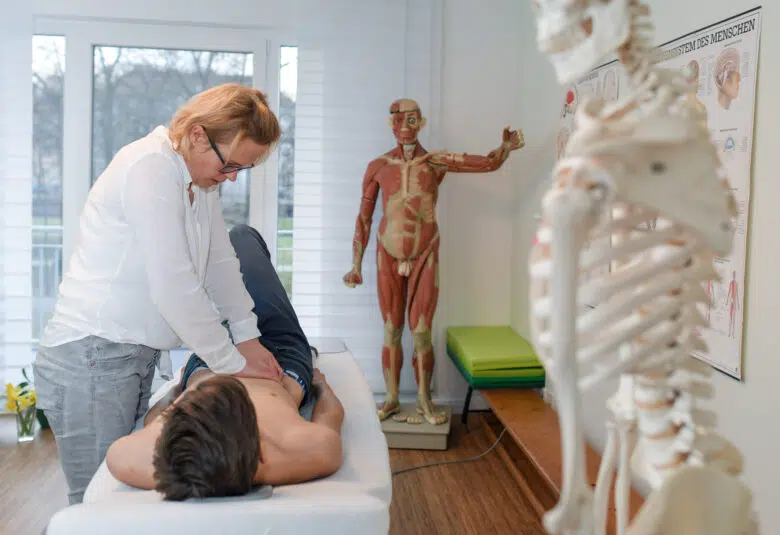
Osteopaths present themselves as a point of contact for all of these people with their varied complaints. They promise something akin to what family doctors provide, but in a different style: spacious rooms, stylish furnishings, warm light and a relaxed atmosphere. The first session usually lasts an hour. The practitioner takes a full history of your health and daily habits. What troubles you? What symptoms have you had, and for how long? Then the osteopath palpates the body with their hands, searching for restricted movement or tension in the tissues, muscles, bones and organs.
From the osteopathic point of view, pain might arise, for example, if the liver is not moving freely and the resulting tension travels through the fascia into the thoracic spine. Or perhaps the lymphatic system is overloaded, so waste products accumulate in the body, leaving people exhausted and sluggish. Or maybe the membranes surrounding the spinal cord have been left tense after the trauma of birth, causing strain throughout the body.
Once the supposed source of the discomfort or disorder has been identified, the osteopath tries to correct it. “Basically, we work in ways similar to physical or manual therapists,” says Davy Schneider, who runs a practice in Cologne and heads the German Osteopathy Institute. Over several sessions, osteopaths might press gently on a shoulder, work the tissue beneath the ribs, or lay a flat hand across the forehead.
A promise of healing
“What we as osteopaths are committed to,” Schneider explains, “is seeing the whole person and working together to pinpoint where things might be going wrong and how to change them.” The aim is to activate the body’s self-healing powers and restore balance to both body and mind.
At first glance, it may seem harmless except, perhaps, to your wallet. A session costs between 80 and 150 euros. But the issue is more complicated than that. Unlike providers of Thai massage or yoga retreats, osteopaths promise genuine healing. They refuse to be pushed into the wellness corner or dismissed as alternative medicine. The two main professional associations in Germany describe osteopathy as “an independent, holistic form of medicine” and are campaigning to have treatments covered by statutory health insurance.
There has been a great deal of broad research, but very few robust studies.
It is at this point, however, that many doctors and scientists object: Anyone who wants to belong to the medical field, anyone who wants to be part of evidence-based healthcare in Germany, must prove that their methods are evidence-based. Even if thousands of osteopaths in Germany observe daily that their treatment helps patients, and even if surveys and observational studies confirm it, that does not count as evidence in the scientific sense, critics argue.
Like any other therapy, properly conducted clinical trials are needed to demonstrate that osteopathy is more effective than a sham treatment, in other words a placebo. Ideally, it should prove superior to standard therapies such as physiotherapy.
“Osteopaths have so far failed to provide evidence that their therapy works,” says one of their fiercest critics, Edzard Ernst. A professor emeritus of complementary medicine research at the University of Exeter, Ernst is also a writer and blogger. When he takes aim at osteopathy in public, the German Association of Osteopaths is quick to fire back.
Its chairwoman, Marina Fuhrmann, insists: “Osteopathy meets the criteria of an integrative, evidence-based, and independent form of medicine.” Welcome to the minefield.

(Credit Image: © Apolline Guillerot-Malick/SOPA Images/ZUMA)
Anxiety and evidence
Anyone who searches for osteopathy in scientific databases will come across thousands of entries. Among them are numerous systematic reviews and meta-analyses. These are regarded as especially authoritative because they pool results from many individual studies and calculate an overall effect. In the case of osteopathy, the conclusion often looks something like this: “There is evidence that…” There is evidence that osteopathic treatments help with neck pain, with health problems in premature babies, with anxiety. And then, almost inevitably, come the “buts.” But the results are too inconsistent. But the measurement tools are too imprecise. But the risk of bias is too high.
In fact, the range of studies included in these reviews is often extremely varied. Sometimes osteopathy is compared to physiotherapy, sometimes to acupuncture. Sometimes there are too few participants, and often they start out with very different symptoms. A large review on the effectiveness of osteopathy in children illustrates this clearly. It examined 47 individual studies, but almost every one focused on a different condition. Some children had ADHD, others a blocked tear duct, still others colic. The authors of the meta-analysis concluded that while some studies suggest a positive effect of osteopathy, larger and higher-quality trials focusing on a narrower set of conditions are urgently needed.
For some osteopaths, findings like these are enough to declare that osteopathy works. Others are more cautious, likening the current state of research to a housing development where many homes are under construction: plenty of foundations have been laid, some structures have gone up, but very few are finished. That is how one osteopath described it to Die Zeit.
In other words, there has been a great deal of broad research, but very few robust studies on specific conditions or symptom patterns. Scientists usually distinguish between different levels or grades of evidence, such as very low, low, moderate and high. If professional societies clearly recommend a therapy in their guidelines, the level of evidence is typically high. That means there is strong certainty that the treatment truly produces the effect shown in the studies. When it comes to osteopathy, though, the level of evidence in many areas remains low. There is evidence that it might work, but that evidence is often uncertain or unreliable.
Could osteopathy be harmful?
Some osteopaths argue that more conclusive studies would exist if osteopathy were a recognized and legally regulated profession. The reasoning is that such recognition would open the door to much-needed research funding. In Germany, for instance, a tax advisor with a naturopath license can currently call themselves an osteopath after taking a handful of weekend courses. The same applies to a physiotherapist who has completed more than a thousand hours of additional training at a private osteopathic institute, or to an orthopedist with an extra certificate.
The two professional associations in particular have been pushing hard for official regulation in recent years. And lately, they seem to have moved closer to that goal. According to the coalition agreement, the government intends to regulate osteopathy through professional legislation. Exactly what that will mean remains unclear.
“If this plan were to give osteopaths legal status and raise them to the level of a paramedical or even medical profession, I would consider that extremely dangerous,” Ernst says. Like many doctors and scientists, Ernst sees it as fundamentally problematic for people without a medical degree to make diagnoses and manipulate the spine, head or other parts of the body with their hands: Even if they use gentle techniques, and even if hardly any side effects of osteopathy are known so far. For this reason, the method is often considered safe even for infants, pregnant women and the elderly.
Critics argue that osteopathy can still harm patients in other ways.
But critics argue that osteopathy can still harm patients in other ways. The danger lies in offering seemingly plausible explanations for symptoms that are not actually accurate. The notion, for instance, that constant fatigue must be caused solely by an overloaded lymphatic system can be highly seductive. Or that a baby cries incessantly only because of two blocked cervical vertebrae. Such explanations can feel reassuring, especially if the family doctor or pediatrician has previously sent you home with advice like “Try to reduce stress” or “This is just a phase you’ll have to get through.”
“Such explanations are only partly compatible with the findings of modern medicine,” says Hermann Locher. He is an orthopedic surgeon and, unlike many of his colleagues, quite open to osteopathy. To the techniques, that is, not the theories behind them. “They are based on 150-year-old ideas about how the body works and how diseases arise, ideas that have long since been disproven,” says Locher. Unlike Edzard Ernst, who rejects osteopathy as ineffective, Locher values the manipulations and techniques osteopaths use. “Out of curiosity and interest,” he trained in osteopathy himself and until recently served as chairman of the Society for Manual Medicine, with which osteopathy is sometimes associated.
Like osteopathy, manual medicine aims to relieve ailments through the use of hands, but without the philosophical framework. Its main purpose is to identify dysfunctions in muscles, joints, tendons, and nerves and correct them with targeted movements. Both manual medicine and osteopathy are essentially “treatment through touch,” says Locher. His patients, in fact, cannot usually tell whether he is applying an osteopathic technique or one from manual medicine.
Is evidence-based osteopathy possible?
Orthopedic surgeon Hermann Locher suggests stripping away the philosophy of osteopathy while preserving the concept, integrating its manual techniques into the field of manual medicine. Manual medicine is already listed as a treatment option by some professional societies, for example in the guidelines for low back pain. It is also included in continuing medical education.
In 2024, about 22,000 physicians were registered with medical chambers under the additional designation “Manual Medicine/Chiropractic.” A report by the German Medical Association, in which Locher took part, concluded that osteopathic procedures can in principle be applied “without adopting the particular human image of ‘osteopathy.’”
Osteopaths such as Davy Schneider disagree. Schneider himself rejects what he calls esoteric notions, like those formulated by osteopathy’s founder Andrew Taylor Still at the end of the 19th century. Still, for example, spoke of a life force that must flow freely through the body for a person to be well. “But Still also had no idea how the body works, how nerves function, how the immune system works,” says Schneider, who argues instead for a more modern form of osteopathy: “The worst thing that can happen to us as a profession is if we say ‘This person’s shoulder pain comes from the trauma of their birth,’ and then they actually have cancer.”
There is no evidence for this. How could there be?
But even in its modern form, osteopathy cannot be reduced to a single technique, Schneider insists. He gives an example: Some time ago, a 32-year-old Brazilian woman came to his practice with neck pain and was also suffering from depression. “If I had used only manual therapy, I would have pressed, pulled and twisted her neck.” He did that, but he also kept asking questions: Why was the woman in psychotherapy? How did she live? What did she eat and drink? And he discovered she was not eating in a way her body needed. He gave her a nutrition plan. Two months later she returned, and not only was her neck pain improved, but her depressive symptoms had eased as well.
It is well established that nutrition and psychology are connected. Still, Schneider understands why advocates of evidence-based medicine remain skeptical of such an approach. “There is no evidence for this. How could there be?” And with that, he points to the central problem: to reach a high level of evidence, randomized controlled trials are essential. Test subjects of similar age, lifestyle and symptoms would have to be randomly divided into groups: some receiving osteopathic treatment, others a sham therapy or the standard treatment. Ideally, neither patients nor practitioners would know who belonged to which group. But such studies are nearly impossible for osteopathy. In practice, most participants realize quickly whether they are receiving osteopathic treatment, and the therapists know as well.
Other factors also make research difficult. Osteopaths adapt their treatments to each individual patient. Two people with similar symptoms are often treated differently by the same osteopath. From an osteopathic perspective, neck pain might result from years of warehouse work in one person, while in another it might stem from depression. This makes it difficult, if not impossible, to establish standardized, comparable protocols for studies. And even with the same patient, two different osteopaths may treat them in entirely different ways.

Maybe it just works
Schneider, unlike some of his colleagues, does not see the fact that evidence-based osteopathy may never truly exist as a problem but rather as an advantage. “The situation right now is actually quite comfortable: many people enjoy going to osteopaths and are willing to pay out of pocket.” If osteopathy were ever included in statutory health insurance, osteopaths would likely earn significantly less and, in turn, have less time for their patients. But time is probably the decisive factor. Time to ask questions, time to listen, time to give care.
When asked what they expect from treatment, many participants in a UK study said they wanted to be able to ask questions, to be listened to, treated with respect, and given a clear explanation of their symptoms in terms they could understand. It is well known that a caring, empathetic practitioner can relieve symptoms.
The same applies to medical information (in the scientific sense) and to touch itself. The placebo effect may account for the rest. There is even what is called a placebo by proxy: because parents believe osteopathic treatment will help their crying baby, they behave differently, perhaps more calmly, which in turn has a positive effect on the child.
For most people, it probably does not matter why osteopathic treatments help them. What matters is that they do. Or, more precisely: that they feel like they do. For this reason alone, it seems unlikely that osteopathy will disappear from the healthcare landscape any time soon. Osteopaths fill a gap that clearly exists. And at best, they complement medicine. But this brings us back to the central problem: that alone is not enough for recognition as a medical discipline and a licensed healing profession.
For that, more solid studies are needed. To prepare the ground for possible regulation of the profession, policymakers are planning an evidence review. Its detailed results remain to be seen. What is clear, however, is that mines can also explode.