
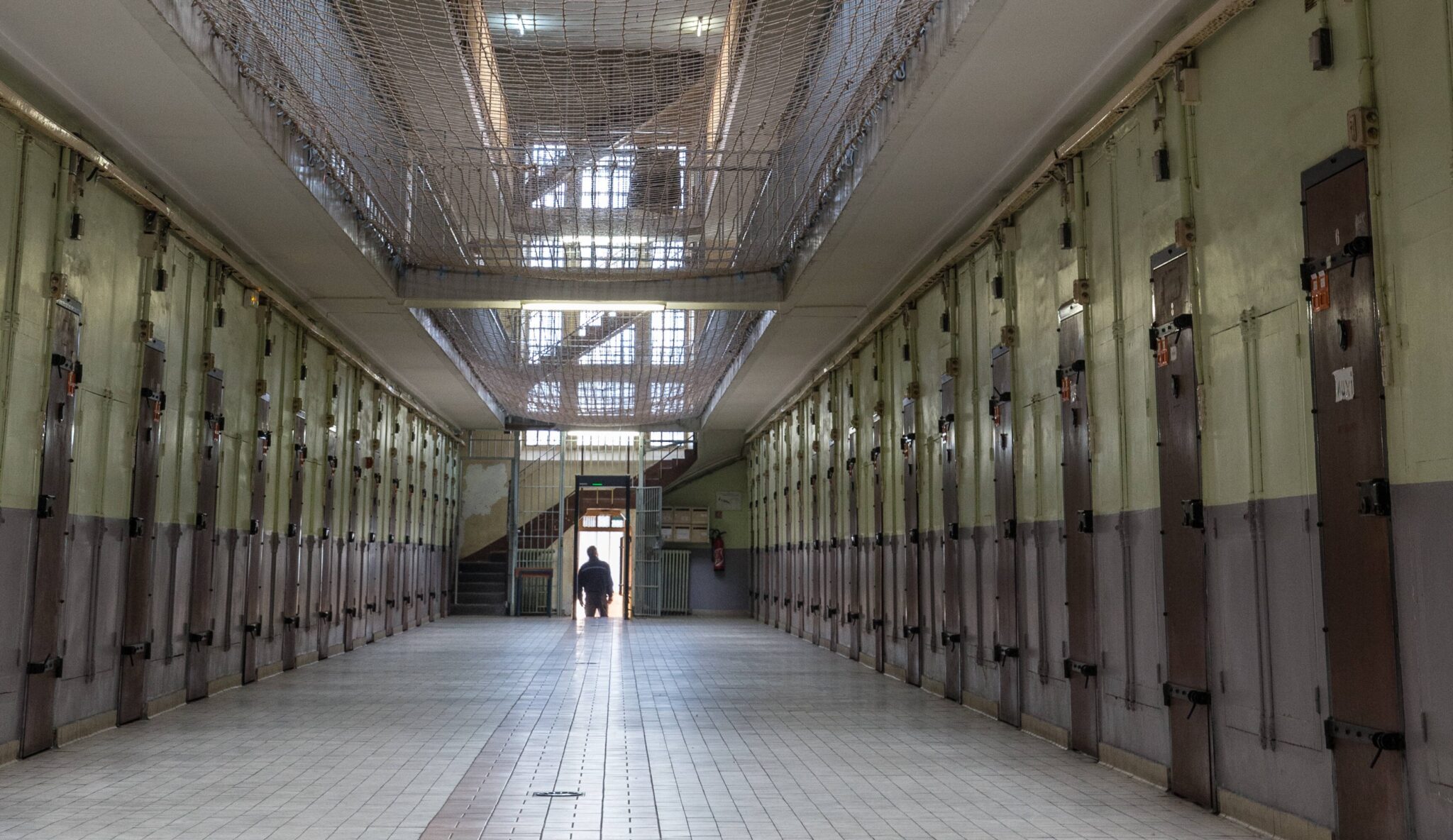
TOURS — The sound of keys. The sound of a door. “Welcome to the devil’s lair,” jokes the guard. And then, with a wink, he adds, “But don’t worry, the people here are nice.” The prison in the city of Tours is known for being quiet. Overcrowded, but quiet. On the ground floor are the cells for “vulnerable” inmates: elderly and LGBTQ prisoners. On the second floor are the cells for those awaiting trial. The top floor houses conventional prisoners serving short sentences, hence the term “nice guys.”
Sandrine, Tiphaine and the guard, who can only be referred to by her job title, “guard,” walk through the corridors, which reek of weed. In a gray room that also serves as a prayer room, they arrange chairs in a semicircle and place Twix candy bars and Oasis soft drinks on a table.
The sound of keys, the sound of a door. Guillaume, Omar and Sabih enter the room one by one. The three inmates greet one another and sit down facing the board. They seem relaxed, accustomed to the routine. For the seventh time in three months, they have come to attend a workshop on fatherhood, a program for which they have volunteered.
Over eight sessions spread out over three months, Sandrine and Tiphaine, prison integration and probation counselors (CPIP), try to get them to think about ways to be present for their kids despite being in prison and once they’re released. The supervisor, who attends the visits and therefore knows the details of their lives, is there to bridge the gap between theory and practice. This “father-child” program is new. At the prison in Tours as well as in Belfort, which Le Figaro also visited, these workshops are being held for the first time.
Life goes on in their absence
Inspired by American and Canadian programs such as The Dad HERO, they are designed to prevent these men from feeling lost when they are released into a family life that has continued in their absence. In 2023, 44% of the 85,000 men in prison reported having at least one child.
Any initiative that can help these men, who have been “deprived of responsibility” by the prison system where every action is regulated and subject to authorization, find their footing again is worth pursuing, according to Alain Bouregba, president of the Fédération des Relais Enfants Parents (Federation of Parent-Child Liaison Services). However, he believes that these workshops are sometimes “disconnected from the dysfunctional family relationships” that most of these men have.
Are they effective? In their fight against recidivism, CPIP counselors have no “obligation to achieve results.” But at a time when single-parent families are on the rise, being better informed about the needs of one’s children can’t hurt.
“A family secret”
Today’s topic, Sandrine announces, is the impact of prison on development. “In your opinion, what consequences might your incarceration have on your children?” she asks the group.
Omar and Sabih mention nightmares and problems at school. Tiphaine writes these points on the board. “My second daughter has changed,” Omar says.
The supervisor smiles at him. “It was tough last time, wasn’t it?” In the visiting room the week before, his six-year-old daughter clung to his leg, crying.
But it’s important, even babies, they breathe in your scent…
The burly 40-year-old in a green T-shirt sighs: “Some people prefer not to bring their children to the visiting room. But it’s important, even babies, they breathe in your scent…” Somewhere, he thinks “it’s okay.” His daughters are doing “great” at school, where their classmates don’t bother them because his detention is a “family secret.” Practice, no doubt. Omar has already been “caught” twice for drug trafficking.
He had not yet met his wife during his first sentence, and their eldest daughter was 1 year old at the time of the second. This time, the couple had “organized” themselves.
Guillaume, meanwhile, is serving his fourth prison sentence. And then, “among gypsies, families are familiar with prison.” His son, Jason*, 14, the only one still at home, doesn’t have to justify himself to his friends; he has been taking classes through the National Center for Distance Learning (CNED) since he was little. Guillaume told him, “You’re the man now.” His wife “simply” had to settle in Tours for a few months, “she found a job,” and they will rejoin their community, which has already moved south, when he is released. Guillaume’s neighbor does not display the same calm.
For Sabih, prison is “shameful.” His father is a special education teacher, responsible for preventing kids from ending up there.

When Sandrine asks, “How did your wives react?”, he is the only one to exclaim, “Very, very badly!” His wife had just given birth when he informed her of his imminent arrest — he was ‘caught’ for trafficking and “got 18 months.”
“I had one fear: that the police would come and break down the door at six in the morning.” He was “very lucky”: “The detectives came during the day and were extremely polite. They asked if my wife was afraid of dogs.” For his 12-year-old son, his departure for prison was “as if I were abandoning him. He said to me, ‘Dad, they’re going to hurt you.’”
“What did you say?“ Sandrine asks.
He reassured him. He told him that prison was “a big recreation center“ with nice people. Thanks to the workshops, he learned to listen to him, “much more than before.” He also opened up. “For me, talking about sexuality with my son was inconceivable, for example. But they [the CPIP counselors and the supervisor] pushed me into a corner. There are paths I’m going to have to take.”
“Omar,” the supervisor says. “Earlier, you said that you and your wife had prepared yourselves for incarceration.”
“Not really… but it was in the air. When I met my wife, I had already been to prison before.”
Sandrine: “Maybe she thought you would change with the arrival of the children.”
Omar seems skeptical.
“She said to herself: That’s life, that’s how it is. And since there’s nothing else to blame me for in our love life…In our circle of friends, there are men who aren’t in prison but who sleep around.”
“There are also families where everything is fine.”
The trick is to never forget that you’re ruining their whole life.
“For me, prison is over,” Omar says. “I know what to do now: The trick is to never forget that you’re ruining their whole life.” His eldest daughter, whose 10th birthday he just missed, “told her mother that she was angry with me. It’s the first time.”
Eight sessions, two weeks
One, two, three transparent plastic garbage bags are placed in the corridor. It is 8:30 a.m. and at the Belfort prison, the guards go from cell to cell collecting trash.
“Mr. A., you have the workshop,” the guard reminds one of the inmates in charge of household chores. Mr. A. nods and smiles at Estelle and Anna. Like Sandrine and Tiphaine, these two women are CPIP counselors. In Belfort, with 50 inmates for 29 places, the program is intensive: eight sessions in two weeks, during which the inmates make a notebook filled with poems and drawings for their children. In Tours, father-child activities are organized by the CPIP, but not here. Each institution does things its own way.
The director, Mohamed Messaoudi, is delighted: “Family ties are a good way to stabilize inmates.”
“These programs allow them to keep their heads above water,” explains Philippe Uzureau of the National Union of Regional Federations of Associations of Homes for Families and Relatives of Prisoners (Uframa). Some apply to spend two hours outside the 9 square meter cell where they are crammed in, three to a cell, 22 hours a day. In Tours, six of the eight on the list woke up this morning. Bruno, Nathan, Leonardo…
The search for sexual identity
The theme of this fourth session: “Are children little adults?” Estelle and Anna suggest recapping the previous lesson. Who remembers what? “We said that just because you’re here doesn’t mean you’re bad fathers, right, Mr. T.?” Mr. T. looks about 20 years old; his son, a baby, was placed in foster care before his detention. Through these workshops, he hopes to learn how to assert his rights. Meanwhile, his pale, sickly head rests in his arms, far from the exercise on page 68.
“In your opinion, is a teenager searching for 1) professional identity, 2) sexual identity, or 3) social identity?” Estelle asks.

Mr. D., the “nonchalant” one in the class, 27, covered in tattoos, including “guilty” on his eyebrow and a light bulb on his arm, grumbles that no, he won’t check “sexual identity” because “if it’s a boy, he goes with girls, if it’s a girl, she goes with boys!”
“Some children don’t know and need to experiment,“ Anna says. “Your kids need to be able to ask you these questions without fear of being judged, Mr. D.!”
Was it because they were further along in the program? Fewer in number? Older? Accompanied by a supervisor? While the fathers in Tours made specific comments about their children and expressed the wish never to impose detention on them again, those in Belfort seemed more reserved. The situations are more painful. And the workshop is more detached, in line with the fears expressed by Bouregba of Relais Parents-enfants.
Three of them do not receive visitors, thus have fewer personal examples to bring to the table. The notable exception is Mr. A., who, although he cannot read or write — he never went to school — responds eagerly. When Anna and Estelle give general information such as “when they experience their first heartbreak, they won’t come to you” or “if they get a bad grade, you should always ask why,” he nods and mentions his daughter who is taking the baccalaureate exam for high school students.
He is happy because he “pushes her to study hard.” His neighbors, including Mr. T., who has come out of his torpor, agree with him. At the same age, they were hanging out with the “big kids.”
As in Tours, the workshop alternates between theoretical lessons and friendly semi-lectures. “Why don’t you want them to have the same life as you?” the CPIP counselors ask.
Because we didn’t grow up in a healthy environment.
“Because we didn’t grow up in a healthy environment,” replies the oldest, a father of two grown daughters. At the age of 13, one was confined to his home by his father. Another dropped out of school to do who knows what. To the point that part of the program falls flat. During the break, Mr. D. — who whistles Rossini’s “Figaro, Figaro” at us — explains that he is grateful to his parents for “hitting him a lot.” Especially after the time he himself hit a teacher. It “put him back on track.” He stayed in school and got his diploma.
“Now the law prohibits hitting, so young people do whatever they want,” he exclaims as he serves coffee during the break. But if I’d had the law behind me, my father would be in prison and I wouldn’t have a diploma.” For him, ”the state has no place in education.“ Laughing, he returns to the subject of sexual identity. “If my son tells me he’s gay, I won’t disown him, of course, I’m not a monster! But I’ll tell him I don’t want to know anything about it.” One of the probation officers seems to note some progress.
In any case, the child won’t say anything to his father. Ange*, 7, is “nonverbal” autistic. “It took us three years just to hug.” Tried in summary proceedings, Mr. D. has not seen him since January. He gets along well with his ex-partner, but prison could upset the little boy. So Mr. D. comes to the workshops to plan for the future. “And to learn things,” even if he doesn’t agree.
*The children’s names have been changed.