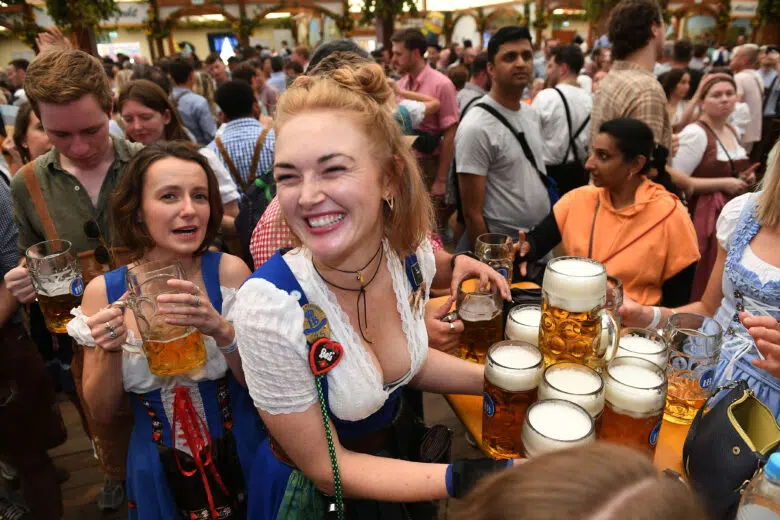
Shortly before noon in the Hofbräu tent at Oktoberfest.
“Welcome to the Wiesn (Bavarian for Oktoberfest)” booms from the speakers. It’s Saturday, just minutes before the first beer of the festival is poured. Hundreds of people in lederhosen and dirndls crowd together on the benches. They start clapping, slowly at first, then faster and faster. 10. 9. 8. 7. 6. 5. 4. 3. 2. 1.
For the latest news & views from every corner of the world, Worldcrunch Today is the only truly international newsletter. Sign up here.
“Woah!” the entire tent screams. “Woah!” echo the waitresses lined up at the tavern, waiting for their turn to haul the ordered “mass” mugs, which hold 1 liter (33 fluid ounces), to the next table. For 16 days, they will run back and forth between tavern and benches. “I’m a little worried I won’t be strong enough,” says one of them, wearing a gingerbread brooch that reads Marie. She is bringing 10 mugs to a table.
Marie Ranger: How many kilos do you think 10 mass weigh?
Colleague Joana: 25 kilograms? But I’m not sure.
Marie: I think 1 liter weighs 500 grams.
Joana: We should weigh it, but no time for that today.
The Oktoberfest in Munich is the largest folk festival in the world. Each year, more than 6 million visitors come from the United States, Italy and the United Kingdom. Every year, they queue for hours to secure a seat inside the tents. Every year, they rush in as soon as the gates open at 9 a.m. Over the course of 16 days, they drink about 7 million liters of beer.
This year’s Oktoberfest poster shows a waitress balancing a tray piled high with pretzels, beer, a tuba, and the spires of the Frauenkirche church. Christian Scharpf, the center-left Social Democratic Party (SPD) politician in charge of Oktoberfest for the first time this year, called it a tribute to the “strong women” who make the festival possible. It is meant as “a homage to all those working behind the scenes.” But what does a day at Oktoberfest actually look like through the eyes of a waitress? German weekly Die Zeit accompanied one of them on opening day. In the packed tent, it is easy to get lost before you even get a beer. That is why the waitress wears a microphone.
Saturday, 7:30 a.m., at a subway station in Schwabing, four and a half hours before the tapping. Marie Ranger is recognizable from afar. Blue dirndl, green apron: the Hofbräu uniform. She strolls past a pharmacy where a gingerbread heart hangs in the window with the words “Stay healthy.”
“Hopefully, I won’t get sick,” the 24-year-old says. To make sure of it, she drinks an immune booster every day for all 16 days. This is her second year serving at Oktoberfest, though she has never lived in Bavaria. It has long been a dream of hers. Her mother carried the mass from tavern to bench for decades, despite not being Bavarian either. Last year, they traveled to Munich together for registration day. Two days later, Ranger was walking through the tent in a green and blue dirndl.
I’m curious to see what my arms can handle.
“It’s not my scene, to be honest,” Ranger admits on the subway. She prefers techno parties. Still, she made the trip from Hamburg to Munich with two dirndls, six blouses and two aprons in her suitcase. Is she worried about someone throwing up in her section today? “No,” she says. That only happened three or four times last year. And what about aggressive men? “Last year wasn’t as bad as I thought. They’re more flirty than aggressive.” This year, there’s even an app to summon security instantly if needed. What worries her most is her strength. “I’m curious to see what my arms can handle.” She recently went on a long bike ride, but she hasn’t trained her upper body.
8:08 a.m., on the Oktoberfest grounds, four hours before the tapping starts.
The sun shines so brightly on the tent it looks staged for a commercial. “Help, it’s about to start,” Ranger says as she steps inside. At the reserved section near the entrance, her colleagues are already marking their ten tables with orange gaffer tape. Monika, from near Passau. Joana, who lives in Landshut in the summer and in Brazil the rest of the year. Both have worked at Oktoberfest for more than a decade. “Here, for you,” Joana says, handing Marie two laminated sheets: a pocket-sized menu and a cheat sheet with beer prices: you can order up to 10 mugs at once.
9 a.m., the gates open.
Staff stand outside the tent, phones out, filming. “Have fun celebrating at Oktoberfest,” blares the loudspeakers across the grounds. From far off: cheering. Then: pounding footsteps. Suddenly: running lederhosen and dirndls.
10:00 a.m., inside the Hofbräu tent.
People are still streaming in. Americans, New Zealanders, Brits. The only thing missing is the beer, which won’t flow until noon. Marie, Monika and Joana sit together, reviewing the menu and chatting about the guests.

Monika: After just one mug, you can usually tell how much someone can handle.
Marie: Americans can always drink a lot.
Joana: New Zealanders too, but at least they eat something.
Marie: They’re always such massive guys.
Joana: But handsome ones, too.
11 a.m., in Block C.
Marie serves a group of Americans.
American: Will you look after us today?
Marie: Of course.
Second American: Will you really look after us, okay?
Marie: I will.
12:11 p.m., at Tavern 4.
Marie bursts out of the tavern. Five beers in each hand, lips pressed together. In seconds she reaches her table, slamming the first mugs onto the wood. “Yeah!” one of the Americans yells.
Marie: First table!
American: You really pulled it off.
Second American: Best trick you could have done.
She collects 154 euros. The men babble incomprehensibly.
Marie will walk more than 20,000 steps. It’s both a physical and a mental challenge.
Shortly after 1 p.m., lunchtime.
Whistles sound from every corner. Waiters, hands full, whistling their way through. A rumor swirls that Bavarian Minister President Markus Söder is in the tent. Ranger has no time for it; her cheeks are flushed, peroxide-blonde hair pinned up at the nape of her neck.
A man, in English: Can I have nine schnitzel sandwiches?
Marie: Schnitzel sandwiches aren’t a thing.
The man: What’s that then?
Marie: That’s chicken.
The man: Fine, chicken. Nine.
2:29 p.m., in the tent.
The air is thick with beer, chicken and sweat. On stage the band plays “Working 9 to 5” by Dolly Parton. Marie will work nearly 12 hours, walk more than 20,000 steps. It’s both a physical and a mental challenge.
A man, in English: Are the schnitzels coming yet?
Marie: I already brought them.
The man: I think we ordered more.
Marie: Did someone vomit in this mug?
A woman: This one? I’m not sure.
Marie: I’ll take it. And sorry about the schnitzel.
Shortly before 3 p.m., at Tavern 4.
Ranger takes her first sip of water. She says she’s already dumped out three pints of vomit today. “At least it’s practical when they vomit into the mugs.”
4 p.m., in the beer garden.
Three of the tables in Block C are empty. Ranger must find new guests outside. What does she look for? She lists them. People who:
- don’t look drunk
- look like they can drink a lot
- look like they’ll tip well
- come in big groups

Behind the barrier tape, the crowd stretches out their fingers to show their group size: two, three, seven. Unable to decide, Ranger sends Monika instead and slips to the break room for 10 minutes.
Shortly before 5 p.m., at a beer bench.
A man slurs something.
Marie: Oh, you’re speaking German?
The man: (unintelligible) call?
Marie: Who should I…
Man: Can we call you?
Marie: Me? I’m right here.
Man: Do you have a number?
Marie: No.
6:40 p.m., in Block C.
A woman orders a wine spritzer. The final boss of orders. The wine bar is on the far side of the tent. Ranger dashes off, ducking under another waitress’s tray, past the line at the kitchen, past a couple kissing behind the chapel, past a drunk fumbling with eyedrops. She disappears into the wine bar and sprints back. At the table, the woman says: “And now, a second one.”
7:22 p.m., in the tent.
The band belts out “We Are the Champions.” The singer shouts: “And we keep on fighting till the end.” Marie and her colleagues have over three more hours to fight through.
Marie shouts: Hey! Someone touched her inappropriately.
The chance to make that much money so quickly was what drew her here.
She keeps going. She can’t use the app because her hands are full. She doesn’t have time to yell. She isn’t even sure who it was. No one reacts. The aisles are too jammed. “He touched me.”
8:40 p.m., somewhere in the tent.
Marie is doing her accounting. She can’t give exact figures. She explains: She and her colleagues load money onto a chip in advance, use it to buy food and drink, then sell at the same price. They earn a percentage on sales, plus tips. “The chance to make that much money so quickly,” Ranger admits, was what drew her here. She already knows how she’ll spend it: a months-long trip through Vietnam right after Oktoberfest.
Shortly after 10 p.m., in Block C.
On the floor, a young woman slips off her sneakers and stumbles through in socks. Buttons, sunglasses, even an open condom litter the wood. Sawdust lies in piles to soak up vomit. Sawdust everywhere.
10:25 p.m., in the tent.
On German children’s TV, “Unser Sandmännchen” signals bedtime. In Japan, “Auld Lang Syne” closes shops, trams and pools. At Oktoberfest, it is “Angels” by Robbie Williams that closes the night. As the singer croons “I’m loving angels instead” one last time, an older man approaches Ranger.
Older man: I just got here. How does ordering work?
Marie: Ordering is over.

