
-OpEd-
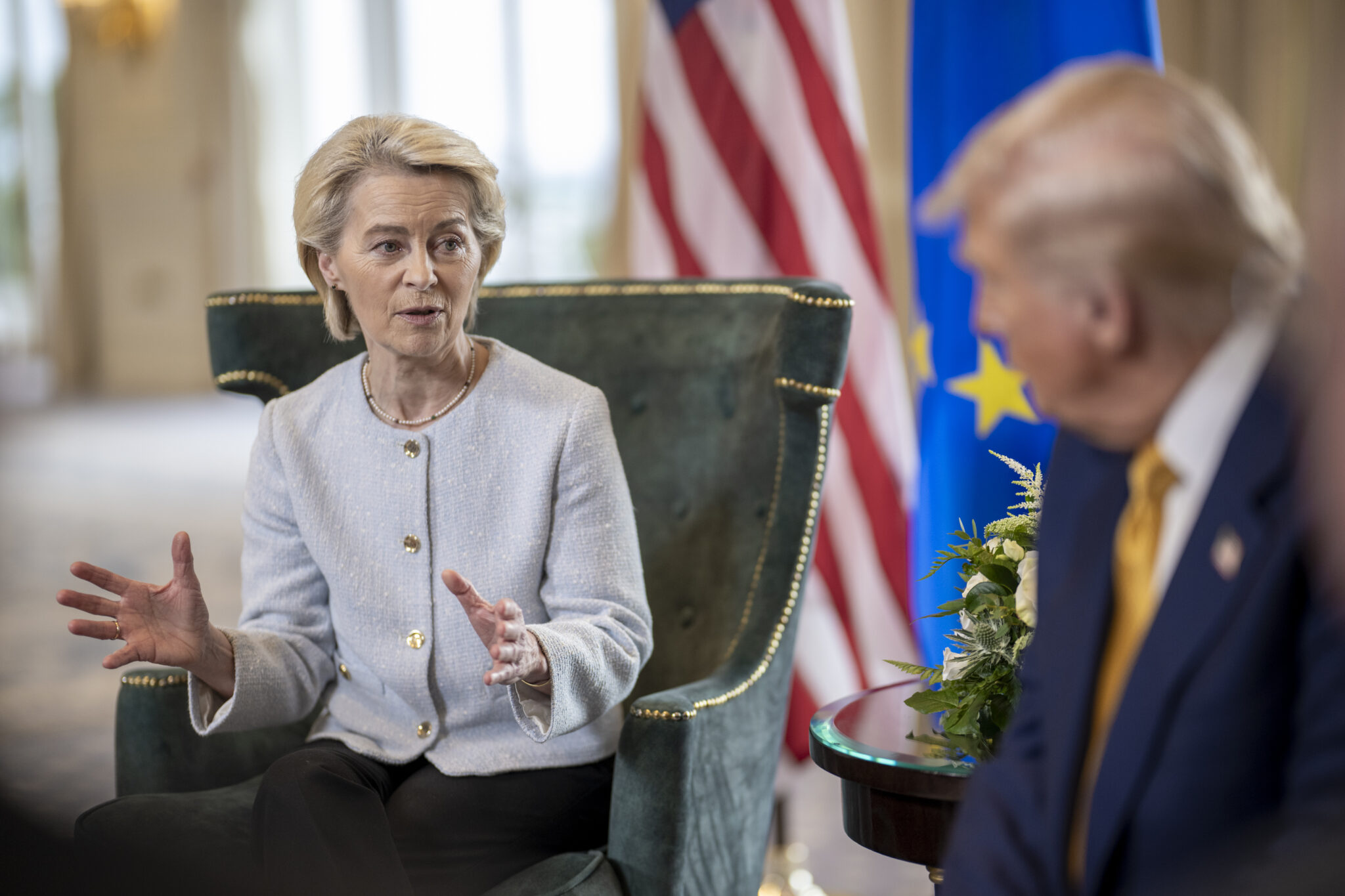
BERLIN — The video Ursula von der Leyen recently posted to her Instagram channel about the agreement in the trade dispute between the European Union and the United States opens with a curious close-up.
It shows a firm handshake between von der Leyen and Donald Trump, followed by the U.S. president gently patting the back of the European Commission president’s hand. The gesture is presumably meant to signal that a hard-fought compromise has been reached. Von der Leyen likely anticipated that the deal would draw harsh criticism in Berlin, Paris and Rome, and might even be called a humiliating surrender to Trump. That first shot in the video, then, was probably no accident.
The scene is reminiscent of something from the Cold War, as if Leonid Brezhnev and Richard Nixon had just sealed a long-awaited step toward nuclear de-escalation. And that may well have been the intended message: “This is realpolitik, folks, and it’s better than nothing!” And that is true.
Germany’s export-driven economy, not to mention the EU as a whole, would have taken a serious hit if the trade conflict with the U.S. had escalated. Moreover, given Europe’s military support for Ukraine, the EU can hardly afford to open another rift with Washington.
Still, even judged by the standards of realpolitik, the deal at first glance looks like a capitulation to Trump. While the U.S. is now slapping a 15% tariff on most imports from the EU, the EU is dropping its tariff rate to zero on all U.S. industrial goods, cars and certain agricultural products. On top of that, von der Leyen has committed the EU to buying American weapons on a large scale and investing heavily in the U.S. The EU is also supposed to purchase energy supplies worth $750 billion from the U.S. over the next three years — that is, until the end of Trump’s term.
Huge, surreal numbers
But is any of this even feasible? Maybe this agreement should not be seen purely through the lens of realpolitik. It could mark the beginning of a new kind of surreal politics. A closer look at the deal reveals that, at least in part, it belongs more to the realm of absurd political theater. For one thing, the European Commission cannot directly buy weapons or make investments, so carrying out these promises depends entirely on national governments and private companies. For another, the volume of promised energy deliveries seems completely unrealistic.
Energy expert Simone Tagliapietra noted in an interview with ZEIT that EU member states don’t actually need that much oil and gas, and that the U.S., in any case, wouldn’t be able to supply it in such a short time. The deal makes no real economic sense for either side. The point, it seems, is simply to dazzle Trump with gigantic numbers.
“And all of this is being done,” Tagliapietra says, “in the hope that Trump will forget about it after a while — and that no one will bother to check whether any of it was actually implemented.”
Waiting for Godot
Seen this way, von der Leyen and Trump staged their own version of Waiting for Godot, the absurdist classic in which the main character never shows up. The only difference is that the Commission president is betting Trump will forget who Godot even was by the second act.
That’s not an unreasonable bet. After all, the U.S. president’s attention span sometimes rivals that of a squirrel on caffeine. And American trade policy has become so confused that even insiders are sometimes unsure of what has actually been agreed. Just try asking what kind of trade deal the U.S.s has with Vietnam — or whether one even exists — and you’ll get different answers depending on whom you ask.
Von der Leyen’s cold, surreal strategy could offer a master key for dealing with Trump.
That said, Europeans would be wise not to celebrate too soon. There may well be people in the Trump administration who do read the fine print before waving the white flag, and who might remind their boss of one agreement or another. And even if Trump is replaced by a Democrat in three years, there is no guarantee the deal won’t come back to haunt the EU. After all, former President Joe Biden kept in place several tariffs that Trump imposed during his first term.
But if von der Leyen’s cold, surreal strategy does succeed, it could offer a master key for dealing with Trump. The idea would be to temporarily step into a Trumpist parallel universe, promising him everything he wants — without ever actually delivering. Of course, that kind of political double life carries real risks. You would have to know when and how to exit. Still, it might be the only way to beat Trump at his own game. And that would be, in surreal terms, a dream come true.