
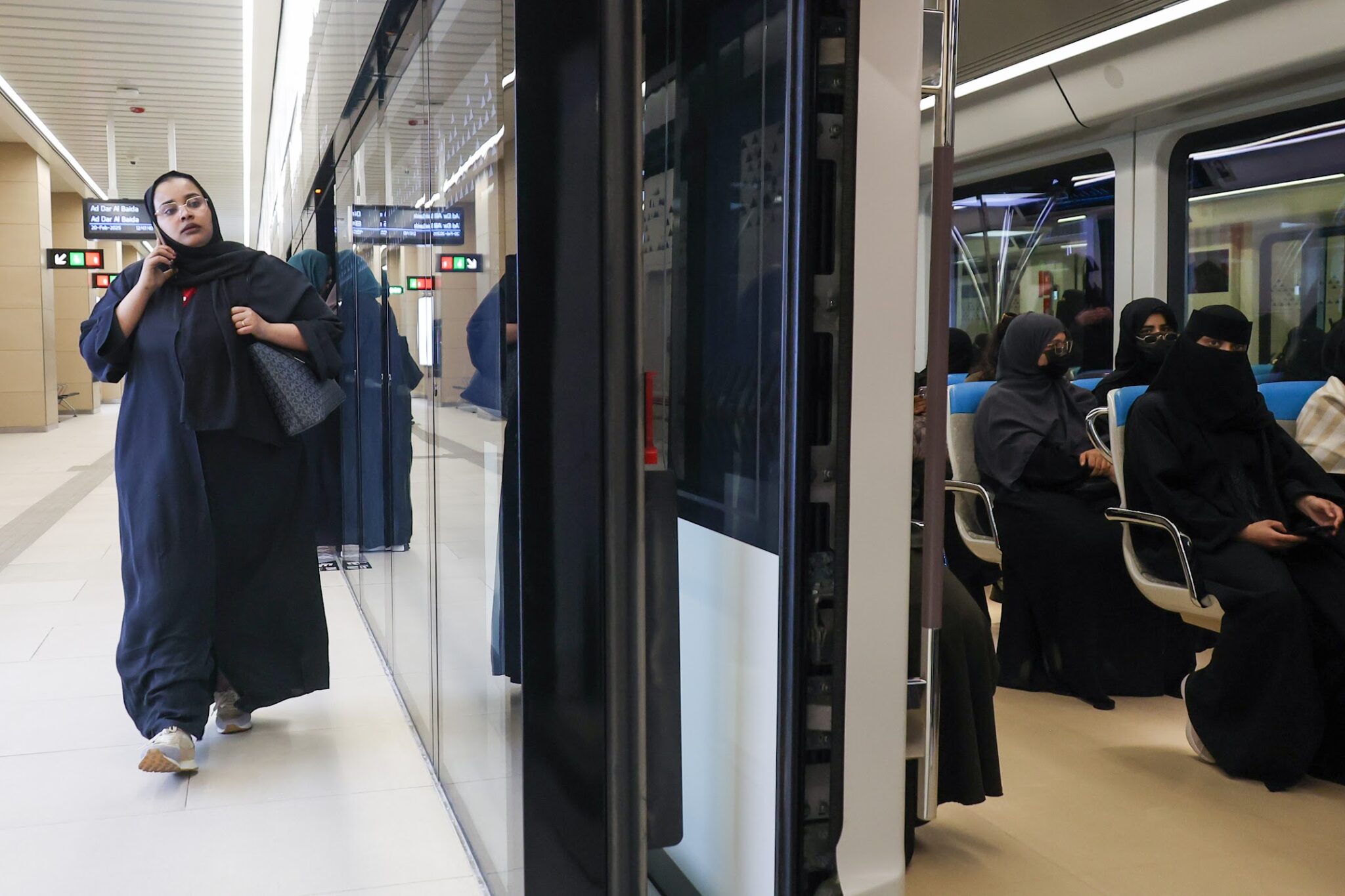
RIYADH — It’s 5:55 p.m. on Saturday, October 18, when a crowd of Saudis pours into the striking Qasr al-Hokm metro station, in Riyadh’s al-Qiri district, south of the city. Topped by a stainless-steel dome, the station is one of 85 across the capital, inaugurated on November 27. In the center, a lush green wall offers a touch of coolness against the desert heat. Outside, the chaos of traffic jams and honking horns seems far away, as children play on bicycles and rollerblades in the calm above the underground bustle.
Below ground, the choreography is precise. Everyone knows their place: families gather in the “family” section, single men are confined to the “single” area, while those willing to pay a little more enjoy “first class.” Ten Saudi riyals instead of four — about €2.50 rather than €1. It’s an impeccably organized system in a society that has only recently opened up in terms of individual freedoms. And while this crowd might seem ordinary in most cities, in Saudi Arabia it’s nothing short of revolutionary. Until just a few years ago, the kingdom — four times the size of France — had no public transport at all. Land Rovers, pickup trucks, SUVs… the car, in all its forms and sizes, reigned supreme in this oil-rich land.
That was before the rise of Mohammed bin Salman Al Saud —a.k.a. “MBS” — the king’s son and, since 2022, head of government. Convinced that the country must reduce its dependence on fossil fuels, the crown prince is determined to diversify Saudi Arabia’s sources of revenue. After the 2015 oil price collapse, which left the kingdom with a record budget deficit of nearly 15% of GDP, he launched the sweeping Vision 2030 plan to transform Saudi Arabia into a global economic and tourism hub.
MBS also aims to bring the world to Saudi Arabia — securing the 2030 World Expo and the 2034 FIFA World Cup — and he’s willing to spend lavishly to do so, particularly on public transport.
A Metro built in the desert
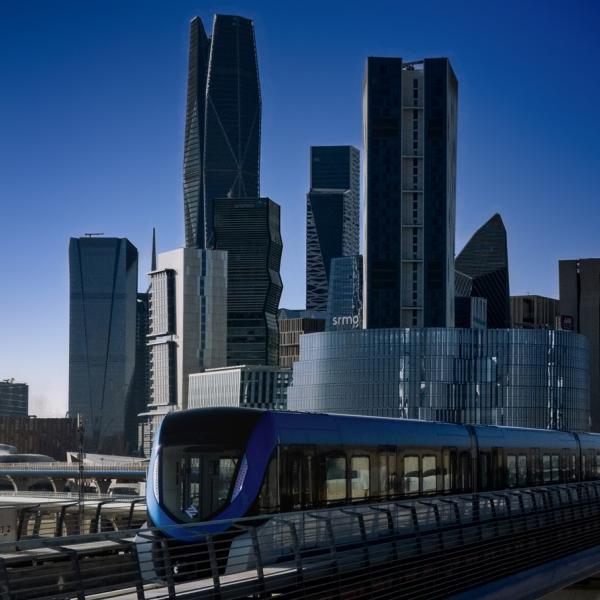
One of his most audacious projects is the new Riyadh Metro — built from scratch for a city of 8 million people. And not just one or two lines, but six at once. Stretching more than 176 kilometers, the network connects the airport, universities, the King Abdullah Financial District (KAFD), and several of the city’s historic neighborhoods. To realize this $25 billion (€21.4 billion) project, the Royal Commission for Riyadh City (RCRC) brought in some of the world’s leading transport companies, including France’s RATP Dev, Alstom, and Siemens.
“Our goal is to position Riyadh among the world’s most remarkable cities in terms of quality of life, tourism, and services,” says the crown prince, who never seems short of new ideas. The creation of this metro network — scheduled for completion by late 2024 and modeled on systems in Paris and New York — is a case in point.
“With six automated metro lines built simultaneously, what has been achieved here is absolutely unique,” says Hiba Farès, CEO of RATP Dev, whose teams have been involved from the start and now operate the network’s two main routes: Line 1 (the Blue Line) and Line 2 (the Red Line). The results speak for themselves: in less than a year, 122 million trips have been made on the metro, with 60% on those two central lines alone.
Women lead the way
Perhaps the clearest sign of success is the number of women using the network. For many, it’s the only way to travel independently. On Sundays — the first working day of the Saudi week — young women crowd the metro to reach Princess Nourah bint Abdulrahman University, a vast all-female campus on the northern edge of the desert city. Dressed in abayas and carrying tablets, they look like students anywhere else in the world.
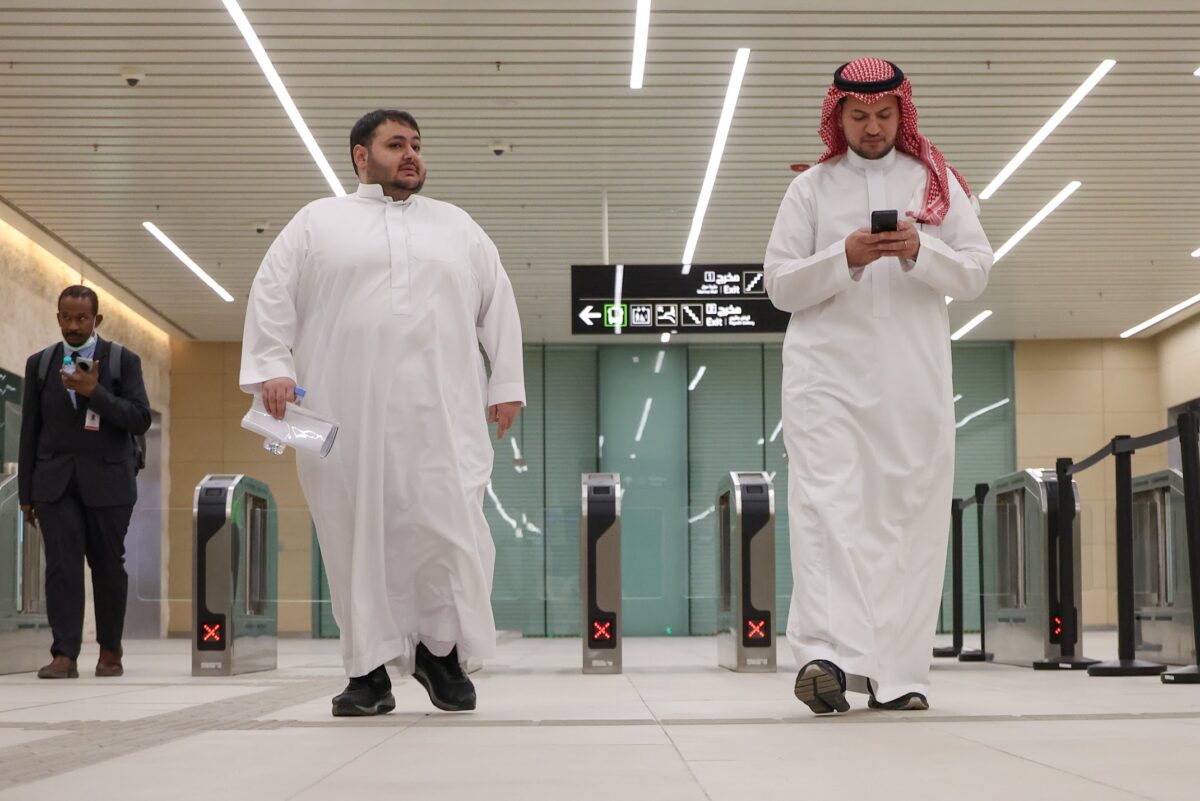
The metro’s arrival a year ago has changed their daily lives. Previously, most had to rely on a driver — often a relative — or take a taxi or bus to class. “With the metro, we can come on our own, and it’s much faster. But many still prefer the car,” admits a young woman on board. Women have only been allowed to drive for a few years, and habits are slow to change. “My husband still drives me to work most days,” another passenger explains.
The network’s reach also remains limited. Riyadh covers more than 1,790 square kilometers — by comparison, Paris is just 105. To address this, and in a city where sidewalks are rare and temperatures can exceed 50 °C, the Royal Commission has developed a network of 89 bus lines, designed to complement the metro and offer a truly multimodal system for commuters.
For now, the wealthiest Saudis are rarely seen navigating Riyadh’s sleek new underground. But time may change that. Between a booming population and constant road construction, traffic jams have become one of the capital’s main scourges. Meanwhile, the project continues to expand. Plans are underway for a seventh metro line linking the new districts of Qiddiya, Diriyah, and King Abdullah International Gardens — all currently under development. An extension of Line 2 is also on the drawing board.