
Updated Oct. 29, 2024 at 5:45 p.m.*
-Analysis-
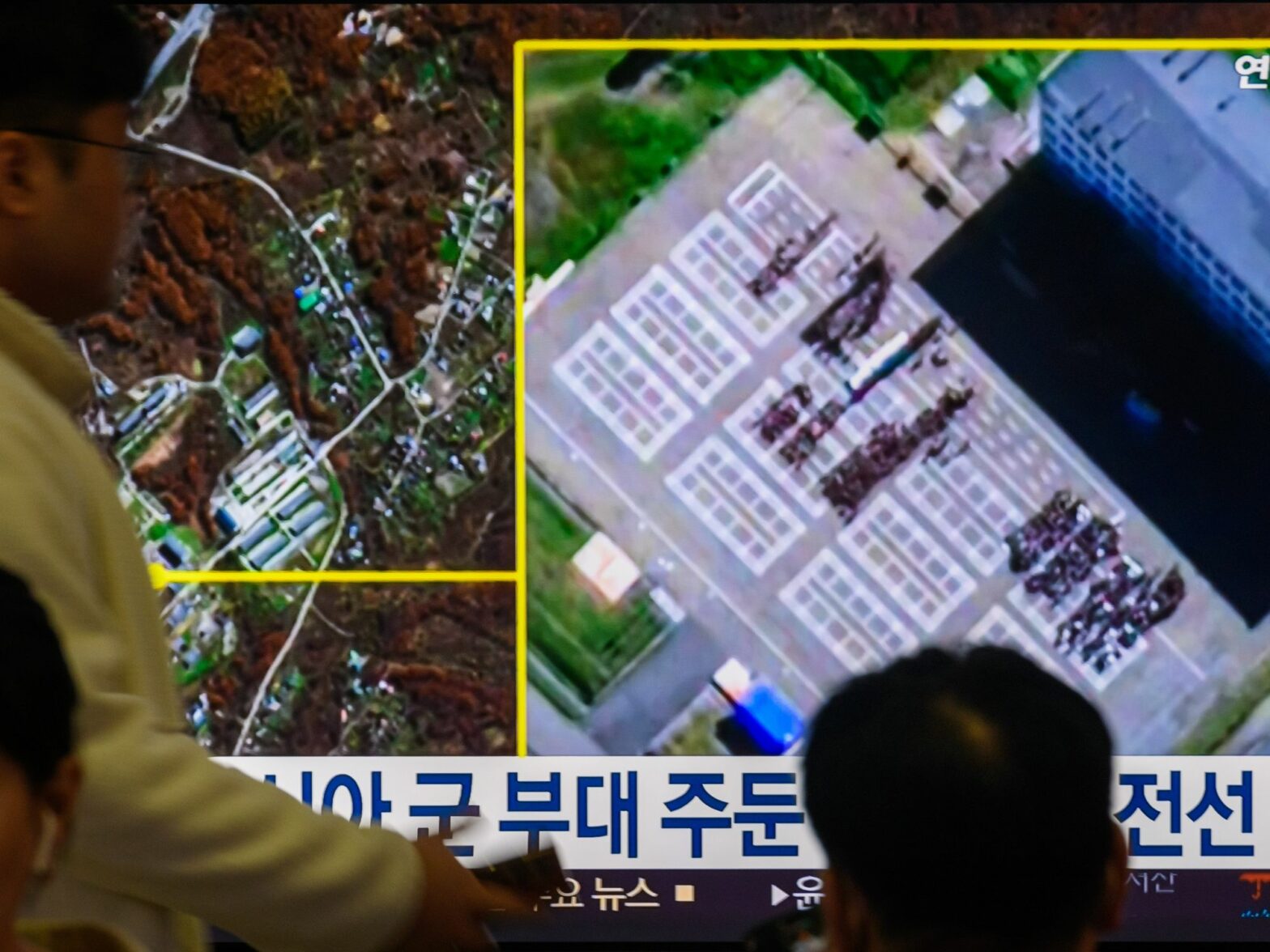
Russian President Vladimir Putin’s war against Ukraine looks set to take on a whole new political and military dimension. According to NATO Secretary General Mark Rutte, an estimated 10,000 North Korean soldiers have been deployed to Russia’s Kursk border region, sent there for training and potential combat roles in Ukraine.
Pyongyang’s involvement is, according to Rutte, a sign of Russian President Vladimir Putin’s “growing desperation,” but also “a significant escalation (and) dangerous expansion of Russia’s war.”
In an off-camera, on-the-record press briefing, Pentagon spokesperson Sabrina Singh confirmed that the troops were believed to be advancing toward Kursk, where Russia has been facing difficulties in countering a Ukrainian incursion. Meanwhile, U.S. Defense Secretary Lloyd Austin said it would be “very, very serious” if the North Koreans were preparing to fight alongside Russia in Ukraine, as Kyiv has alleged.
Earlier, South Korea’s Yonhap news agency reported that North Korea was planning to send as many as 12,000 troops, including elite special forces, to support Russia.
[shortcode-Subscribe-to-Ukraine-daily-box]
While Western nations, particularly the U.S., are arming and training Ukrainian forces, North Korea, a staunch ally of Russia, is reportedly stepping in with boots-on-the-ground deployment.
According to the NIS, Russia is giving the North Korean soldiers fake documents and disguising them as members of the Buryat ethnic group from Siberia. The Ukrainian government even released a video allegedly showing North Korean soldiers receiving new uniforms at a Russian military training camp.
What’s in it for North Korea?
On the surface, it might seem like Russia’s use of North Korean troops is a way to avoid mobilizing more of its own citizens. But that might not be the case. According British Ministry of Defense estimates, about 1,000 Russian soldiers are dying each day, so 12,000 North Korean troops aren’t likely to make any major difference.
Moreover, war experience is important, and North Korean soldiers do not have any. Russia already has battle-hardened forces with experience from Syria, where they fought to support Bashar al-Assad’s regime.
Kim, like his father and grandfather, has been obsessed with military power.
Russian-backed militias have also been fighting in eastern Ukraine since 2014. On the other hand, North Korea hasn’t seen real combat since the Korean War (1950–1953), when it fought the South with support from China.
For North Korean leader Kim Jong-un, however, sending his soldiers to Ukraine is a valuable opportunity for his troops to gain combat experience. The effectiveness of the military is a top priority for the regime, and North Korea boasts one of the largest standing armies in the world — over 1.2 million soldiers out of a population of around 25 million.
Kim, like his father and grandfather, has been obsessed with military power, building up nuclear capabilities that might now include as many as 60 warheads. While the people starve, almost all of the country’s resources are funneled into its military.
What Kim gets
Kim’s support for Russia isn’t new. It’s estimated that North Korea has already sent more than 13,000 containers of much-needed artillery shells and missiles to Russia. South Korean intelligence claims that over 8 million artillery rounds and missiles have been delivered.
The military cooperation between North Korea and Russia has been intensifying, with the two nations signing a comprehensive strategic agreement in June, which includes mutual support in case of an attack by a third party. In July, North Korea even sent a delegation of elite soldiers to Russia as part of a military exchange.
There’s even speculation that Russia might pass on nuclear and satellite technology.
But for now, experts believe North Korea’s biggest contribution will be its technicians, helping the Russians operate the weapons Kim’s regime has provided. Many of the North Korean artillery shells and missiles have proven to be poor quality, often failing to detonate. Yet, with Russia desperate for supplies, the North Koreans are still being paid handsomely.
In return, Kim is getting crucial resources like oil and food to prop up his struggling economy. There’s even speculation that Russia might pass on nuclear and satellite technology, although there are reasons to be doubtful about that: for Putin, this is valuable military knowledge, the disclosure of which would reduce Russia’s strategic advantage in the region.
Beijing factor
So why would Russia want 12,000 North Korean troops, most of whom lack battle experience and could quickly become casualties in Ukraine? It might be a trial run, a test to see if foreign soldiers can be successfully integrated into Russian operations. The fact that Russia is disguising the North Koreans as Russians suggests that Putin is keen to avoid a strong international backlash.
This deployment could also be a psychological tactic, signaling to Ukraine that Russia is not fighting alone. If the North Koreans prove effective, Kim could send even more troops, eventually allowing Putin to avoid mobilizing additional Russians.
But all of this hinges on China. North Korea is economically dependent on China, and Kim will likely need China’s approval to fully commit to supporting Russia in Ukraine. Officially, China maintains a neutral stance on the conflict, though it has been covertly supplying Russia with “dual-use” goods — items that can serve both civilian and military purposes.
All three leaders — Xi, Putin and Kim — share a common goal.
Chinese President Xi Jinping has also rolled out the red carpet for Putin many times in Beijing, announcing a new era of cooperation between their two countries.
What Xi might not want, however, is for North Korea to get too close to Russia. If Putin were to share valuable military technology with Kim, it would weaken China’s influence in Northeast Asia.
Still, all three leaders — Xi, Putin and Kim — share a common goal: to challenge and undermine U.S. global dominance. Iran is also part of this axis, providing Russia with drones in its war effort.
If Xi were to give the green light for North Korean troops to fight in Ukraine, it would be a clear sign that he values a united front against the West more than regional rivalries with Russia. More North Korean boots on the ground in Ukraine, that would signal Xi’s full commitment to an anti-Ukrainian, anti-European and pro-Russian stance.
*Originally published Oct. 22, 2024, this article was updated Oct. 29, 2024 with new information about North Korean troops deployed on the Russia-Ukraine front lines.