
The Syrian army’s refusal to fight for Bashar al-Assad did not go unnoticed in Tehran.
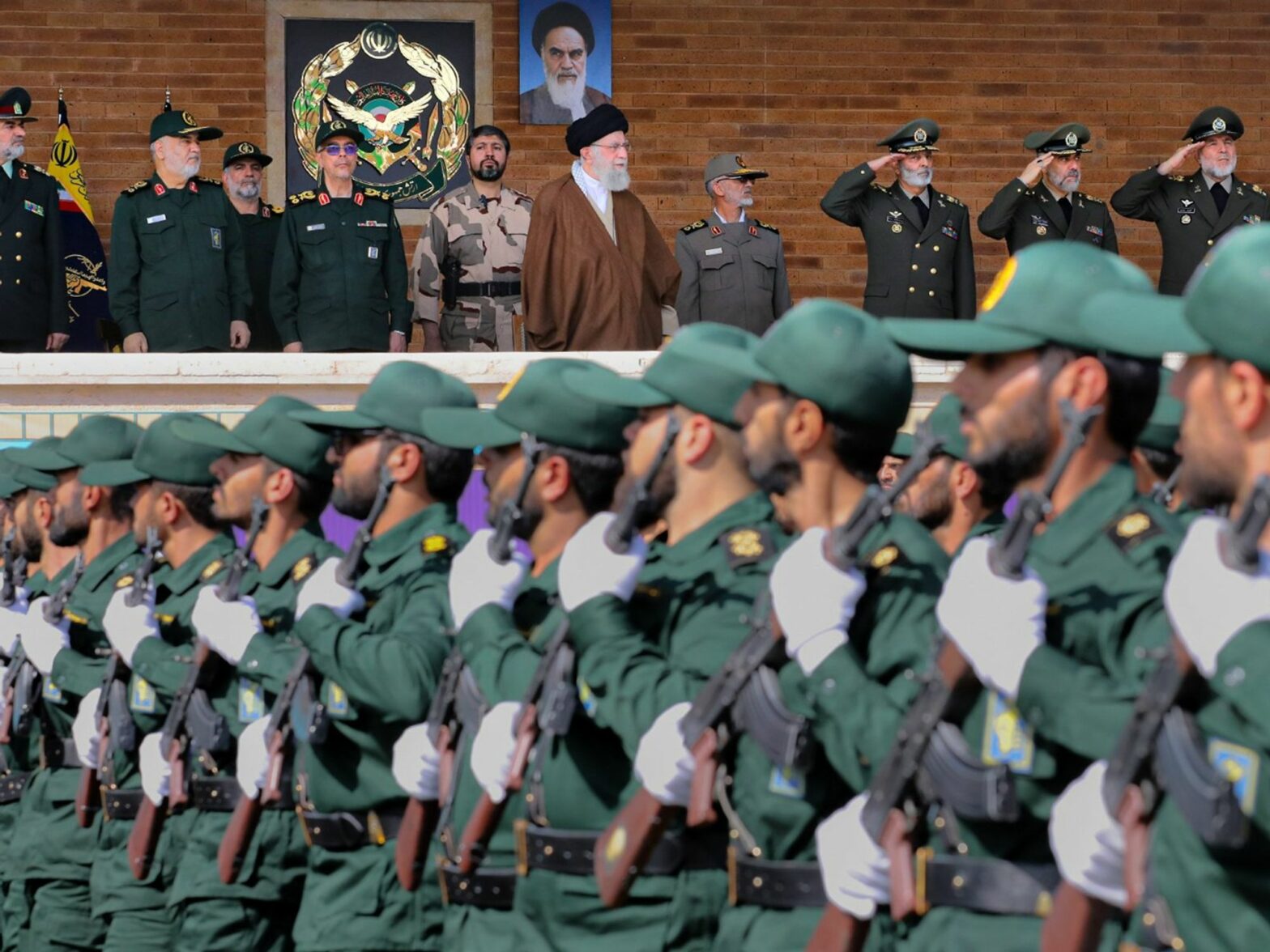
There have been signs that Iranian political and military leaders are increasingly worried about a similar scenario unfolding in Iran. Would thousands of Iranian soldiers refuse to fight, like their Syrian counterparts who laid down their weapons, which led to the lightening collapse and fleeing of the Assad regime? What would happen if the mass unrest that shook Iran in 2022 were to repeat?
The Iranian regular army’s deputy-commander in charge of training, Alireza Sheikh, recently told a gathering of cadets in Tehran that “recent events in the region have shown that we must be careful with the bullets the enemy is firing at us. The soldier’s real bulwark against enemy fire is strong, heartfelt conviction.”
That is why, he explained, the teaching of religious principles and customs were an important part of military training, and soldiers must strive to safeguard their “fundamental beliefs.” Sheikh warned about the dangers of “enemy exploitation” of the Internet, adding people’s conduct “in real life” mirrored their online behavior, and moral and religious principles must be protected in both spheres.
The head of Parliament’s National Security committee, Ismail Kowsari, told the website Jamaran last month that the Syrian army had “betrayed” Assad, and “when military forces in a country are not up to the task, you can be sure the government will suddenly collapse. Because there is nobody to defend the country.”
Watching the affair
Kowsari, a former Revolutionary guards officer, effectively echoed the words of the Guards’ present commander, Hussein Salami, who recently chided critics who had asked why Iran had not rushed in to help Assad. It made no sense, Salami said, when “the country’s army was just watching the affair.”
Iran has itself used militiamen to quell unrest in the past.
Kowsari noted that the Syria’s army “initially opposed” the creation by Iran of a “patriotic” militia in Syria including Hezbollah and foreign fighters, but had caved in under Assad’s orders, themselves taken under Iranian pressure. The ‘patriotic’ militia however was gradually dismantled, he said without giving details, leaving the Syrian army incapable of blocking the rebels’ advance.
Iran has itself used militiamen, called Basijis, and reportedly even members of Hezbollah and other foreigners, to quell unrest in the past, though there is little concrete evidence as the presumed agents involved were without a uniform or acting as sharpshooters. So far at least, the regime appears not to have used regular troops to crush protests.
There is no consensus among regime hands in any case on the exact reasons why the regime’s ally Assad fell. The veteran Tehran daily Jomhuri-e Islami observed in a December 17 editorial, entitled “They Have Plans for Us,” that economic problems will certainly rob a system of public backing, “paving the way for its debilitation and even collapse.”
There was no need to refer to Iran’s own, dismal economic conditions including constant power outages. No regime can hope to endure without popular backing, the daily stated, adding that “certain people involved with the Axis of Resistance” had also attributed Assad’s rapid downfall to the economic plight of a good many Syrians including state servants.
Besides the undoubted economic problems, Iranian officials are also concerned by the foreign intelligence infiltration of state agencies, notably by Israel. They have no information on its precise scope, but have witnessed multiple Israeli actions in recent years to kill high-profile individuals inside of Iran.
Revolutionary Guard infiltration
Already in June 2024, the Judiciary chief Gholamhussein Mohseni-Ejei warned about “infiltrations” into the Revolutionary Guards’ own intelligence department. Early in November 2024, Ali Larijani, a foreign policy aide to the Supreme Leader, said on television that foreign intelligence agencies had indeed infiltrated the regime thanks to “years of neglect” and the regime’s inability to stop this penetration.
Who can be trusted?
A notable example of such concerns is reflected in the rumors swirling around the fate of the head of the Revolutionary Guards Quds regional task force, Ismail Qaani. It still isn’t entirely clear whether he was killed or maimed in Lebanon, or arrested and taken back to Tehran under suspicion of aiding the Israelis. Qaani is rarely seen these days in any case.
Who can be trusted then in a context of regional weakness, a widening perception that the regime’s fate is sealed and repeated cases of Israel acting as it pleases, now with full U.S. backing? With the regime’s nemesis Donald Trump about to take office again in Washington, will the military fire on Iranians if protests erupt, or is an Assad scenario already in the offing?