
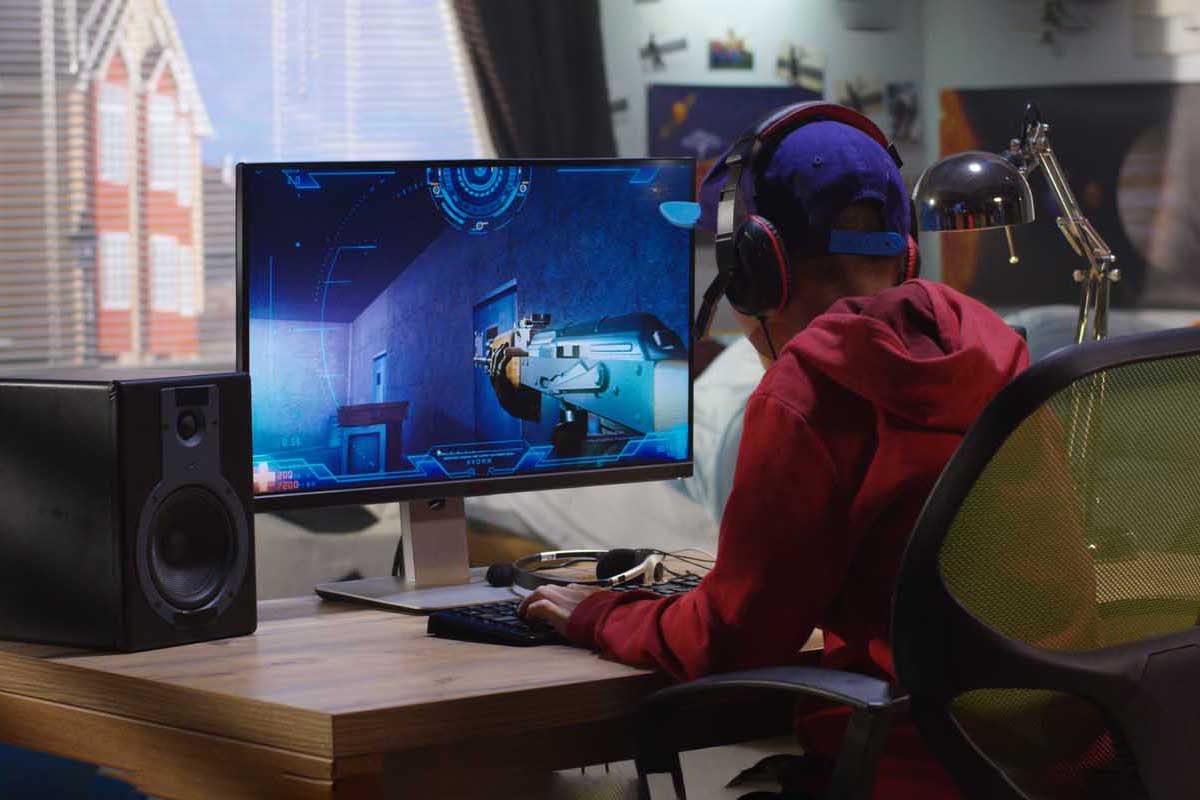
HAMBURG — A round begins in the tactical shooter Tom Clancy’s Rainbow Six: Siege. An anti-terrorist unit and a group of hostage-takers clash. Samantha Schwemm is playing on the hostage-taker’s team. “Barricade yourselves in that room,” a computer voice instructs, “you have to keep the hostages safe…” A gunshot. Schwemm’s character, the only woman, collapses. Her round is over after just three seconds, shot by one of her own teammates, a taboo act.
“What the hell was that?” Schwemm asks the other players in voice chat.
“Shut your fucking mouth!” comes the reply. “Do us a favor and leave the round. You don’t even belong here!”
Schwemm’s YouTube series OMG a Girl began with these kinds of scenes in 2018. For seven years she has documented the hostility, insults and harassment she encounters in a male-dominated environment simply because of her gender. The footage, which Schwemm now collects under the name Spawntaneous, serves as a contemporary record of misogyny and toxic masculinity in video games.
Comments like “Women don’t understand things properly, their brains just don’t work the same” slide effortlessly into orders such as “Go back to making food and doing laundry” or into verbal assaults like “I’d fuck you. Add me ;).”
Sexism and misogyny in gaming have been actively debated since the 2014 online harassment campaign known as Gamergate, and they remain relevant today. A study published in August by the Bertelsmann Foundation found that sexist attitudes are far more common among young male gamers than in the population overall. Which raises the question: Has the gaming community really not changed at all in the decade since Gamergate?
Death threats
Beginning in 2014, misogynistic and in some cases right-wing gamers launched a campaign of terror against indie developer Zoe Quinn, who had been falsely accused by an ex-partner of influencing gaming journalists through sexual favors. Their next target was media critic Anita Sarkeesian, who exposed sexist stereotypes in games in her vlogs, and developer Brianna Wu, a trans woman who became a target when she criticized Gamergate supporters on Twitter.
Before long, several other female journalists were hit by similar hate campaigns. These attacks included publishing private information and addresses through doxxing, efforts to discredit them with their employers, and threats of rape and murder.
We now know it is not just a small, loud minority.
Much has changed since then, or so it might seem. Starting in 2017, the MeToo movement exposed systemic abuses in the media industry, sparking a wider social reckoning that also reached gaming. Major studios like Ubisoft, Blizzard and Riot Games faced lawsuits over allegations of sexual assault and gender discrimination. Many online game platforms introduced codes of conduct, account suspensions, and automated language filters in an effort to rein in harassment in chats. And women are no longer outsiders in gaming. According to GAME, the German Games Industry Association, they now represent 48% of local players.
“And yet the problem hasn’t gone away,” says psychologist and gaming researcher Rachel Kowert in an interview with Die Zeit. Since publishing a 2015 longitudinal study on the link between video game use and sexist attitudes, Kowert has continued to examine sexism in gaming. What has changed, she says, is how we understand the scope of the problem, though the findings are sobering: “We now know it is not just a small, loud minority.” Instead, sexist behavior has become ingrained in gaming culture.

Even children partake
In one study, Kowert analyzed voice chat tirades and found that even very young children spout “the most horrible, most disgusting things,” even when they do not understand what they mean. “They pick it up somewhere and just repeat it without thinking,” says Kowert. “When asked if they really believed these misogynistic things, they said no, they didn’t. It’s just the way people talk and act in chat.”
At the same time, Kowert admits, there has been progress in game design. The rise of indie developers, in particular, is reshaping the landscape. Smaller studios are breaking from mainstream conventions and introducing strong, non-sexualized female protagonists. Consider games like the coming-of-age drama Gone Home, the pseudo-documentary Her Story, which explores failed motherhood from multiple angles, or the autobiographical Quantum Witch, which almost entirely excludes male characters, alongside the multiplayer adventure Split Fiction.
By showcasing non-stereotypical women, indie studios are putting increasing pressure on big companies. This matters, Kowert says, but the most significant change must come from the community itself. “Because today’s gamers are tomorrow’s game developers,” she adds.
One of the core issues is the persistent male dominance in development studios.
From her perspective, one of the core issues is the persistent male dominance in development studios. Although the gender split among players is now balanced, “developers and those in leadership roles in the industry are still overwhelmingly men.” And gaming has been historically framed as a male pursuit: “For decades, games were socialized as toys for boys. Research shows that even now, parents are more likely to buy a console for their sons than for their daughters.”
This has real consequences for women’s self-image. “When you ask women whether they see themselves as gamers, they are much more likely to say no,” says Kowert. She traces this to the entrenched misogyny in many gaming communities. The result is that girls and women often fail to see themselves as part of the culture and instead feel excluded. In short, it is a vicious cycle: Sexism thrives because women are invisible, and women remain invisible because of sexism.
Don’t mute your microphones
Schwemm also knows the advice women are often given to fit in. In a recent video, she says many people suggested she use software to make her voice sound male, or to mute herself altogether. But she refuses to censor her identity. “I’m a woman, and I should be able to play however I want.” That is why she insists on using voice chat despite the harassment. “Women,” she urges, “don’t mute your microphones. If you do, you’re silencing yourselves, and that’s exactly what they want.”
As long as sexism persists, she argues, misogynistic players must be confronted — and not only by women. “Other guys need to speak up. Men have to call out men, because they don’t listen to women. They dismiss us as overreacting.” Until sexists face pushback, they will never experience consequences for their actions. Instead, their behavior will only be validated.
Meanwhile, Schwemm continues to push forward: staying vocal, denouncing abuse and refusing to back down. But she admits it is becoming harder. “I really don’t know if I want to keep the series going,” she says. Sometimes, while editing, she has to ask her partner for a hug because the endless stream of insults is so demoralizing.
She would actually prefer to play other games where the atmosphere is less toxic, or perhaps produce baking or crochet videos. The problem, she says, is that many viewers might not even want to watch that. Instead, plenty seem more interested in watching a woman being insulted while gaming.