
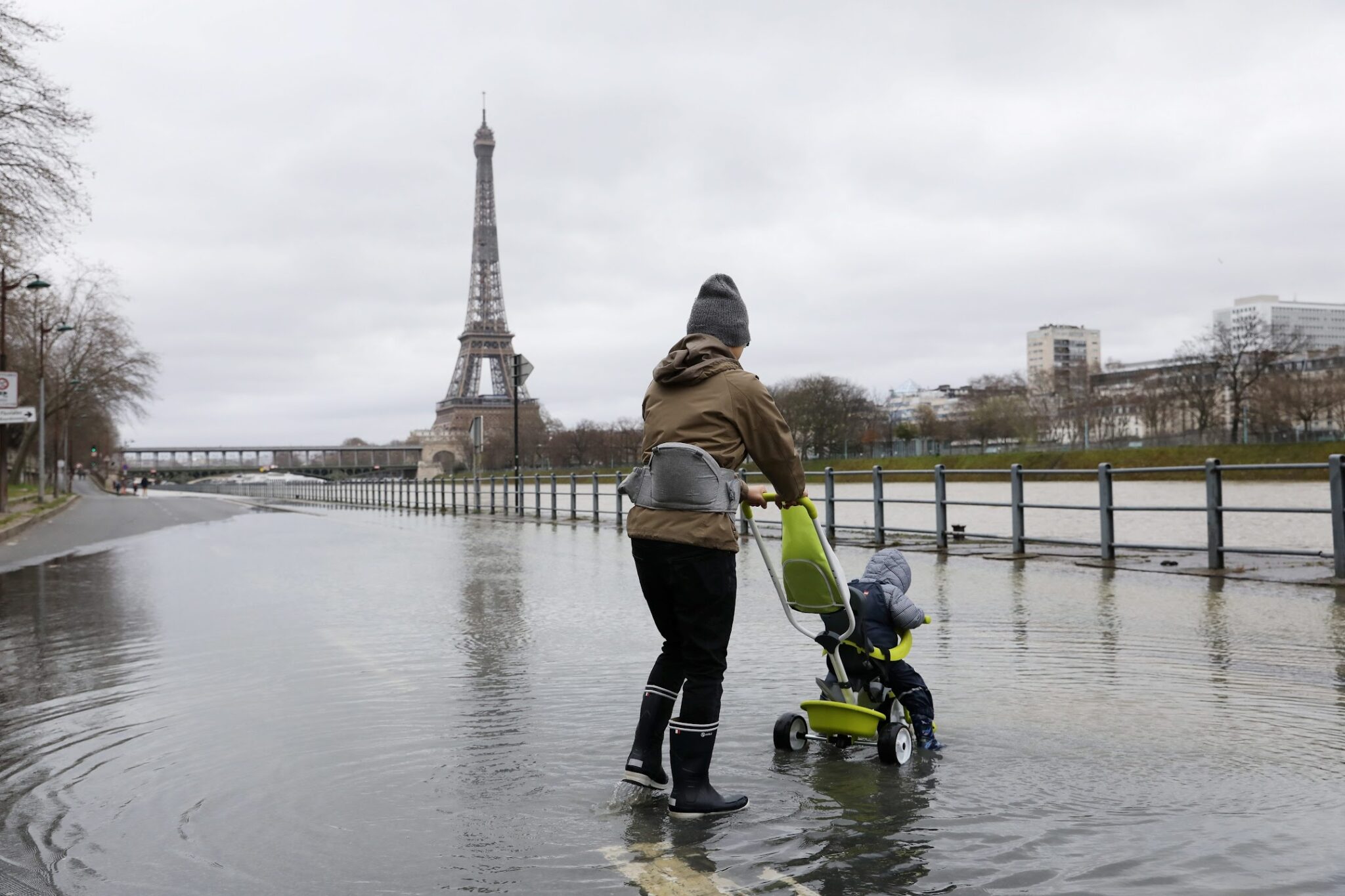
PARIS — Picture this: it’s the near future, deep in winter. The Seine has been overflowing for two months, and overnight, following a storm, its level has surged to 7.10 meters. Hundreds of thousands of people must be evacuated; the metro is submerged; gas and electricity have been cut off. The sewers are on the brink of overflowing, and food shortages are imminent.
This disaster scenario — devised by the Paris City Hall — was brought to life on Monday, October 13, during a large-scale flood simulation in the capital. Around 60 residents of the Marais district, including a class of fifth graders, took part in a day-long role-playing exercise that simulated the evacuation of a building to the Climate Academy (4th arrondissement), temporarily converted into a reception and assembly center. The goal: to raise public awareness and reduce the risks of poor crisis management in the event of a real flood.
As part of the same initiative, on May 14, the city of Paris installed simulators of cars submerged by floodwater on the steps of the 11th arrondissement town hall. That day, sitting behind the wheel of one of these simulators, Chahinaz tried to open the door. With 10 cm of water, the mother was still able to get out of the mock vehicle. However, when the water level rose to 20 cm, things became more complicated, forcing the Parisian woman to use her feet to open the door. “It’s impressive, I didn’t think water had that much power,” she said in surprise, her hands resting on her daughter’s stroller.
Like Chahinaz, local residents and other onlookers were invited to test the force of water during floods, particularly in the event of being trapped in a car, using machines provided by the French Association for the Prevention of Natural and Technological Disasters. The activity, like the more recent flood simulation exercise, was organized jointly by the Paris City Hall and the police headquarters to teach the public how to respond appropriately.
Flooding is the number one natural hazard threatening the capital, where an overflow of the Seine could affect up to 700,000 people, warned Pénélope Komitès, deputy mayor in charge of resilience at Paris City Hall, which organized the two exercises. “If there is a flood, my first reaction would be to take my car and go pick up my children from school,” admitted Chahinaz. However, “this is the most dangerous decision to make,” warned Béatrice Steffan, prefect and secretary general of the Paris defense and security zone, who was also present at the scene.
This awareness program, inspired by Nordic countries where a “culture of risk” is more widespread, was created after the historic floods in Pas-de-Calais in November 2023, followed by various floods that occur throughout France every year. A growing awareness of the risks was also observed after the floods in Valencia, Spain, in October 2024, which claimed the lives of 240 people.

Hundred-year flood
However, most Parisians cannot imagine their city experiencing a climate disaster of such magnitude. “Floods are the main natural risk likely to affect the Île-de-France region,” Béatrice Steffan pointed out in May. “The idea is therefore to help the population prepare for it” through an information meeting in each district town hall, she explained. Around a hundred local residents, retirees, families, and young professionals responded to the call in the 11th arrondissement.
Throughout its history, the French capital has been marked by major floods. The flood that stands out in the minds of the French and scientists alike is the one in January 1910. In the space of ten days, the water rose to 8.62 meters at the Austerlitz bridge and submerged many neighborhoods. Since then, Parisians have experienced other floods, albeit on a smaller scale, such as in 2016 and 2018. So, could the city of Paris experience a climatic event like that of 1910? “Studies show that there is a trend towards an increase in the risk of flooding,” says Éric Gaume, a hydrologist and researcher at Gustave Eiffel University, cautiously, emphasizing the uncertainties that remain. “While we are able to predict atmospheric warming, it is more difficult to predict whether it will rain more than before,” he summarizes.
If a flood like the one in 1910 were to occur today, 14 out of 20 arrondissements could be flooded.
Vazken Andreassian, the director of the hydrology unit at INRAE (the French National Institute for Agricultural Research), recalls the theory of the hundred-year flood: “There is a 1 in 100 chance of a flood like the one in Paris in 1910 happening every year. That doesn’t mean we’re likely to experience one every year.” Local authorities point out that “2024 was a particularly rainy year in the Île-de-France region” and that “the water tables are full.” “This increases the risk of flooding in the event of heavy rain.”
If a flood like the one in 1910 were to occur today, 14 out of 20 arrondissements (not the entire arrondissement) could be flooded, according to scientists. Among the areas that would be particularly affected are the Gare de Lyon area and the 15th arrondissement near the Seine. The Opéra, Madeleine, and Louvre neighborhoods could be affected by rising groundwater levels, says Éric Gaume.

“Paris’ guardians”
Since the disaster of 1910, work has been undertaken to limit the risks. “The hydraulic system has been improved, meaning that water from the Seine flows better, with particular thanks to the modernization of dams, which have lowered the water level by 35 cm,” explains Éric Gaume. But above all, large lakes have been created on the Seine. “Four basins were built upstream of Paris between the 1960s and 1990s to divert and store water flow and thus protect Paris. They provide an additional 35 cm. In summer, this allows the capital to be supplied with water,” explains the hydrologist.
However, these “guardians of Paris” are not infallible. For one thing, because these basins are located “too far” from the capital. “During the floods of June 2016, for example, they were ineffective,” explains Éric Gaume. They must also be empty in order to receive water in the event of flooding. However, flooding always occurs as a result of heavy rainfall and when the ground is saturated with water.
The city council is therefore seeking to reduce the potential damage by preparing the population. This involves flood simulators, workshops, and meetings in district town halls, as well as other projects such as the “flood mural.” Based on the same model as the climate fresco, it was created by the European Center for Flood Risk Prevention (Cepri) and is now available at Paris’ Climate Academy.