
BOGOTÁ — Miraña is his last name, as well as the name of his language and his people — who are traditionally from the Amazonian region of southern Colombia. Elio Miraña is from the Booanamʉ (Boa) clan on his father’s side and from the Neebaje (Achiote) clan on his mother’s side.
He has been documenting the Miraña language as part of the Programa de documentación de diez lenguas para 2025 (“Program to Document Ten Languages by 2025”) undertaken by Colombia’s Caro y Cuervo Institute, a public research body for the arts and humanities.
The term Miraña itself, he says, is of Tupí origin (or tupí-guaraní, one of the linguistic families of the Amazon basin), and constitutes a colonial distortion of the Miraña’s history, but “we use it as a surname because it is also a way of recognizing and bonding with one another. Having been reduced as a population [in the devastating Rubber Boom of the early 20th century], we all consider ourselves part of the same family, beyond the diversity of our clans.”
The Miraña’s ancestral territory is in the Gwaa’i (Pamá) river gorge, a tributary of the Paa’i (Cahuinari) River. During the rubber genocide, which had its epicenter in the Putumayo region, the group migrated eastward, to areas near the Iñe’i (Mirití) river, the territory of communities like the Matapí and the Yucuna. From 1937, they created riverside settlements on the banks of the Caquetá River, forming the communities of Puerto Remanso del Tigre, Mariápolis, San Francisco, Las Palmas and Metá-Quinché.
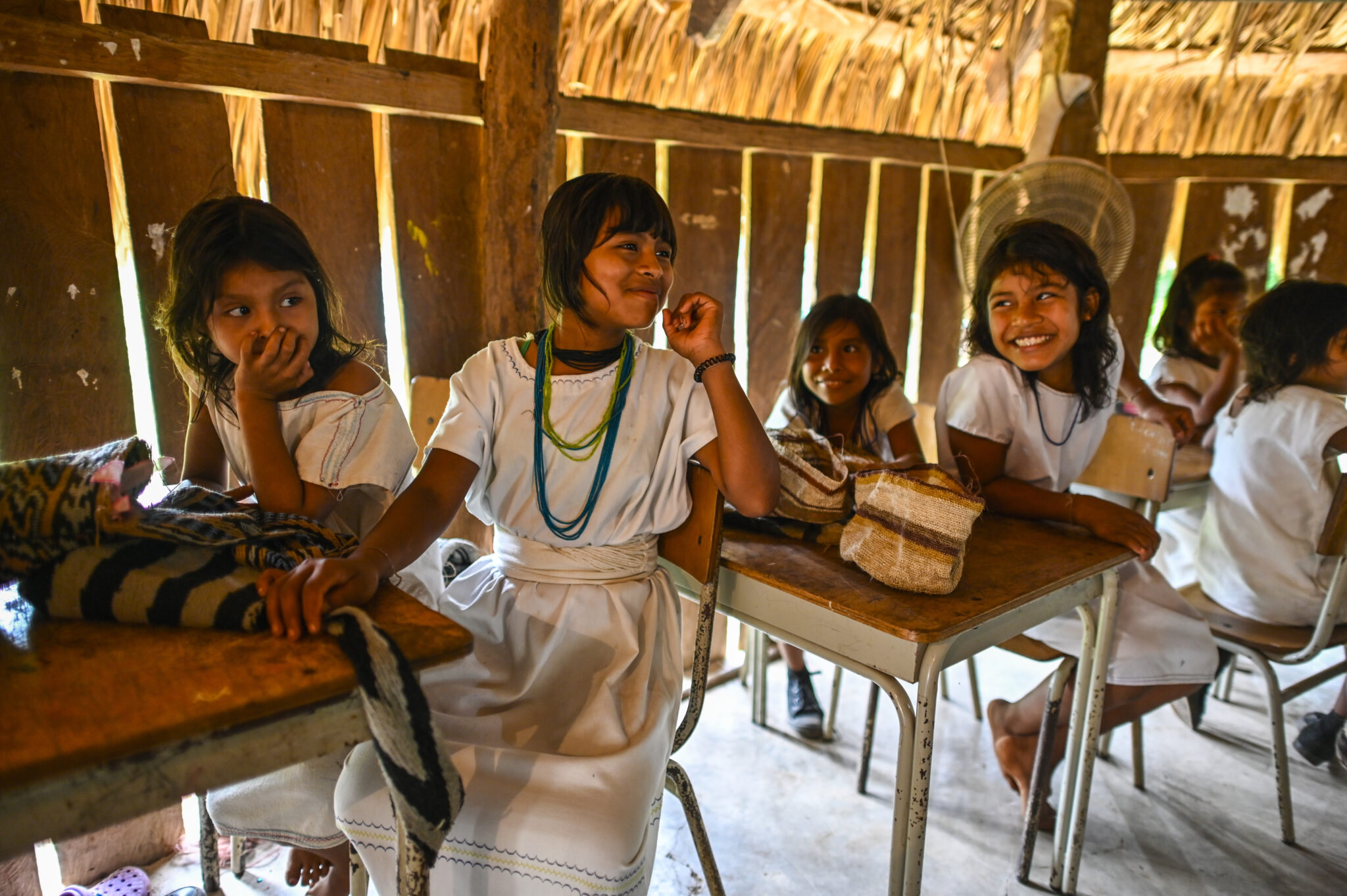
Elio Miraña is a descendant of this diaspora of Mirañas born far from their ancestral territory and has witnessed, from the district of Leticia where he works, the decline in the number of Miraña speakers, for the death of elders who often failed to teach their children the language considering it more useful for them to learn only Spanish.
The filmmaker sees an urgent need for preservation work here: “We can lose everything including the territory, but never the Miraña language, which is our essence. If it disappears, our original way of thinking will no longer be there. That’s why something must be done,” he says.
Preservation work
According to the Culture Ministry’s 2022 Plan decenal de lenguas nativas de Colombia (“10-Year Plan for the Native Languages of Colombia”), of a total population of 759 Mirañas, only 166 (or 22%) say they speak the language. This is a notable drop from the 32% the ministry recorded in 2009. Researcher Yaty Urquijo adds that less than 2% of the reduced number of Miraña speakers were under 18 years of age.
Given the figures, it makes sense for Elio Miraña to complement his documentation and preservation work with linguistic promotion, through workshops with young people to mitigate disruption of language transmission between the generations, gatherings or mambeaderos to reflect on the importance of one’s language, and dissemination of written and audio contents to raise public awareness of his people.
All this is done with the backing of the Colombian National University’s Amazonian campus in Leticia. In multiethnic contexts, the teaching of indigenous languages is a complex issue, given the diversity of indigenous peoples who coexist in the same territory (with at least 26 recognized as living just in the Amazonas department) and the involuntary exclusion of people from other groups.
Miraña says “if the teachers are Miraña, for example, in the best-case scenario they will teach their classes in the Miraña language, but then the languages of children from other ethnic groups are excluded. Generally, what happens is that the teachers end up teaching in Spanish, which is the language all the children speak.” Use of Spanish as chief teaching language would thus constitute one of the dangers threatening indigenous idioms, and reinforces the need for documentation processes.
Researchers being neither of the Miraña community nor speaking their language can pose certain problems and limitations.
Elio Miraña was between 9 and 11 years old when researchers and thesis students from countries like France, Germany and the United States arrived in the territory to speak with his uncle Neeba Gwajko, a singer from the Neebaje clan, and record the conversations. He had no idea at the time why this was happening nor understand the importance of the interviews.
Thirty years on, he recognizes the value of preserving his people’s accumulated knowledge to prevent its disappearance. Nevertheless, in the process of documentation, the fact of researchers being neither of the Miraña community nor speaking their language can pose certain problems and limitations. “I’ve had the opportunity to read the work of other researchers, but sometimes one realizes there’s a lot of interpretation. The absence of the spirit, as we say locally, is evident. An outside researcher is different from ourselves, as we speak the language and understand the context. I’m not saying others can’t do it, but the processes are different,” Elio Miraña says.
As Spanish is the intermediary language here, different contributions and knowledge may be left out or modified, and especially when several of the researchers who came to the Miraña communities were foreigners who spoke Spanish with difficulty. That was a challenge for elders who were already finding it hard to express themselves in their native language.
Importance of song
When a Miraña dies, family members must be rid of all his or her belongings including any record containing their image or voice, a custom similar to those of the Nukaks. If relatives keep objects belonging to the dead, healing and chanting are in order so the departed soul will not bring that illness to the living. After the death of his uncle, Elio Miraña faced a dilemma about what to do with the cassette containing songs from the Neebaje clan that not even other Mirañas knew. While several members of his family wanted the tapes destroyed, Elio Miraña opposed it, knowing such an act contravened their beliefs, but he says, “Burning those songs also meant losing part of who we are as Mirañas.”
It may be his uncle’s singing that motivates him to travel to Leticia and to Tabatinga just inside Brazil, to document and ensure the preservation of lullabies and ceremonial songs. He says, “In our culture, singers are essential to well-being. Just as doctors are essential, so are singers because songs are fragments of stories and stories are healing. Singing and dancing harmonize the territory. That is why the [Catholic] priests did not understand us and stigmatized our beliefs, stories, songs and language.”
They were forbidden to speak or sing in their own languages.
One of the songs collected in his documentation work is about a bush dog, sung by Neeba Jʉmille (Elvira Miraña), the last grandmother of the Neebaje clan. It tells the story of a bush dog that could turn itself into a woman who, during dance nights, would approach the malocas (or big huts) to steal the male children being breastfed. Being a cunning creature, the bush dog convinces the mothers to hand over their children and takes them away. One day, one of the women asks Grandma Armadillo for help to get her child back. Grandma Armadillo goes to the bush dog’s house with a spicy tucupi dish. The bush dog is initially suspicious, but soon hands over the child to taste the food.
She then becomes thirsty, not knowing Grandma Armadillo has dried up all the water sources, and is forced to go far, allowing Grandma Armadillo to escape with the baby. The bush dog then calls on her canine relatives to help her recover the baby and they start to follow Grandma Armadillo’s trail, unaware this time that she created the yarumo tree to confuse them, as its roots resemble the armadillo’s limbs and tail. The story conveys distrust toward the outside world that is likely rooted in the dynamics of relations between native peoples and white folk.
Abandoning their culture
As is well known, the Rubber Boom had devastating consequences for the peoples of the Amazon, including abuse, enslavement, and massacres suffered primarily by members of the Murui, Bora, Okaina, Muinane, Andoque, Nonuya, Resígaro and Miraña indigenous groups. While there is no exact data on the number of indigenous victims, official figures mention 60,000 murders though others have suggested a death toll of up to 100,000. After those events, a population of orphaned children came under the care of Catholic missionaries, who placed them in orphanages and boarding schools in different parts of the country’s Amazonian region, where they underwent indoctrination.
They were forbidden to speak or sing in their own languages, which led many children to abandon their songs and stories and not pass them on to their children, fearing they would suffer the same fate.
It is paradoxical that the Western world that banned them from using their language should now provide the tools for its preservation. These technologies are a means of ensuring the survival of Elio Miraña’s people. “We recognize that many of the documentation programs and tools originate in non-Indigenous contexts; however, we adopt them as our own in an effort to safeguard and strengthen our knowledge. Our style is oral tradition, but oral tradition requires certain conditions: specific diets, places and times. It’s a different space, a different context, but thanks to this exchange of knowledge, it’s possible to carry out the documentation.”
Ethical pressure
Likewise, much of the previous works of researchers has been valuable in raising awareness of the group, like those of Colombian linguist Rosa Alicia Escobar, who in the 1980s documented information relating to this people’s vocabulary, numeracy and storytelling. The French anthropologist Dimitri Karadimas worked with the Miraña and Neeba Gwajko from 1988 to the 2000s. The German linguist Frank Seifart, who met in 2001 with members of Miraña community in Puerto Remanso del Tigre, has contributed to the development of the definitive written form of the language. His experience provided a basis for the 2002 teaching handbook, Una guía para escribir la lengua miraña (“A Guide to Writing the Miraña Language”), produced jointly by Seifart and Miraña.
We are one of the roots that will connect the history of the past with the present.
Drawing on all these experiences and lessons learned from the past, Miraña says it is now time for the communities themselves to lead their linguistic research and documentation processes.
Motivated as he is by what he terms ethical pressure and responsibility, Elio Miraña says, “We are an essential instrument so the knowledge of the past can converse with the new knowledge. That is why we must do serious, conscious work, from the heart, always keeping the interests of the community in mind. We are one of the roots that will connect the history of the past with the present. We are the vehicle that will connect the knowledge of our elders with the new generations. That is the essence and the seed of the Miraña.”